Thursday, October 25, 2012

Wide Cars, War Cards, and Crickets

I kicked off last time with a paean to the idea of automotive extinction, and how many passenger cars are going the way of the passenger pigeon. Yes, it was just a ruse so I could say something untoward about Fleer Stars ‘n’ Stripes, but there have been worse setups.

Having embarked on that road, I have no choice but to put the figurative pedal to the theoretical metal and discuss some other cards and card concepts that deserve to go the way of the Dodge St. Regis, the only Mopar vehicle named after a second-rate New York hotel (the Plymouth Days Inn having been scratched from the drawing board).

I thought it might be fun to match up these card sets with their automotive counterpart, so I went to hagerty.com and grabbed its lists of threatened, endangered and extinct car species. If you’ve ever wanted to know the trading-card equivalent of the AMC Pacer X, take heart. Your hour is coming.


Dart/Pro Set/Topps/Other Gulf war cards vs. 1988 Pontiac Fiero GT. So much perplexment, so little time. As we sit here in our 14th or so consecutive year of fighting assorted Middle Eastern demi-wars with absolutely no trading cards to document any of them, it is astonishing to me that the first Gulf War, all six months, three weeks and four days of it, generated no fewer than four trading-card sets.

Pro Set had the slickest; you could learn more from a pack of Pro Set Gulf War trading cards than you could from a month of watching Fox News – unless what you want to learn from watching Fox News is how to order catheters over the phone. Pro Set had map cards, map-with-arrows cards, gun cards, bucket cards, missile cards, plane cards, bomb cards, tank cards, Humvee cards, radar-station cards, cards of generals, cards of the enemy, battle cards, skirmish cards, strategy cards, chase cards literal and figurative, announcer cards, and cheerleader cards[1] .

Topps was next; its set was not Son of Mars Attacks, more’s the pity, though it lacked the CNN-ness of Pro Set’s war effort. Topps additionally foil-stamped a special run of its baseball cards, ostensibly for shipment to the troops; however, “troops” in this context meant the troops of dealers who hijacked cases off of shipping docks in search of the ever-elusive Gulf War Mark Lemke card.

After Topps came at least one flag-waving America First set that combined the depressing jingoism of the Koch brothers’ super-PAC commercials with the production values of a rummage-sale sign, and after that came Dart Flipcards’ Gulf War set.

Dart Flipcards was the brainchild of a delightful iconoclast named Dino Frisella. Frisella, like so many of his cardmaking contemporaries, simply appeared one day. He seemed to have absolutely no past, and nothing that would suggest he had the competence to make trading cards other than the fact that he was actually making trading cards.

Dino made his mark with the best Vietnam War set ever made, which should not have its legacy tarnished by the fact that it was the only Vietnam War set ever made. Its strength was that it took a largely dispassionate – and therefore, an entirely Canadian – view of a conflict that did not encourage dispassion through its duration. The card fronts were extremely understated, largely watercolored sketches of war action, but Life magazine and CBS News had already delivered the startling, shocking images and there was nothing to be gained by repeating. The Dart set was a dose of Paul Desmond after years of boiling bebop.

Dino was able to sell his Vietnam cards in packs, and it’s some sort of testament to the frenzied trading-card market of the late ‘80s that a A) Canadian cardmaker could sell B) watercolored sketches of C) cards of an unloved war that ended 20 years prior D) in convenience stores to E) 10-year-old boys.

You’d think the Gulf War would have been a natural followup, but not so much. Dino made the strategic error of selling his set in complete-set form, relegating it to the land of Major League Writers and Harness Heroes. He also lacked the capital to slug it out with Topps and Pro Set, though Dart’s photos of actual battle action came from Reuters and the Bettmann Archive and were every bit as good, if not better, than the big boys’ pix. Finally and fatally, Operation Desert Storm to most Americans consisted of America circling the wagons around Kuwait and Tomahawking Baghdad, and Canadians have to drink from the water fountain over there.

The various Operation Desert Storm sets accomplished one very odd purpose: They transformed Gen. Norman Schwarzkopf into a chase card. No amount of gold foil could duplicate the trick for the current chief of Afghan operations, bless his jar-shaped little head.

So where does the Pontiac Fiero fit into this? About the same places it fit into in the automotive landscape of the late ‘80s, which is to say nowhere. The first general thought when Pontiac introduced the Fiero was that the company had lost its mind; the second thought was that this might not be half-bad; the third thought was that this was way more than half-bad; and the final thought was that it all ended just when they got this right. That’s the way most wars go, with the second and third thoughts reversed, and that’s about the way the public felt it went with Operation Desert Storm. In the proletariat’s eyes, we let up just as we were about to turn the Cradle of Civilization into the world’s largest Walmart parking lot.

War cards got as right as they could get with the various Desert Storm sets, but it’s beyond okay that they’re not around anymore. Like the Fiero, this exercise in extinction was more than appropriate.


Pacific Crown Collection vs. AMC Pacer X: Remember the old Puffed Wheat slogan, “Shot from Guns”? No? How about the latter-day Saab slogan, “Born from Jets”?

Good, because this is the part of the blog where we look at cards and cars Designed by Aliens.

Let’s start with the car. The AMC Pacer X was designed and built in Kenosha, Wis., mostly by Americans with the assistance of only a few aliens, a couple of recent immigrants and maybe a foreign national or two.

Unlike the recent Infinitis that drew their styling cues from a brushstroke on paper and the recent Hyundais that were inspired by all-night Gumout-huffing raves in the back room of the Inchon Elks Club[2], the Pacer X’s styling cues were painfully obvious. It was designed to be a four-wheeled version of the ball turret off of a B-17 Flying Fortress.

I’m of that age that can remember Pacer advertising. Pacers were advertised as “the wide car,” apropos of any established need for wide cars.[3]

Its inherent wideness combined with fact that the Pacer looked like a rolling Biodome made the idea of a performance version laughable, yet that was what the Pacer X delivered.

Let’s be honest: The Pacer X definition of performance differs from a Saleen Mustang’s definition of performance in the sense that the Pacer X didn’t deliver any real improvement in performance; instead, it delivered the suggestion of improvements in performance in the form of vinyl-covered bucket seats[4], floor-mounted gearshift, extra chrome, and fancy wheels[5]. And that makes it the perfect foil, so to speak, for Pacific Crown Collection anything.

Pacific Crown Collection actually owes a debt to Hyundai as well, since they share the same value proposition. A fairly basic Hyundai is stuffed with a 12-speaker stereo, navigation system, heated seats, leather, moon lamps, fog roof, a power driver’s seat, and every other gimcrack you can think of to get people through the showroom door and the car off the showroom floor. It’s only after living with the car a couple weeks that you realize the 12 speakers are made of Mountain Dew cans, the nav system is based on 1979 maps, the heated seats fry your butt, and the power driver’s seat only goes backwards. And it has the resale value of an Asian carp.

Cover that with thin gold foil and cut it in the shape of a Pacer X and you have Pacific Crown Collection. Some people want that. Your only recourse is to wonder why.


1971 Plymouth Cricket vs. 1993 Team NFL Super Bowl set: One of the biggest mistakes a seller of anything can make is misunderstanding what the public is asking for. The Pacer was an answer to a request for wideness that never came from anywhere, like a lounge singer hearing a phantom voice from the wings and saying, “What? You want to hear ‘The Pina Colada Song.’ Hey, sure we can do ‘The Pina Colada Song,’” and counting it off. The 1993 Super Bowl set was a similar response to a similarly anonymous small voice in the back piping, “I want a set of some pretty good players sort-of-but-not-really built around a quasi-Super Bowl theme.”

The set certainly fulfilled the request, and threw a couple bucks in the tip jar. There’s a Super Bowl logo on the first card and cards of Dennis Byrd, Junior Seau, Sterling Sharpe, Terry Bradshaw, Fred Biletnikoff, Keith McKeller, Kelvin Martin, Alvin Harper, Emmitt Smith, and more than a dozen other semi-luminaries.

The struggle for commonalities begins as soon as you look at the names. Dennis Byrd and Kelvin Martin? Fred Biletnikoff and Sterling Sharpe? You can do some limited grouping – position, team, era, neck injuries – but as a group they’re not unified by anything more than having played in the NFL.

There’s nothing wrong with the production values, though the ghosted field shot that serves as the background for the card backs could do with more ectoplasm and the Arial Extra Extra Extra Bold type face is about one “Extra” too many. Where this set fails is in the raison d’etre category. Even as a Super Bowl memento it’s about as focused as Dez Bryant in the last two minutes against the Ravens.

And that brings us to the Plymouth Cricket. See if you can determine its reason for being from Hagerty’s description:

“Produced in the U.K. by Chrysler’s subsidiary, The Rootes Group, it was known there as the Hillman Avenger. Like most captive imports, Chrysler’s heart was never into selling the car in the U.S. and its dealers were perplexed. Chrysler squashed it just before the energy crisis, selling the entire design to Iran’s state car company where it was produced under license. Add that to the Shah’s litany of crimes. As a genuine car guy himself, he should have known better.”

We should cut Mopar some slack, in the sense that 1971 was one of the postwar car industry’s first what-the-hell? years, when slamming a bigger engine into a bigger hole suddenly did not equate with technological advancement. But the Cricket was small in the absence of any companywide desire for smallness. The car guys didn’t want a rebadged Hillman Avenger, the sales guys didn’t want to sell it, and the bean counters who greenlighted it in the first place curbed their enthusiasm when Cricket inventories started piling up like binders full of women. [6]

I know the trading-card business is infamous for committing to cardboard projects that were better off left for laugh time on the conference call.[7] But every trading card does better when it’s wanted.

The same goes for trading-card blogs, actually. I’ll be back when I’m wanted. In the meantime, toodle-oo.


[1] You think I jest? George H.W. Bush was not exactly in there swinging; what was he if not a cheerleader, short pleated skirt notwithstanding?
[2] We’re talking to you, Hyundai Veloster, and not the Hyundai Azera, the only car whose appearance was improved by adding a Romney sticker.
[3] The Pacer was touting wideness about the same time or shortly after Pontiac was marketing its marque as “wide track,” but there was one big difference between the two: “Wide track” suggested great handling; “wide” suggested obesity.

[4] As opposed to what? Vinyl-covered buckets?
[5] But not spinners, as that would suggest more movement than the Pacer X was capable of.
[6] The first gratuitous political reference, but not the last.
[7] e.g., Pinnacle Inside.

Friday, September 28, 2012

Stars 'n' Tripes

I’m fascinated by the concept of automotive extinction. Having learned to drive on a three-on-the-tree Ford Maverick, and having seen countless three-on-a-tree Ford Mavericks being jump-started or towed or hauled out of ditches or trailing dark clouds that could have hid the U.S.S. Enterprise or up on a rack having their corroded underbellies swapped out, it’s staggering to me that there may no longer be any three-on-a-tree Ford Mavericks randomly killing themselves at stop signs anywhere in the world. It’s not a bad thought, just an overwhelming one. Our mortality is infinite compared to that of a K-car.

Automotive extinction also got me thinking about trading cards. Long ago my friend Hal postulated that most cards from the late ‘80s and early ‘90s were fated to be worthless until enough of their numbers could be destroyed and equilibrium struck between the numbers of collectors wanting these cards and the numbers of cards. Right now the cards are winning by a margin of 12,473 to 1, but the margin keeps narrowing. At this rate, and with a little help from global warming and allied disasters, the scales should be even sometime in the 24th century. But it wouldn’t be a bad thing with some of these sets if the scales tilted in favor of collectors and the number of interested collectors was a smaller number – zero, say.

So trading cards are the cockroaches of the collectibles kingdom, and therefore mostly worthy of extinction. Naturally the most extinction-worthy emanated from the Handful O’Landfill era. Where else but a landfill for cockroach collectibles?


Tops on my list is Fleer Stars ‘n’ Stripes. It’s the effluent byproduct of a cash-fueled M&A boomlet that came about because trading cards are a high-margin product. You pay the league, you pay the players, you pay the photographers, you pay the printers, and you’re done. Most of those costs are up front, so after a certain point everything is profit – and that point came a whole lot earlier than it used to starting around 1989.

Before everything went shinier and sparklier and thicker, trading cards really were just pictures on cardboard. Gold foil was a luxury. Spot UV was as bourgeois as putting a free Bentley Flying Spur in every pack. Miniscule production cost and maxiscule sales meant cardmakers were loaded, and they did what the loaded do: they went shopping. Pinnacle spun itself off, SkyBox ate its distributor, and Fleer splurged on the hard-candy maker Asher Confectionery.

A hard-candy company? Really? Really really. Fleer’s roots were in confections. Fleer invented Razzles, after all. Far be it from Fleer to buy a new-media company when there were plenty of perfectly hidebound confectioners like Asher to be had.

Asher’s raison d’être was candy canes. Nothing wrong with candy canes. Nice, steady business two months of the year, followed by six weeks on clearance. Candy canes haven’t yet been able to pull a Peeps and create seasonal varieties –pumpkins or footballs or hearts or tree trunks for Arbor Day, or wreaths, for Decoration Day -- but there’s nothing to say that candy canes might not someday be as big as Bit-O-Honeys, if not bigger.

Anyway. Fleer bought Asher, and as a sort of a welcome-to-the-family gift, came up with a product that combined the crazy collectibility of football cards with the classic irrelevance of peppermint stick candy.

That product was, of course, Fleer Stars ‘n’ Stripes.

Unfortunately, the name was as clever as Stars ‘n’ Stripes got. The front design was boxed-set pedestrian, photographs were Grade Q, backs were cut-and-pasted, packaging was awkward, the candy was broken (gaaaaah!!), and the decollation simply didn’t exist.

Decollation: the process of putting number-ordered cards into random order. One of Hal’s great pet peeves was people who called decollation “collation.” “No!” he would exclaim. “You’re not collating – you’re decollating!”

Well, maybe he was. The bottom line was that you could look at the top card in a Stars ‘n’ Stripes pack – where two peppermint sticks flanked a cellophane-wrapped brick of cards, Lincoln Memorial-fashion – and predict with 95 percent certainty the rest of the cards in the pack.[1]

Needless to say, the packs with stars – loosely defined in that set as Randall Cunningham, Barry Sanders, and Jerry Rice – were quickly snapped up, and the only packs left on the shelves at ShopKo delivered dose after freaking dose of Percy Snow, Andre Ware, Rich Camarillo, and Tunch Ilkin.

Talk about confections: Stars ‘n’ Stripes was the Anthrax Ripple of card sets, an appalling amalgam of homely product, shoddy packaging, negative star value, and scant attention to the barest basics of collectibility. With Stars ‘n Stripes Fleer delivered the trading-card version of the Cutlass Diesel, GM’s raised middle finger to the car-buying world.

If only football cards could rust.


Baseball cards in bike spokes notwithstanding, trading cards are not a real flexible medium. There aren’t many trading-card parameters you can alter to create a new and radically different product. You can make them taller (SkyBox Superman), wider (Topps Big), thicker (Fleer Flair), or generally more gigantic (Leaf Studio, Bee Hive); change what they’re made of (Sportflics, Metallic Images, Topps Gold) or their shape (Pacific Crown Collection); alter their topography (Action Packed) or their scarcity (Score Printing Plates); sign them (Signature Rookies), stack them (Stak-Its), or place them inside one another (Pinnacle Zenith); or make them smaller.

Topps Minis were the reasonable downsized extension; Topps Micros brought smaller down to a much tinier and wholly illogical level.

The Topps Micro set took a perfectly innocent 1991 Topps Baseball set and shrunk the cards to 1 x 1-3/8 inches, or about 40 percent of normal card dimensions. The result was a complete set of baseball cards that could fit in the space occupied by a tube of anchovy paste.

There was precedent for cards of this size in the form of the 1969 Topps Football Stamps. These were basically regular 1969 cards printed four-up on a 2-1/2-by-3-1/2 piece of cardstock that was perforated and gummed on the back. The cards could be broken up and pasted in their appropriate team albums. Kinda fun, and kinda scarce now. But note that the cards started out normal size and involved actions on the collector’s part to make them smaller and organize them. No such forethought went into Topps Micros. They were just regular Topps cards viewed from a great distance.

See, simply shrinking cards by 60 percent takes whatever functionality or interactivity they might have and flushes it down the loo. You can’t read the backs of Topps Minis without assistance; they fail in bike spokes, they make lousy card houses, they flip like crap, and they look foolish when you put them in nine-pocket sheets, the official trading-card interactivity of the morbidly obese. All you can do is keep them in their anchovy-paste-sized box, which fortunately fits well in other boxes. And even that would have been borderline-fine if there was some randomness to the enterprise, if your box of Topps Micros was somehow different than your buddy’s box of Topps Micros. No such luck; everyone got the same box of the same cards of the same players, to squirrel away in a different box until such time as it was safe for it to move about in genteel company, a day that is nowhere close to arriving.

So seeing as the topic is trading-card extinction, how would the world be changed if there were no Topps Micros? It’s not like that picture of that player on that card design doesn’t exist. It does, and in a size that can actually be appreciated by people without Ted Williams Vision. There would be more room in countless boxes in countless storage rooms around the country, and anchovy-paste-tube-sized spaces would be safe for tubes of anchovy paste again.

Neil Young was fond of saying that he stayed out of the middle of the road because you found more interesting people in the ditches. In trading cards, the middle of the road was where the action is. The ditches were full of Topps Micros.


My friend John B. Seals nominated Score Dream Team for extinction, and he brings up a fine point. When was there ever demand for trading cards featuring art shots of athletes in various states of undress[2]? Did the people at Score look at the demographics, smack their collective foreheads and say, “My gosh! There are no cards anywhere of Rickey Henderson in his skivvies. We must act! We can’t let the Russkies beat us to the punch! Mr. President, we must not allow a Rickey-Henderson-in-his-skivvies gap to develop!”

There’s a certain grace to the Annie Leibovitz shot of a topless Jose Canseco rippling his chemistry-set muscles in the ’91 Score Baseball Dream Team subset. The rest of the monochrome cards add bupkis to the oeuvre.

Still, I’d see Seals his Dream Team and raise him a Christie Brinkley. Several years after the Dream Team, Pinnacle footed the bill for sometime-photographer, sometime-wife-of-a-crazy-person Christie Brinkley to descend on spring training and photograph various stars – which she had no trouble doing, since she was Christie Brinkley and by definition better looking than Mitch Haddad (cf. T&M Umpire Cards). The trouble was that Brinkley’s skills as a trading-card photographer approximated Haddad’s skills as a supermodel, and no amount of hubris or Photoshop could cover that up. Besides, if you’re pulling a mediocre Randy Johnson card out of a pack, how much does it matter that Christie Brinkley took the picture?

On the other hand, I did get a nice (though disturbingly phallic) T-shirt out of the project.


We'll talk more trading-card extinction next time.


[1] The only sets I can remember with worse decollation were the Berenstain Bears set and the first Comic Ball set, which were meant to be sold in number order, and a NASCAR set of undetermined lineage that was made by boobs.
[2] Or in the case of Frankie Sweet Music Viola, various states of mustache.

Tuesday, September 18, 2012

Seashells and EMTs

I don’t know if you’ve noticed, but the road to seashells and balloons in the NFL does not involve being a defensive lineman and the No. 1 overall pick.

The first name that springs to mind faster than he ever sprang in real life is Walt Patulski. Walt Patulski; even the name evokes onion farming in the mud flats of central New Jersey. But what can you say? The guy was a Notre Damer, and Notre Dame defensive linemen are famous for translating their college gridiron exploits into professional success. Except for Mike McCoy. And Kevin Hardy. And Paul Grasmanis. And Steve Niehaus. And Jeff Alm and Mike Fanning and Mike Kadish and Chris Zorich. [1]

There were exceptions to the linemen-No.-1-overall thing, namely Lee Roy Selmon and Bruce Smith. And we won’t be too hard on Bubba Smith, who was headed to Canton until his knees got in the way, forcing a career shift that netted him a special sort of fame that can only come from playing a token large black cop in a series of dumb-and-dumber movies.

But for every Lee Roy Selmon there were two Russell Marylands, and for every Bruce Smith there was a Kenneth Sims or a Courtney Brown. And for every Mario Williams (who is not a sure-shot Cantonian by any means) there is a Steve Emtman.

Steve Emtman was neither the guy who composed the music for the Batman movies nor the guy who snatched the foul ball from Moises Alou at Wrigley Field. He was a very active if not Mt. Rainier-sized defensive end from Washington who was chosen No. 1 overall by the Colts in 1992, at the very height of the Handful O’Landfill era.

A big reason why for so many years the Colts were the Colllllllts, just two small vowels away from colitis, was because when the Cowboys had the overall No. 1 they chose Troy Aikman, and when the Colts had the overall No. 1, they chose Steve Emtman. [2]

You can’t fault the Colts for not knowing that Emtman was a ticking time bomb of bodily breakdowns that would blow nine games into his rookie season, when he tore everything tearable in his left knee. The next year he shredded the patellar tendon in his right knee. The year after that he blew out a disc in his neck in a collision with a teammate. [3]

This particular card was the promo card, the high supreme collectible, of Courtside’s 1992 Draft Pix set.

There are a number of incongruities to consider here. The first is that there would be a series of football-draft-pick cards called Courtside. It’s a little like oceanfront property in Nebraska. The other is that something could conceivably be accomplished by shortening “Picks” to “Pix.” How does that make these cards more fun, more youthful, more dynamic, more collectible, or anything other than more dysfunctional? In the end, they kinda deserved Steve Emtman, and he them.

The combination of No. 1 overall and Colts and defensive lineman – and Courtside endorser – was lethal. Steve Emtman should consider himself lucky he got out alive.

The one true golden non-sport franchise regardless of manufacturer, time, date, place, cost, quality of cards, or quantity of cards was Star Trek. This was because the absolute best audience for non-sport trading cards was Trekkies, seeing as they were spending every waking hour, all five-and-a-half of them, hanging out at their local card-cum-comics stores throughout the entire span of the Handful O’Landfill era, Sundays and holidays included, arguing over why there weren’t more Klingons in Star Trek: The Motion Picture and playing marathon sessions of RuneQuest because Dungeons & Dragons just wasn’t hardcore enough.

(Okay, I realize I’m painting with a broad brush here. Many Trekkies overcame their essential gravity and went on to have productive careers as video-store clerks, RPG programmers, and Medieval Languages majors.)

The Star Trek license made many stops along the way, including Topps, SkyBox, Decipher, and the Rittenhouse Archives. All of them made money for the licensee and the licensor. But despite the wealth of material – remembering that you could done screen captures of the original episodes at one-second intervals, so you could have made flip movies with a complete set, and they would have sold like William Shatner hairpieces – SkyBox in particular always gave the impression with its cards that it was scraping the bottom of an extremely large barrel.

Case in point: This card from the 1991 Star Trek set shows cover art from one of the few Star Trek art forms that didn’t crush it at the box office, the Star Trek Pocket Books. The artwork is black-velvet quality – maybe that’s why the Pocket Books didn’t sell, huh? – and couldn’t be any less evocative of Star Trek or unseen enemies if it had featured golfing dolphins. [4]

Because it was Star Trek, this card sold along with all the others. But not on its merits. Because unless you’re naming a star, you can’t sell something you don’t have.

[1] We’ll give you Alan Page, and call it a draw on Justin Tuck, Bryant Young and Renaldo Wynn.
[2] This was not an isolated instance. Two years earlier the Colts had the No. 1 overall and chose Jeff George, just to get the taste of Art Schlichter out of their mouths. And back in 1983 when the Colts had the overall No. 1 they chose John Elway, but were forced to ship him to Denver in a blackmail deal involving Mark Herrmann, Chris Hinton and a couple of mismatched socks. Some people say the Colts should get a get-out-of-jail-free card because Elway wanted to play on the West Coast. I say if the Colts had been something other than the Colllllts Elway would have been happy as a clam in Baltimapolis. Uneasy lies the crown on Andrew Luck’s head.
[3] Having a name that started with “EMT” might have been a giveaway.
[4] Reference: Sometime during the Handful O’Landfill era we received in our office a copy of a kids’ book titled Arnold Palmer and the Golfin’ Dolphin. It wasn’t explicitly stated in the book or the accompanying materials, but I got the very strong impression that a significant quantity of Arnold Palmer Hard Half and Half was involved in the creation of this book. In the end, it was just another high-concept media project that fell flat. Like Cop Rock.

Wednesday, September 5, 2012

Swann Drive

I might as well tell my Eric Swann story.


In another life far different from my current and previous lives I was the Assistant General Manager of the U.S. National Semipro Football Team on its first-and-only tour of the British Isles.

My job duties as described to me consisted of 1) carrying the ball bag and 2) paying the General Manager $1,800. By all measures I did fine on both counts.

However, other duties arose that were not described to me when I performed Duty No. 2. For instance, when the team arrived in England we were under the impression that we had reserved two 14-passenger vans for our sojourn to Blackpool, the aptly-named quasi-resort town on the North Sea. However, the people at the rental-car agency were adamant that we had reserved seven four-passenger sedans. And because this was England, not only did the cars have the steering wheels on the wrong side, they had standard, shift-it-yourself transmissions.

I was quickly named one of the seven drivers, and was tasked with driving from the airport to Wembley Stadium, where the inaugural World League of American Football championship – the never-less-aptly-named World Bowl – was being held that day.

The counter clerk drew the route from Heathrow to Wembley. It looked like something the Gauls painted on their chests before battle.

Two wide receivers from Texas whose combined height was not more than 10 feet piled in the back seat and a linebacker sat up front with me, in the seat where there should have been a steering wheel. They had no idea what they were getting into, but since that was the usual state of affairs in semipro football, they were content as lambs. With only a modicum of grinding – and only some of that from the gears – we were off.

If you’ve never made the driving-in-America-to-driving-in-England changeover, let me set the scene for you. The roads around London were built in 1670 and are clogged with Vauxhalls, Citroens, Peugeots, Skodas, Opels, Morrises, Morgans, MGs, Minis, Minors, Majors, and assorted packing containers that would never be allowed past American customs, all running as quietly and efficiently as chainsaws and spewing enough exhaust to conceal the Sixth Fleet. Plus, the roads are slightly less wide than Vince Wilfork, and moving over to accommodate oncoming traffic usually means climbing a wall. The English also view the roundabout as the solution to every traffic situation, including parallel parking. And all of that would be manageable if you didn’t occasionally glance to your right and notice six feet of car sticking out where a mirror should go, and a freaking gear shift where there should be an arm rest.

In other words, I would not recommend your first English driving lessons be in a stick-shift automobile navigating from Heathrow to Wembley Stadium. I’m thinking something a little less crowded, like the Crab Nebula.

In between finding second, searching for third, and learning English culture through its vulgar insults I glanced in the rear-view mirror at the two diminutive wide receivers. They were huddled together, as far from the doors as they could get, with the same popeyed looks on their faces that Z-list B-movie actresses get before the knives come down.

I still don’t know how the car and I made it to Wembley unscathed, though I was one of the fortunate ones. A tight end named Al who swore he could drive a stick broke down 14 miles from Heathrow. Turns out he never shifted the car out of first.[1]

After that the World Bowl was anticlimactic, but the inaugural World Bowl was anticlimactic after a warm bath.

Eventually our little caravan made it out of central London onto the motorway. I caught a few minutes’ sleep cuddled up amongst the ball bags and then spent the rest of the ride to Blackpool getting to know the individual members of the U.S. National Semipro Football Team.[2]

In addition to the fellow you’ll meet later who claimed to have taught Pete Gogolak everything he knew about soccer-style football-kicking, there was the guy whose most memorable game came against the inmates of the Oregon State Penitentiary. (It was a home game for the inmates, naturally.) One set of goalposts was painted on the prison walls. He said it made The Longest Yard look like an episode of Full House.

A number of the guys had played against Eric Swann, who was drafted No. 1 by the Cardinals in 1991. They said he wasn’t the best semipro player they had ever seen, or even the best semipro lineman; instead, he was the most logical, for one reason or another.[3]

I hadn’t realized this until today, but Branch Rickey said the same thing about Jackie Robinson.

In that context, Eric Swann was what Jackie Robinson would have been if integration in baseball had stopped right there, if there had been no Larry Doby or Roy Campanella or Monte Irvin – a sort of footnote, something for people like me to write about.

There’s a gulf of differences between the situation of Jackie Robinson and the situation of Eric Swann, most having to do with the heart-wrenching unfairness of Robinson’s situation. But they tunneled under the English Channel. They joined France and England. The things that unite Swann and Robinson are in many ways greater than what separates them.

[1] We later named him “Lucky Al” for this incident, coupled with the sprained ankle he received crossing the street and the case of the “flu” he came home with after a tour of Blackpool’s livelier establishments.
[2] Except for the guy from Indiana who couldn’t make it because he thought you could take a passport photo yourself. With a Kodak Instamatic. In front of a tree. With your dog.
[3] Not having a rap sheet as long as your arm was one big reason.

Tuesday, August 28, 2012

The Fast And The Spurious


From the Department of Amplifications, a correction.

When I was referring to a crew member pictured on a Traks racing card with the statement, “This is what hand-fishermen do on their off hours,” I was mistaken. The Clyde Booth card shows what feed-mill operators do on their off hours. The Greg Moore card shows what hand-fishermen do on their off hours.

The Times regrets the error, and so do I.


In a previous edition I mentioned how the 1992 Score Baseball All Star subset created a series of caricatures that “was less distorted, anthropomorphically, than Woody Allen.” Here is more proof. Ramon Martinez was roughly 90 percent head and 10 percent body, with the body stretched along a six-foot-four-inch frame. All the warnings plastered to buckets aimed at head-heavy two-year-olds applied equally to Ramon Martinez. Many’s the day when the aftereffects of Ramon bending over to tie his shoes was a call to the paramedics. Had R-Mart been able to use his head as a counterweight, as is suggested in his card, he might have been able to throw the ball 120 miles an hour without his shoulder disengaging from his body, the condition that ultimately killed his career.

Somewhere out there is a Score All Star where the huge head is bestowed on someone so entirely bottom-loaded, so Bozo-bop-bag-shaped that the caricature actually has some sock.[1] But I’m still looking.


I realize that those also serve who sit and wait, but by the same token, I always thought of trading cards as the one playing field where everyone plays at once. Happy Feller gets a card just the same way that Walter Payton gets a card. Even the special cards deign to include the proletariat. Ted Shows How features Ted Williams and Mike Epstein. There’s a Boyhood Photos of the Stars card of Wilbur Wood. The SkyBox Slammin’ Universe subset includes Tony Dumas. Like Sly Stone said, everybody is a star.

So is it right to single out Detlef Schrempf not as the top player, not as No. 2 or No. 3 or No. 4, but as the sixth man? I realize being the next guy in after the starters have played can be a special thing in basketball, but it’s really only a basketball thing. The twelfth man in football is only relevant in Canada and College Station. The 10th man in baseball is Casey Candaele. The seventh man in hockey gets you a two-minute penalty for delay of game. The fifth person on a relay team gets you disqualified.[2] And even in basketball the sixth man doesn’t always come into the game on a winged chariot of fire trailing clouds of rosin dust. (cf., the sixth man on the 1989-90 New Jersey Nets was Purvis Short.)

My other problem with this card is that I have a personal bias against haircuts whose sole reason for being is to simplify headstands.

Detlef Schrempf was a fine basketball player whether he started or came off the bench. Should we really draw lines on an endless green expanse?


In my rather lengthy treatise on umpire cards several months back I danced around the nasty truth of cards showing officials: Officials really don’t do much, even when they’re doing their job, and when they do something interesting you can’t show it. This goes for managers and coaches, too. I can think of only one exception: The 1972 Topps Billy Martin In Action card shows the volatile manager chewing out an umpire while pointing to a spot where someone was safe or out or went to their mouth or caught the ball or dropped the ball or missed a called strike or a foul tip or a balk or catcher’s interference. There are no cards of Jim Mora ripping off a headset, Buddy Ryan flying into apoplectic shock, Slick Leonard tossing a chair, Don Cherry getting unhinged, or Lou Piniella repositioning second base. Similarly, there are no umpire-and-official cards showing Dale Scott getting it on with Martin, Mendy Rudolph teeing up Bill Musselman, or Don Koharski going after Jim Schoenfeld.

Instead, we get this: Pat Dapuzzo bent over at the waist.

While I admire completeness (and do appreciate the fact that Pat is an avid weightlifter and karate enthusiast, like several million other individuals worldwide), the wages of completeness in Mr. Dapuzzo’s case are a lifetime of autographed-set completists chasing him through hotel lobbies and cornering him in restaurant restrooms.

Was it worth it? Pro Set is out of business and Pat Dapuzzo’s image is frozen in thousands of collectors’ minds as the guy who looks like he was just gut-punched by Superfly Jimmy Snooka. Upon further review … nah.


Talk about excitement. For several years before Fleer got a Major League Baseball license (and for several years after, actually) this was Fleer baseball: A team logo and clip art on the front on the front, and a baseball quiz on the back.[3] Fortunately Fleer picked a fairly animated piece of clip art to suggest action and canted the letters in “Baseball Quiz” at odd angles so we knew it was all in fun and didn’t misunderstand. Otherwise we might have thought that it was, you know, a colossal waste of cardboard.


I give up – which one is this?

If I'm Vin Diesel, I'm royally hacked off right now.


I understand the problems with checklist cards in the pre-computer era. You want to know all the cards in the set because you want them all, even the elusive Derek Livernois card. However, the card you want least is the card that shows you all the other cards you want, and that’s a conundrum.

Cardmakers have been wrestling with this forever. They’ve put facsimile autographs on checklist cards, team logos, head shots of stars, or photos of players milling around batting cages comparing runs in their doubleknits, all in hopes of sparing the cards from a painful death at the business end of a Daisy Red Ryder. However, most of the time they’ve cut their losses and put as many players as would fit onto cramped, ugly checklist cards. They were a cost of doing business.

Like everything else associated with trading cards during the Handful O’Landfill era, this cost of doing business went up, too. There may be more unattractive, inefficient checklist cards than the checklists from the 1990 Best minor-league set, but I haven’t seen them. It probably doesn’t help to note that there are six of these cards, each in a different color, and the job could have been accomplished with two.

Sometimes three of these cards would show up in a pack, filling the spaces between cards of Scott Plemmons, Sam Ferretti, and Jeff Mutis. They added negative value even under that scenario. And that truly is as low as you can go.


It’s fantasy-football-draft time again, and this card emerged from the floor to remind me of my best fantasy-draft experience ever.

It’s the afternoon of April 4, 1994 – Opening Day – and a fantasy-baseball draft is being held at The Lakeview, in Iola, Wis. The Cubs game is playing as the draft begins, and Cubs centerfielder and leadoff man Tuffy Rhodes is having the game of his life. Rhodes goes four-for-four with three home runs off of Dwight Gooden in a losing effort, but Rhodes’ effort is enough to get him drafted, and highly, by one of the fantasy managers, to a chorus of groans, shouts, flung french fries, and pelted pretzels from everyone in the room – even the Norwegian bachelor farmers at the end of the bar who hardly knew English, much less baseball, fantasy or otherwise.[4]

Two weeks later Rhodes was out of fantasy baseball, and he was out of the majors not too long after that, but he had accomplished his purpose: In one game, he had won a week for his owner.

Speaking of stupid things, printing a player’s name in six-point type and burying it inside a rainbow-colored bar has dubious merit from aesthetic and practical standpoints, so naturally Topps was all over it for its retro-styled Bowman set, which dearly wanted to appropriate the no-name-on-the-front aesthetics of the original Bowman set without actually going there.[5]

Rhodes was the fantasy-ball equivalent of the stretch-drive rent-a-player, a body employed to produce but designed to be cast aside as soon as conveniently possible. As long as everyone’s good with that we’ll move on.


The reality is that Brad Daugherty is seven feet tall and Larry Nance is 6-11. The impression is that Mark Price has the dimensions of Billy Barty and is holding Mr. Wiggins’ prize pumpkin.

Some cards do their subjects no favors. In the case of this card and Mark Price, it doesn’t even insult him well.

Good to be back. We’ll talk more soon.

[1] Current Brewers catcher Martin Maldonado comes to mind.
[2] Though the fifth Beatle, George Martin, was knighted.
[3] Sample question: “True or False? The Mets played their home games at Ebbets Field in 1962.” If I’m an eight-year-old kid, I’m saying, “I don’t give a crap.”
[4] He wasn't our most popular owner. I'll leave it at that.
[5] It helped that the original Bowman photographs were generally so stunning they needed no embellishment.

Friday, August 3, 2012

A Card Blog Only For Adults And Absolutely Nobody Else

Today only it's the Same-Sex-Kiss edition of "Handful O'Landfill"! Just keep it to yourselves, if you don't mind.


A while back I mentioned that creating a card set for girls and calling it “A Card Set For Girls” is the kiss of death. That also applies to card sets made just for kids. Donruss Triple Play was such a set. It was low-cost, low-quality, and bright and colorful and obvious as an episode of Sesame Street but less educational, unless your career goal is writing the straight dialogue for A.N.T. Farm. It ignores everything that consumer research has learned about kids over the years, which is if you want to make Metamucil For Kids call it Metamucil Only For Adults And Absolutely Nobody Else. The kids will get there.

The back of this card reads, “Baseball players like to have fun at the ballpark. This photo shows three New York Mets who think they are playing for the New York Giants. David Cone is trying to block Jeff Innis’ kick. John Franco is the holder. Even though work is serious, this shows you can have fun at your job.” Yes, and family is the most important thing, and even though you’re young you can make a difference ‘cause everyone is special, and being different is okay, and it’s what’s inside that counts, and when you send a kid off sniffling in the third reel he comes back to save the day in the fifth, with a proton-beam accelerator crafted out of popsicle sticks and Play-Doh.[1]

Life lessons are important, but they’re better taught by someone who’s lived a portion of a life, and not a sunburst-bordered baseball card showing a bunch of pitchers screwing off.


Just in case the Scott Chimparino promo card of a couple of weeks ago didn’t get your blood racing for 1990 Donruss Baseball, here’s a Kevin Morton promo. Restrain yourself.


One of the big areas of the Handful O’Landfill I really don’t have covered is fantasy art. There were dozens of fantasy-art sets released from about 1990-95, and some of them sold extremely well. Companies like Krome Productions and Comic Images made demi-scads of money on sets featuring characters like Lady Death and artists like Frank Frazetta, Boris, Roger Dean, and the Hildebrandts.

There were a lot of these sets. As former Cards Illustrated editor Don Butler put it, “Basically any artist who ever did a prog-rock album cover got a card set.”

I always found fantasy-art cards to be sort of limiting, but I realize now I had it totally upside down. If Comic Images ran out of pictures for its Ujena Swimwear set, it could call up Ujena and have him/her paint some more hydraulic babes in thongs. If Topps ran out of baseball players three-quarters of the way through Stadium Club 2 Baseball it couldn’t exactly call up the Oakland A’s and have them make more players [2].

That’s the long way around to this Brockum RockCard showing a Megadeth album cover, done up in a style that would loosely qualify as fantasy art. The back of this card is black. I like the back better.


Score had no way of knowing the future when it made this card, but in retrospect we say: Not the best choice, guys.


Just as a reminder that at or about the time of Bo Jackson there were three players excelling at major-league baseball and NFL football – Brian Jordan, Deion Sanders and Jackson.[3]

Maybe today’s pro athletes are bigger, faster, and stronger. But they ain't Bo.


Quick – guess the set!

That’s right – Young Indiana Jones Chronicles, from Pro Set.

This card has a place of honor right next to my Pagemaster promo cards.

I know you’re dying to know what’s on the back of this card, so here goes: “Indy is totally lost in the bush. A large Askari rescues him and takes him back to camp. Indy’s parents are very angry with him but are glad he is alive.”[4]

Alive until the Nielsen numbers come in, that is.


And here’s another card from the same set. No, Topps did not print this card. This was an (intentional) 3-D card, meant to be viewed with the glasses that came in every pack.

Okay, so viewed through the 3-D lens of history it was all a failure – the 3-D cards, the base cards, the glasses, the marketing, the TV show, the marketing of the TV show, the works – but there are other measures of failure besides sales. And by those measures Young Indiana Jones Chronicles trading cards were a hit. They looked good, read well enough for the audience, were colorful and interactive, encouraged play, and didn’t take themselves too seriously. In every way but one they were superior to similar TV-show sets of the ‘60s and beyond: Gomer Pyle USMC, Charlie’s Angels, Valley of the Giants, The Monkees, and so on. The difference was that people cared then – cared about the cards and the shows. There were only three-and-a-half networks, so the number of shows airing across the nation at any one time was maybe a dozen, with tens of millions of people watching the top three. There was no VCR, no DVR, no Hopper, no PS3, no Xbox Live, no Netflix, no Hulu, and no YouTube. It’s not hard to get wrapped up in Captain Parmenter when your other options are Gunsmoke, Adam-12, or doing the dishes. Similarly, the card-and-toy aisle wasn’t awash in Pokemon and Bakugan and Digimon and Gundam Wing and Pagemaster and Marvel vs. Wildstorm and Webkinz and Neopets and avatars of a thousand flavors. It had jacks and paddleballs and a couple of 100-piece puzzles, some cars, some Barbies, and lots of guns.

There was less of everything except guns, and because there was less of everything there was more time to pay attention to the things that were there [5]. It’s great to be able to choose; it’s better to revel in the choices you have.


I think I show so many Traks cards because I’m fascinated by the thought process that places such an emphasis on crew members and car haulers and all the assorted camp followers and monkey wrenches of auto racing. I understand the numbers perfectly. It’s hard to make a 250-card set for a sport where there are fewer than 40 cars, 40 drivers, 40 owners, and 20 racetracks. On the other hand, baseball-card sets at their most desperate (and disparate) did not show cards of trainers, clubhouse boys, tarpaulins, or chartered aircraft. Umpires, yes. Trophies, yes. Stadia, yes. But there the line is drawn, and stays drawn.

I also appreciate card backs that note as a career highlight, “Started 20 years with United Parcel Service, oversaw 10,000 vehicles as Northeast Region Automotive Manager.” It foreshadows PeopleCards, and I do love me some PeopleCards.

All was not equal in the Handfull O’Landfill world. Some cards existed merely to fill the spaces between cards of stars (or, in this case, cards of cars). But do you think any of that matters to Clyde Booth? I’m guessing not.

Anyway, if there’s a card that’s more evocative of the daredevil, thrill-a-minute world of big-time stock-car racing … it’s one of many. This tells me what hand-fishermen do on their off hours.


Remember: Every stupid fashion look throughout history was considered attractive and stylish at the time, and there may come a time in the not-too-distant future when you say, “Hey, a bumblebee-striped stovepipe baseball cap looks really cool when you pair it with a black doubleknit top.[6]”

I personally am hoping I am not alive at that time.


[1] This is one of the reasons I really appreciate Phineas and Ferb. At its best it takes a lot of the hoariest kid-programming clichés and turns them on their heads. In that regard, it’s reminiscent of – but more subversive than – the best episodes of Animaniacs. In the absence of anything as artistically satisfying as Looney Tunes, it’s the best kid-colored social satire we can get.
[2] Hey, but it could break out another Rob Mallicoat card!
[3] Drew Henson, Chad Hutchinson, Josh Booty, and D.J. Dozier were close on both counts – they were bad major-leaguers in both sports. Booty and Henson missed breaking balls and open receivers. Hutchinson couldn’t miss bats or opposing D-backs. Dozier was a so-so fielder who couldn’t hang onto the ball. And don’t get me started on Michael Jordan.
[4] As a disassociated statement, this is remarkable. As an allegory, it’s enlightening. “Indy” must refer to the Colts, and Andrew Luck specifically. I’m thinking the large Askari is either Askari Jones or a normal-sized example of a breed closely related to the Labradoodle. And Indy’s parents are Roger Goodell and Jim Irsay.
[5] I think about this in terms of music. If musical evolution had been pushed back 50 years, Mick Jagger would never have been able to spot Keith Richards with a copy of a Muddy Waters record under his arm because it wouldn’t have been Muddy Waters but one of several hundred Muddy-Waters-type artists (categorized even more diffusely as rural Delta blues artists with urban overtones), and they would both have been plugged into iPods and not making eye contact anyway.
[6] I wonder: At what point did single knitting not be good enough?

Friday, July 27, 2012

Stuck Inside Of Aikman With The Edgemar Blues Again

Have you ever wondered what it feels like to be stuck inside of Mobile with the Memphis blues again? I'm guessing it's like being a trading card and going through the washer and the dryer. Oh, well. I just made the surviving examples that much more valuable.


There was a time when traded cards made sense, when Topps was making a 900-card baseball set and issuing it in seven series and it had burned its Aurelio Monteagudo card in Series Two before he was dealt from the A's to the Tigers, and Topps really wanted to put another Aurelio Monteagudo card in their set. Under that set of conditions – space to fill, a trade after the editorial deadline, Aurelio Monteagudo – a traded card was Topps' only recourse. But over time the necessity for a traded card faded away. Trading-card manufacturers began making a new set basically every month, so if regular Topps didn't catch the trade Stadium Club would, and if Stadium Club didn't Finest would, and if Finest didn't Bowman would, and so on. Even under those circumstances manufacturers persisted in issuing traded sets, or rookie-and-traded sets, at the end of the baseball year as another means of wringing blood out of the collecting turnip.

Still, as photo-retouching techniques became more sophisticated the old ways of airbrushing a new cap[1]  over the prior one or resorting to the file photo showing a hatless Jack Baldschun became unnecessary, since even Photoshop 1.0 could do better in a couple of minutes what Topps artists could barely accomplish in a day.[2]

Finally, competitive pressure cut deadlines, so a set that used to go into production in December to be issued in March was being cranked out in late January. A lot of Casey Candaeles can trade addresses in that amount of time.

The upshot is that by the time this card of Olden Manynice was issued NBA Hoops had a half-dozen options at its disposal that would have been more appropriate than slapping a police-tape-ish "Traded To Detroit" along its bottom. Hoops could have cobbled together a Detroit jersey, or Photoshopped the picture or simply cropped it differently, or it could have flipped the generic back photo to the front. Instead, it went the lazy route and hoped that collectors would say, "Oooh, it's just like the old days," which they didn't, because basketball cards never did it that way and it was just Olden Manynice.

This card is like the remake of Footloose. There was no need to make it the way it was made because there were so many other better ways it could have been made. If it needed to be made at all.


I return to the Parkhurst Missing Link set because it's like the Dodge Challenger: It's an unapologetically retro muscle car only better because it has and antilock brakes and steel that won't crumble in your hands and seats that actually hold your butt in one place and a shift knob you can hang onto and steering that steers and a hole for my MP3 player and a zillion other creature comforts we've come to expect from motor vehicles.[3]

All things considered, neo-retro is probably the best of all worlds. Does it matter if it's derivative? Every piece of popular music made over the last 40 years is derivative of Jackie Brenston's "Rocket 88," the Beatles’ Revolver, the Ink Spots’ “My Prayer,” or James Brown's "Say It Loud – I'm Black and I'm Proud." Does it matter? Is "Good Vibrations" less of a song because Brian Wilson had just heard Sgt. Pepper's Lonely Hearts Club Band? Is Paul Simon's Graceland diminished as an accomplishment because Simon appropriated riffs from The Indestructible Beat of Soweto? Do we think less of Straight Outta Compton because it sampled Funkadelic's "You'll Like It Too"?[4]

Everything a society produces is somehow influenced by what went before. Some productions are simply more obvious than others. Drawing a line and calling certain things neo-retro while failing to acknowledge the deep debts to history owed by Facebook or an iPod is revisionist. And I hate revisionism.

With the Missing Link set, Pro Set constructed an intentionally deceitful world. It reincarnated a zombie Parkhurst and built a set Parkhurst never made, considering it simultaneously from the outside – acknowledging Parkhurst's historical reputation among collectors for look and feel and readability – and the inside – making a set that was consistent from the first card to the last. It had to be stupid and careless and intentional and shrewd all at once. And it had to find something interesting to say about Marcel Bonin.

At least the last part was easy. "No other NHL player can lay claim to have wrestled bears as a sideline nor that he eats glass but that is part of Bonin's unorthodox portfolio," his Parkhurst back reads. And, look – it's in French: " Aucun autre joueur de la LNH peut se targeur prétendent avoir lutté comme un à-côté, ni qu'il mange de verre, mais qui fait partie du portefeuille orthodoxe Bonin."

The front is bitchin', too.


You know, it's probably not a good idea to devote a card to Roger Ailes addressing the National Press Club after head-butting Hoda Kotb[5]. I'm not buying that "Dr. Edgemar" stuff for a second.


I talk a lot about draft-pick sets in these excursions and I’m not sure why, other than a whole bunch of draft-pick cards made it into the box of indescribable delights I handed down to my son as his legacy. No stock portfolio of blue chips like Enron and Bank of America; no sir. No stash of bonds, no real estate, no annuities, no cash equity something-or-others, no precious metals, no jewelry, no money-purchase pension plans – none of that stuff. You get draft-pick cards.

But, hey, wasn’t that the way it was supposed to work? Weren’t we all going to cash in our stashes of trading cards right around now, the pristine sealed boxes of ’88 Donruss and the ’87 Fleer tin sets, sell them to the next generation of collectors hungry for Johnny Ray rookie cards and then pass on those profits of patience to our children, who would stare at the check with and then look up at you with gleaming, grateful eyes and murmur, “TWELVE-FIFTY? You kept an entire wall of trading cards in our basement for 25 years and all you got out of it was a lousy twelve dollars and fifty cents? You could have bought cauliflower 25 years ago and sold it for more than $12.50! I hate you! I never want to see you again as long as I live!” And so on, in filial affection.

Looking at back at from this direction, from the other end of the telescope, the numbers seem all distorted. Of course there was going to be no demand for largely vast quantities of trading cards showing players of no interest to anyone currently looking to pay money for trading cards. Even the sure things, the lock Hall of Famers, guys like Ken Griffey Jr., or the recent Hall of Famers like Barry Larkin are of little interest to a collector. You want an ’88 Topps card of Barry Larkin? Maybe if someone gave it to you, but you wouldn’t buy it as an investment nor would you validate someone else’s investment projection by buying from them.

The thing everyone missed about the trading-card boom that precipitated the Handful O’Landfill era was that it was as long-term as Carly Rae Jepsen’s popularity. The gains were all transitory. The only smart folks were the ones who flipped a few cards and got out. All of which has very little to do with this Star Pics card of Troy Aikman. Star Pics, after a few times around making draft-pick cards for various sports and enjoying a tantalizingly small amount of early success, found itself surrounded by competitors in a business where the margins were thinner than Manute Bol’s ankles. Its path to differentiation was to sprinkle in amidst its draft-pick cards cards of players who were draft picks a decade ago. Amazing commonality, yes, and the player wasn’t too terrible – Troy Aikman, practicing for his Rent-A-Center gig. But the card itself was something Salvador Dali might have whipped up for Topps if he was in a variant of Chopped featuring great artists moonlighting as trading-card designers. Picasso did a blue-period Bombo Rivera, Da Vinci went all classic with Mickey Mantle, and Dali did this little piece of business.


And this was Andy Warhol’s contribution to the competition.

It’s hard to know what to make of these as trading cards. They’re phenomenally unattractive worthless cards of a couple of Hall of Famers and some miscellaneous players, and there was never a time they were anything else. They’re tangible examples of the previous step in the collectibility process, the one where someone thought something might be a pretty neat collectible without having any evidence to prove his belief. These are the ideas that sound like good ideas until you actually see them, at which point you go, “Oh, yeah …”

These cards are a couple of those pieces of detritus a society produces and no one wants to claim. And now I have them. And here you go.


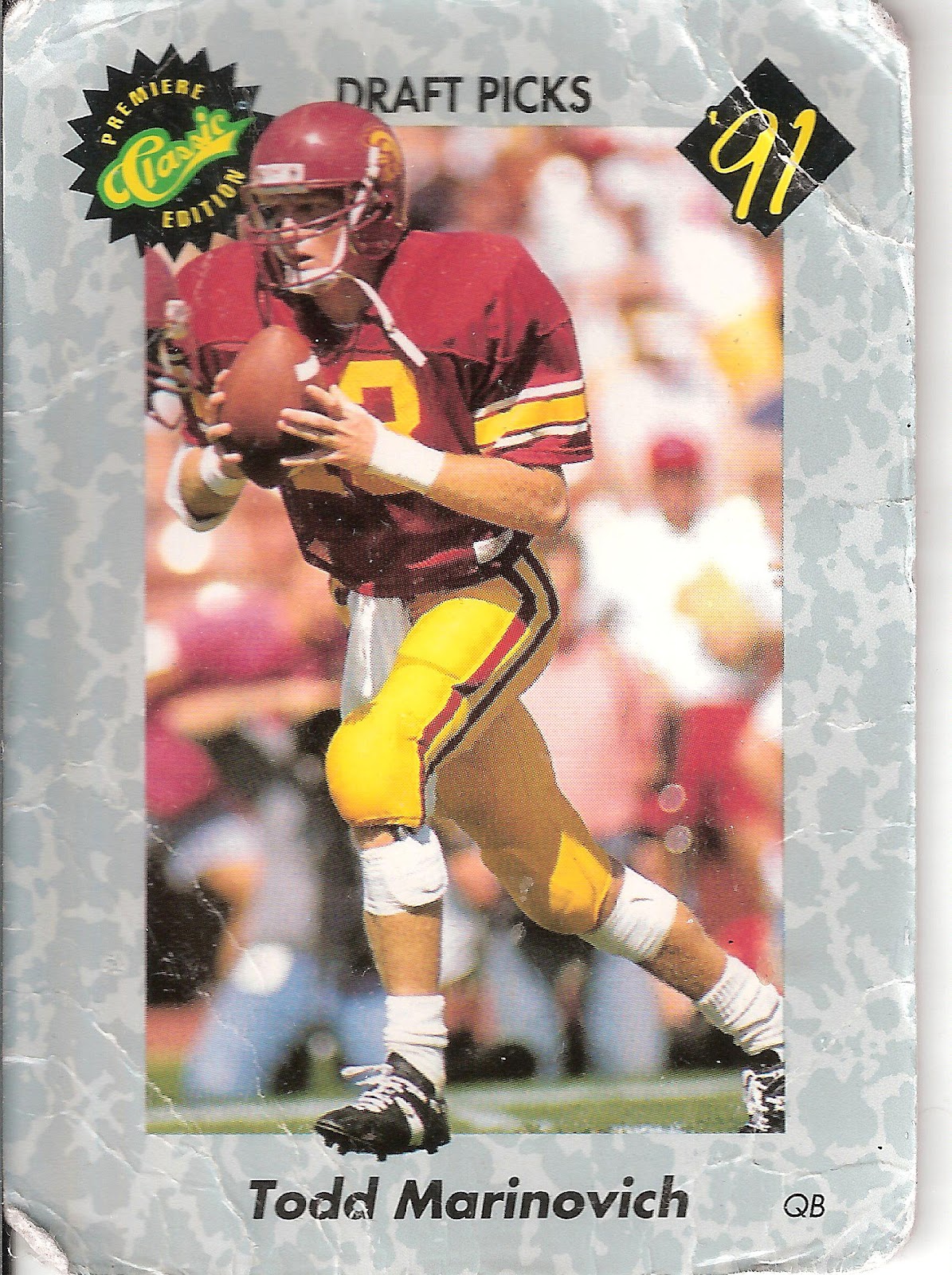
Speaking of pieces of detritus a society produces and no one wants to claim, Todd Marinovich. Once upon a time this card was valuable. Now it’s not. It’s better that it’s not, by a long shot.

I'm digging through pants pockets and dryer filters for more. I'll write when I find some.


[1] Which looked suspiciously like the faux batting helmets that used to house ice-cream sundaes.
[2] Though I wonder if Dr. Timothy Leary wasn't doing Topps' color-matching in the late '60s and early '70s. Some of those cards sport some suspiciously far-out, day-glo shades, like you'd expect to see from artists who would rather be painting Beatles guitars or marking buried power lines for backhoe operators.
[3] I drove a mid-1950s Nash for a New York Times story, and the experience was as revelatory as it was frightening. You had to plan to make a turn about 15 seconds before you actually made it. Braking took a weightlifter's touch, and the brakes grabbed about as firmly as Kevin Youkilis' top hand. The turning radius was larger than the parking lot at Sam's Club. On the other hand, you could fix anything on it with a flathead screwdriver and a roll of electrical tape.
[4] Or consider movies: The Artist is the cinematic Dodge Challenger. The greatest movie musical ever, Singin' In The Rain, recycled old Arthur Freed songs and put them in a comfortable setting of 30 years previous. It was more of a Mustang convertible.
[5] If it was Hoda Kotb head-butting Roger Ailes we might be on to something. Also, I am gobsmacked that this movie is being remade. Had they not seen this card?