Showing posts with label Pro Set. Show all posts

Friday, August 3, 2012

A Card Blog Only For Adults And Absolutely Nobody Else

Today only it's the Same-Sex-Kiss edition of "Handful O'Landfill"! Just keep it to yourselves, if you don't mind.


A while back I mentioned that creating a card set for girls and calling it “A Card Set For Girls” is the kiss of death. That also applies to card sets made just for kids. Donruss Triple Play was such a set. It was low-cost, low-quality, and bright and colorful and obvious as an episode of Sesame Street but less educational, unless your career goal is writing the straight dialogue for A.N.T. Farm. It ignores everything that consumer research has learned about kids over the years, which is if you want to make Metamucil For Kids call it Metamucil Only For Adults And Absolutely Nobody Else. The kids will get there.

The back of this card reads, “Baseball players like to have fun at the ballpark. This photo shows three New York Mets who think they are playing for the New York Giants. David Cone is trying to block Jeff Innis’ kick. John Franco is the holder. Even though work is serious, this shows you can have fun at your job.” Yes, and family is the most important thing, and even though you’re young you can make a difference ‘cause everyone is special, and being different is okay, and it’s what’s inside that counts, and when you send a kid off sniffling in the third reel he comes back to save the day in the fifth, with a proton-beam accelerator crafted out of popsicle sticks and Play-Doh.[1]

Life lessons are important, but they’re better taught by someone who’s lived a portion of a life, and not a sunburst-bordered baseball card showing a bunch of pitchers screwing off.


Just in case the Scott Chimparino promo card of a couple of weeks ago didn’t get your blood racing for 1990 Donruss Baseball, here’s a Kevin Morton promo. Restrain yourself.


One of the big areas of the Handful O’Landfill I really don’t have covered is fantasy art. There were dozens of fantasy-art sets released from about 1990-95, and some of them sold extremely well. Companies like Krome Productions and Comic Images made demi-scads of money on sets featuring characters like Lady Death and artists like Frank Frazetta, Boris, Roger Dean, and the Hildebrandts.

There were a lot of these sets. As former Cards Illustrated editor Don Butler put it, “Basically any artist who ever did a prog-rock album cover got a card set.”

I always found fantasy-art cards to be sort of limiting, but I realize now I had it totally upside down. If Comic Images ran out of pictures for its Ujena Swimwear set, it could call up Ujena and have him/her paint some more hydraulic babes in thongs. If Topps ran out of baseball players three-quarters of the way through Stadium Club 2 Baseball it couldn’t exactly call up the Oakland A’s and have them make more players [2].

That’s the long way around to this Brockum RockCard showing a Megadeth album cover, done up in a style that would loosely qualify as fantasy art. The back of this card is black. I like the back better.


Score had no way of knowing the future when it made this card, but in retrospect we say: Not the best choice, guys.


Just as a reminder that at or about the time of Bo Jackson there were three players excelling at major-league baseball and NFL football – Brian Jordan, Deion Sanders and Jackson.[3]

Maybe today’s pro athletes are bigger, faster, and stronger. But they ain't Bo.


Quick – guess the set!

That’s right – Young Indiana Jones Chronicles, from Pro Set.

This card has a place of honor right next to my Pagemaster promo cards.

I know you’re dying to know what’s on the back of this card, so here goes: “Indy is totally lost in the bush. A large Askari rescues him and takes him back to camp. Indy’s parents are very angry with him but are glad he is alive.”[4]

Alive until the Nielsen numbers come in, that is.


And here’s another card from the same set. No, Topps did not print this card. This was an (intentional) 3-D card, meant to be viewed with the glasses that came in every pack.

Okay, so viewed through the 3-D lens of history it was all a failure – the 3-D cards, the base cards, the glasses, the marketing, the TV show, the marketing of the TV show, the works – but there are other measures of failure besides sales. And by those measures Young Indiana Jones Chronicles trading cards were a hit. They looked good, read well enough for the audience, were colorful and interactive, encouraged play, and didn’t take themselves too seriously. In every way but one they were superior to similar TV-show sets of the ‘60s and beyond: Gomer Pyle USMC, Charlie’s Angels, Valley of the Giants, The Monkees, and so on. The difference was that people cared then – cared about the cards and the shows. There were only three-and-a-half networks, so the number of shows airing across the nation at any one time was maybe a dozen, with tens of millions of people watching the top three. There was no VCR, no DVR, no Hopper, no PS3, no Xbox Live, no Netflix, no Hulu, and no YouTube. It’s not hard to get wrapped up in Captain Parmenter when your other options are Gunsmoke, Adam-12, or doing the dishes. Similarly, the card-and-toy aisle wasn’t awash in Pokemon and Bakugan and Digimon and Gundam Wing and Pagemaster and Marvel vs. Wildstorm and Webkinz and Neopets and avatars of a thousand flavors. It had jacks and paddleballs and a couple of 100-piece puzzles, some cars, some Barbies, and lots of guns.

There was less of everything except guns, and because there was less of everything there was more time to pay attention to the things that were there [5]. It’s great to be able to choose; it’s better to revel in the choices you have.


I think I show so many Traks cards because I’m fascinated by the thought process that places such an emphasis on crew members and car haulers and all the assorted camp followers and monkey wrenches of auto racing. I understand the numbers perfectly. It’s hard to make a 250-card set for a sport where there are fewer than 40 cars, 40 drivers, 40 owners, and 20 racetracks. On the other hand, baseball-card sets at their most desperate (and disparate) did not show cards of trainers, clubhouse boys, tarpaulins, or chartered aircraft. Umpires, yes. Trophies, yes. Stadia, yes. But there the line is drawn, and stays drawn.

I also appreciate card backs that note as a career highlight, “Started 20 years with United Parcel Service, oversaw 10,000 vehicles as Northeast Region Automotive Manager.” It foreshadows PeopleCards, and I do love me some PeopleCards.

All was not equal in the Handfull O’Landfill world. Some cards existed merely to fill the spaces between cards of stars (or, in this case, cards of cars). But do you think any of that matters to Clyde Booth? I’m guessing not.

Anyway, if there’s a card that’s more evocative of the daredevil, thrill-a-minute world of big-time stock-car racing … it’s one of many. This tells me what hand-fishermen do on their off hours.


Remember: Every stupid fashion look throughout history was considered attractive and stylish at the time, and there may come a time in the not-too-distant future when you say, “Hey, a bumblebee-striped stovepipe baseball cap looks really cool when you pair it with a black doubleknit top.[6]”

I personally am hoping I am not alive at that time.


[1] This is one of the reasons I really appreciate Phineas and Ferb. At its best it takes a lot of the hoariest kid-programming clichés and turns them on their heads. In that regard, it’s reminiscent of – but more subversive than – the best episodes of Animaniacs. In the absence of anything as artistically satisfying as Looney Tunes, it’s the best kid-colored social satire we can get.
[2] Hey, but it could break out another Rob Mallicoat card!
[3] Drew Henson, Chad Hutchinson, Josh Booty, and D.J. Dozier were close on both counts – they were bad major-leaguers in both sports. Booty and Henson missed breaking balls and open receivers. Hutchinson couldn’t miss bats or opposing D-backs. Dozier was a so-so fielder who couldn’t hang onto the ball. And don’t get me started on Michael Jordan.
[4] As a disassociated statement, this is remarkable. As an allegory, it’s enlightening. “Indy” must refer to the Colts, and Andrew Luck specifically. I’m thinking the large Askari is either Askari Jones or a normal-sized example of a breed closely related to the Labradoodle. And Indy’s parents are Roger Goodell and Jim Irsay.
[5] I think about this in terms of music. If musical evolution had been pushed back 50 years, Mick Jagger would never have been able to spot Keith Richards with a copy of a Muddy Waters record under his arm because it wouldn’t have been Muddy Waters but one of several hundred Muddy-Waters-type artists (categorized even more diffusely as rural Delta blues artists with urban overtones), and they would both have been plugged into iPods and not making eye contact anyway.
[6] I wonder: At what point did single knitting not be good enough?

Friday, December 23, 2011

Happy HOLidays, Part 1


I have things backward in this entry, so forgive me.

My New Year’s resolution for “Handful O’Landfill” is that I will edit and compile these entries into a book-length something when I hit 50 entries – an event I would very much like to happen early in 2012. So the more posts, the better is my philosophy. But no sacrificing quality. No siree. You can’t do away with something that isn’t there to start with.

With New Year’s disposed of, on to Christmas.

My Christmas gift for you isn’t as tuneful as Phil Spector’s, but it also doesn’t involve wolverine-fur hairpieces or dumpsters full of cocaine. It’s also regifting, in a sense. I’m giving these to you, though I still have them physically. Because they are, like, valuable collectibles.

Nothing says Christmas like a holiday-themed Flik It Kick It Football, right? The fine folks at FIKI sent me this sometime in the early ‘90s and it wound up at work, of all places. I mean, who dreams of playing fingertip tabletop football at work? FIKIs were licensed for many college and pro sports teams, but they couldn’t escape the fact that as a functional item a well-folded-and-taped piece of filler paper worked better, and as collectibles, King-B Jerky Stuff discs beat them eight ways to Sunday. Mele kalikimaka anyway, boyos.


Moving on to the Christmas cards, I miss Inkworks. Not for its formulaic-in-a-pretty-good-way cards but for its Christmas cards, and especially for the folks behind Inkworks. Head Inkworker Allan Caplan defines “impish,” with a voice straight outta Brooklyn. I can still do a great, “Hi, Kiiiiiiiiit. This is Aaaaaaaaaaalan Caaaaaaplaaan.” Martha Modlin is an out-and-out sweetheart. And they both had the wacky idea that trading cards should be fun.

Every year Inkworks would send its A list a special card that promoted the season and its latest product in a fair-ish 25-75 split. Sometimes the product was good – Kung Fu Panda. Sometimes it was not so good – Angel. Sometimes it was just Inkworks being Inkworks. But they were always welcome, and I’m proud to say I never sold one when they were valuable, because now they’re worthless.


Quiz time! Fifty bonus points and my last unopened box of Pacific Flash Cards if you can tell me what the Bible verse is inside this card. That's right – "To every thing there is a season, and a time to every purpose under Heaven." I always associate Pete Seeger, Roger McGuinn and the Byrds with Joe DiMaggio, and I know you do, too. This effort is from Major League Marketing, renowned shouters-into-phones and distributors of Score and Pinnacle, and its subliminal purpose under Heaven was to promote Score Masters, one of the first attempts to fuse art and baseball cards, though not the ugliest.


The only thing missing from this card? The reindeer with the computer Photoshopping Eric Lindros' head on Santa's body.


And look! Here's Eric Lindros' head, attached awkwardly to the body of some minor-league hockey player.  "Peace on Earth" is written inside this Major League Marketing card, because minor-league hockey is synonymous with peace on earth. And chronic traumatic encephalopathy.


People paid big money for Pro Set's Santa Claus cards for reasons both clear and obscure. The clear reason was that people thought the trading card was rare, though "rare" in a Pro Set context meant "less than 2.7 million." Otherwise, the delightful Rick Brown art gives you plenty to ponder – cards of what appear to be a Giant and a Viking and a Bear in addition to the Man in Red himself, a Pro Set binder (full of Chris Berman cards, no doubt), and the Great Ones book, an NFL Properties production that like all NFL Properties productions marginalized the league's dynamic past in favor of a much-better-paying present. The faux elves peering through the window are Pro Set demagogue Lud Denny on top and (I believe)  NFL Properties chief John Bello below. Denny is plotting how to get the Big Guy to ditch the toymaking operation in favor of printing presses cranking out more of that great Pro Set Series II. Not sure what Bello is doing there. 


Brown returned in 1990 and ditched Denny and trading cards (except for some Pro Set packs, a Christian Okoye card and a possible Baltimore Ravens sighting, six years before they actually began play) in favor of NFL Properties' Super Bowl book project – another NFL-sanctioned attempt to mess with football's time-space continuum and split league history into B.C. (Before Commercialism) and A.D. (Anno Dominance). Carb-lovers should note the peanut M&Ms in the candy dish and a half-eaten Super Bar, the abortive Official Confection Treat of the NFL, at Santa's right hand. The December Employee of the Month is less of a scary clown than Lud Denny, unless it’s Denny in mufti, in which case it's totally scary-clown.

The next year, a recently-divorced-from-the-NFL Pro Set returned with another take on the Santa-Claus-as-card-collector theme. Note the NHL hat and the skates and stick hanging in the background, but no helmet. Hey, Santa: You really think that mane’s gonna protect you from an Al MacNeil slap shot? All right, man; it’s your Christmas.

Also notice the absence of any Puck/Rondelle bars. Based on last year’s greeting, I know why. They’re sleeping with the Super Bars.

A hockey card appears to be falling into the bag, along with a Yo! MTV Raps Boyz II Men card, a Payne Stewart PGA card, and a card of an unidentified Colt. Lud Denny makes another appearance as a poster elf. If the poster could talk it'd be telling Santa to set a few thousand cases aside for some special distributors who have been real nice.

This is the best Christmas card of all, and it’s from and for no one in particular. The credit line on the back reads “Mudville Baseball Art, Box 334, McIntosh, MN,” and even though you know the rest I’m going to say it anyway. There was no joy in Mudville when the makers of these cards figured out this Babe was not their salvation. But I still love it.


Finally, there was a time when the otherworldly illustrations of Mark Martin were a big part of my professional life. So while this isn’t a valuable sports collectible per se, I reproduce his holiday greeting in all its whacked-out glory, in fervent hopes that you go back and check out his 20 Nude Dancers 20 collections.

Merry Christmas to all. And watch out for the Martians.

Sunday, November 21, 2010

Floppsy, Toppsy, And A Rotten Tale

I feel like Steve Goodman being taken to the woodshed by David Allan Coe. I did not write the perfect country-and-western song because I didn't say anything at all about mama, or trains, or trucks, or prison, or getting drunk. And what's worse, I wrote about the so-called funny baseball cards of the Handful O'Landfill era and didn't say anything about Flopps.

Flopps were a product of Pro Set circa 1992, when the company was well on its way to world domination through pictures on cardboard. It already had the official cards of the National Football League and the National Hockey League, it had the NBA dead in its sights, it had sold hockey cards with a Canadian Nut Goodie so it could sell practically anything, it had an opulent corporate headquarters that seemed to be made entirely of light beams and Walter Payton statues, and it had a corpulent CEO guaranteed to make a thousand Marie Claire editors go “ick!” The only thing it was missing: a baseball license.

In those days the real money in the card biz was still in baseball, because the NFL and its players’ association (the whole “official card of the NFL” thing notwithstanding) gave away licenses to anyone willing to make a seven-figure donation to their respective labor-unrest war chests, and hockey and basketball were still hockey and basketball, no matter what Michael Jordan said.

Major League Baseball had kept a pretty tight lid on things, meaning it had only five licensees making six products each. This was before baseball cards in cans, so almost all those sets made money. And Pro Set wanted a piece. Very badly.

That was one aspect to Pro Set – “good” Pro Set, if you will. Then there was the Sarah Palin operation, Pro Set gone rogue, mainly under the leadership of trading-card deep-thinker Victor Shaffer. The Pro Set skunkworks made Desert Storm cards and Young Indiana Jones cards and Little Mermaids cards and Dinosaurs cards and racing cards and other non-mainstream sets, and badly wanted to get into the comic end of the non-sport biz.

(There was another level to Pro Set, the money-skimming “evil” Pro Set, but that’s a topic – and a federal investigation -- for another day.)

Somehow the skunkworks got tangled up with the desire for a baseball license and determined the way to get into comic cards and get a baseball license was to use a comic set to slam Topps and many of the superstar baseball players it depicted. The result was Flopps.

Flopps was not Pro Set's finest hour. It was not even its finest couple of seconds. There was nothing about Flopps that was not done elsewhere – and not simply "done better elsewhere," because ha-ha-told-you-so satiric baseball-card sets have never been done well by anyone.

Here are the contents of the promo packs distributed to the media and dealers: Wade Bugs of the Boston Sweat Socks; Stickey Henderson of the Oakland Ughs!; Ken Groovy, Jr., of the Seattle Mindwarps; Barry Bones of the Pusburgh Packrats; and Lance Perishable of the California Airheads.

Laughing yet? If you're not now you never will be, because that's all there is.

The Calvin Coolidge-like lack of humor of the promo cards aside – and remember, promo cards are supposedly the best of the best – the aforementioned Flopps cards point up a bigger problem: sustaining the humor over the course of a set. The promo cards have players hailing from Boston, Oakland, Seattle, California, and Pusbergh. That would be like creating a Garbage Pail Kids set consisting of Adam Bomb, Busted Bertha, Smelly Kelly, Bea Sting, and Glenn Beck. (Yeah, I don't have a problem with it, either.)

And then how big a set do you want? Keeping the knee-slapping mirth going over a handful of superstar cards is one thing; when you get down to cards 466 and 467, Bean Figueroa and Bill Grisly, who's still paying attention? And what, oh what, do you do with Archi Cianfrocco?

The bottom of the theoretical Flopps barrel is the stuff EC Comics were made of: Paul Faires as Paul Fairies. Juan Agosto as Juan Disgusto. Kevin Appier as Kevin Disappear. It would take James Thurber, Dave Barry, and Mark Twain alternating sentences on the back, and Gary Larson and Bill Watterston doing the art, and it still wouldn't come off half as good as a run-of-the-mill Odd Rod.

And that didn't happen. The art has a day-glo sketchiness that makes a Wacky Package look like a DaVinci, and the writing on the back rarely rises above streetwalker level.

"Lance is not a good long-term investment for any team," reads the back of the Lance Perishable card. "Although he's got it together by the early season, by mid-summer he just falls to pieces. Most agree that Lance stinks because he's just plain rottin.'"

There's a perverse, oh-my-God-she's-wearing-that? fascination to Flopps cards. It's like watching your buddy from accounting trying to do karaoke to "Vision of Love" after going four rounds with chocotinis. But that doesn't mean it's something you want to return to time and again.

Rarely has a set been as broken in so many ways as Flopps, so it's probably a good thing it never made it past the promo stage. Why it didn't is a matter of conjecture.

“What we believe happened is that Topps got wind of it and complained to MLB," a former Pro Set staffer says. "The MLB told Pro Set: If you produce Flopps, you will never get a baseball license. Pro Set had every right to produce Flopps; they just realized that it was not worth it to ruin any chance of ever getting a baseball license."

“I remember a giant yawn from the non-sport community when dealers were artificially rigging promo card prices on these weak cards," contends Don Butler, Pro Set expert and former non-sport-card-magazine editor. "I think we received a cello pack -- Wade Buggs was the top card --with an announcement of the set, then it was abandoned either from the threat of a lawsuit or – what I think – the worse threat of no sales."

Whatever did or didn't happen with Flopps, it points up the eternal lesson: Make lemonade when life gives you lemons, but if insist on making your own lemons, don't expect it to taste like Minute Maid.

Friday, September 24, 2010

Do You Have Jim Abbott In The Can?

If Don McLean can pinpoint the Day the Music Died, I’m pretty sure I can pinpoint the Day the Baseball Cards Died.

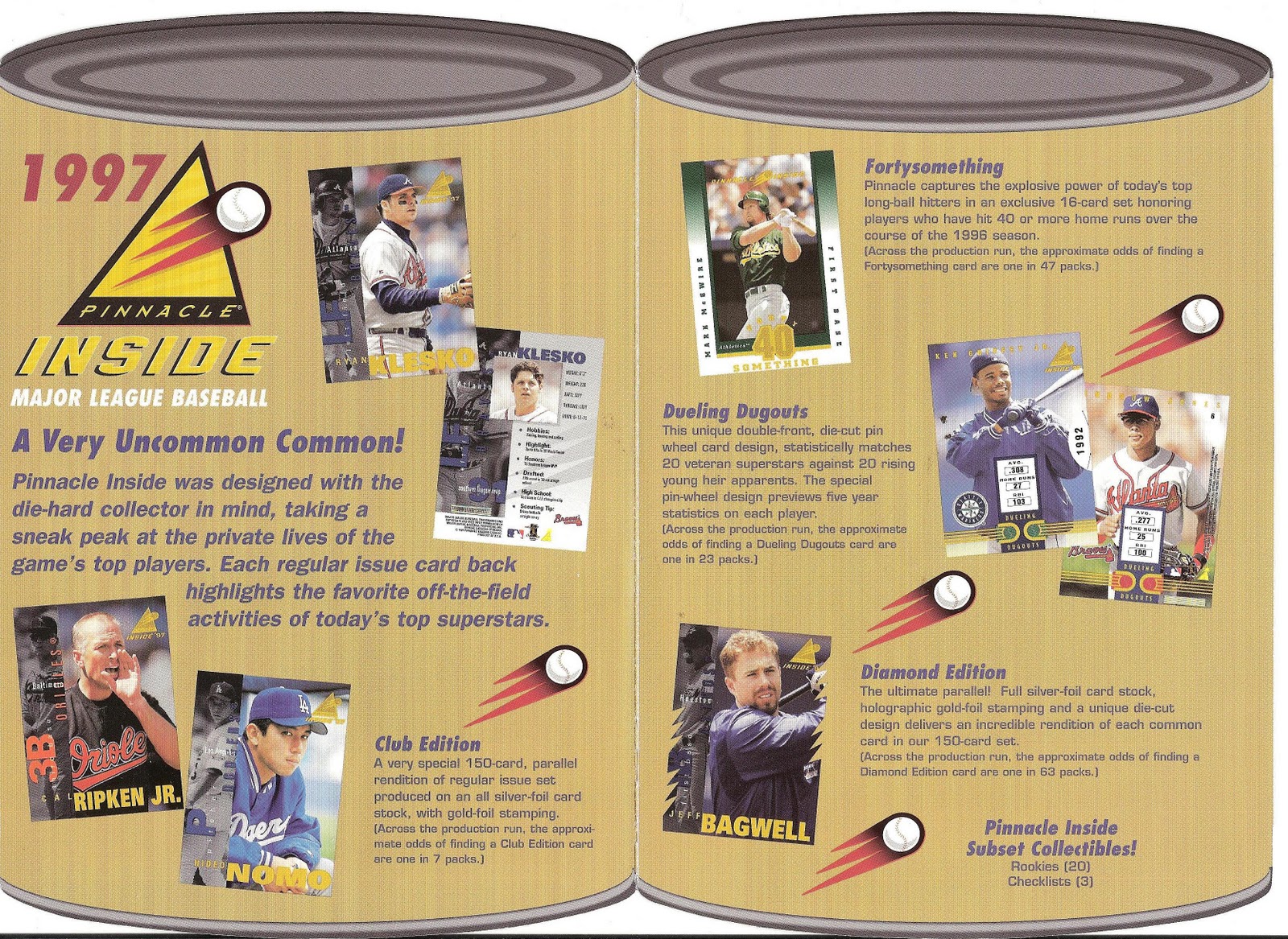
It was the day Pinnacle put cards in cans with Pinnacle Inside.

I know it may seem like untoward Pinnacle-bashing to subject a dead company to my rib-tickling scorn two weeks running, but you need to consider that 1) any company that puts baseball cards in cans has it coming and 2) I was part of the team that put the cards in cans to start with.

I can safely say from my padded cell inside my cozy little insurance company that I didn’t know what the hell I was doing. Neither, presumably, did any of the other members of the development team. In fact, I have no idea how cards in cans got past joke stage. I’m pretty sure no one on our team had the idea spring full-blown from their forehead, like Zeus birthing Athena. I don’t remember a product meeting where someone came out of the bathroom and said, “Hey, guys – let’s put cards in cans!” Meth on a stick I remember. But not cards in cans.

I’m guessing the way it happened is the way a lot of things happened in trading cards in those days. Once Upper Deck hit the scene, printers pretty much called the shots in the card business. If you were a printer and had a special technique for embedding diamond dust into football cards, Fleer was sure to be on line one and Pinnacle on line two. And Playoff was in the lobby, fishing around in its pockets for a dime.

Companies that owned their own printing plant had a leg up in this trading-card space race, unless they printed BP gushers of cards like Pro Set, or only printed in colors dogs could hear, like Upper Deck, or were so all-in on one funky technology that they couldn’t cope with anything else, like Action Packed and Sportflics.

I’ll bet my co-worker’s farm that the way cards in cans happened was that some printer simultaneously printing cans and cards messed up and accidentally put the cards in the cans.

It was one of those chocolate-and-peanut-butter moments where the guy with the cards and the guy with the can looked into each other’s eyes and said, “Let’s call Pinnacle!” And Pinnacle said to us, “Make it collectible, boys.”

Lord knows we tried. I mean, we had plenty to work with in an abstract sense, Gremlin-era butt-ugliness and Kim Jong Il autograph-model illogic notwithstanding. We had cans that could show the same image printed differently in varying levels of scarcity. We had a chase called "Duelling Dugouts," which I'm pretty sure I had nothing to do with. We had the most self-evident product name in trading-card history. And we had cards inside the cans that ranged from one-in-ones up to one-in-83s. The elements were easier to manipulate than a Republican Congress; as a collectiburger it had the Arch Deluxe beat eight ways to the golden M.

However, as noted card expert Junie B. Jones would say, yeah, but here’s the problem: It’s Dare to Tear all over again.

For the life of me, I don’t know how we could have let Pinnacle believe that destroying one collectible to save another was not the card-biz equivalent of invading Afghanistan with a dumptruck full of asphalt and a road roller.

Collectors have never, ever, ever seen the logic in destroying one thing to get at another. They don’t eat eggs for that very reason. They won’t even take a fingernail to their Kohl’s mailer to unleash their 15 percent discount. And I am dead-on certain that somewhere in this great Hole-Digging Mutant-Weasel State a collector is hoarding unused four-year-old lottery tickets because they might be valuable someday and, hey, the gold smears really make those cartoon billiard balls pop.

And furthermore, cans have never been a big part of the sports-collecting oeuvre. There are all kinds of soda cans from the ‘60s and ‘70s featuring athletes, and they’re about as collectible as a macramé kit. Why? They were never a part of anyone’s essential childhood memory package; they were just cans with guys’ pictures on them that were floating around for a little while. And I can tell you from personal experience that no one bought a can of Dr. Pepper because it had Carmen Fanzone’s picture on it.

So what you have with Pinnacle Inside really is an extremely tangible non-collectible with marginal collectibles sealed inside. And a company bankrolled by The Money Guys Who Brought You Enron not understanding why the heck these puppies aren’t flying off the shelves like brisket sammiches.

Oh, yeah, this too: We never gave people an easy way to get into the cans.

I can take my Olympia Beer “It’s the Water” can opener and punch a hole in the lid, but when I do baseball cards do not pour out. There is no opening tab, easy or otherwise, that grants you access to the golden succor waiting within. What I have to do to my can to get at the baseball cards inside my can is grind a clamp-and-twist can opener across the top, peel back the jagged metal, and resist the urge to scrape it across my wrist as I withdraw the cards.

Sure, I could cop out and use a Sawzall, but if you’re relentlessly old-school enough to collect baseball cards you’re not going to use an seven-horse power tool on the stinkin’ wrapper. You’re going to open it by hand, even if results in five stitches in your thumb.

(For the record, hand tools like crosscut saws, splitting mauls, or railroad spikes driven just below the lid with an eight-pound hammer also do the trick.)

Hard to believe, but I had forgotten about cards in cans until last week. Blocked it out of my memory entirely. But now that it’s back I am suddenly struck with a powerful urge to return to those halcyon days … of last week.

I know how to go make it happen, too. Just move the spike a little more to the left … a little more … just a touch … there. Now … SWING!

Ahhh. That's better.