Showing posts with label Classic. Show all posts

Tuesday, July 9, 2013

Who You Callin' A Harlo?

On my bike ride this noon I noticed one of those big plywood storks you can rent to announce the birth of a baby.[1] The plywood stork had clenched in its plywood beak a plywood balloon with the words “Welcome baby Harlo.”

I saw the name and was momentarily taken aback, because I didn’t see “Harlo”; I saw “Harlot.”

I’m special but I’m not that special, so I’m probably not the only person who will make the Harlo-Harlot connection and conclude that naming your child “Harlo” is pretty much like naming her “Rostitute.” 

This is one of those cases where it pays to be complete. You want to name your kid “Harlow”[2]? Add the bloody “W.”

Another area that would have benefited from completeness in communication (transition alert) was the Handful O’Landfill era. I was reminded of this when I found a near-complete run of Trade Fax while cleaning out a file cabinet.

Trade Fax was a weekly trade publication started by Krause Publications to satiate the hobby’s interest for breaking news (breaking in the sense of being less than 10 days old) and break the backs of a couple of competitors, The Brill Report and Beckett Insider. Today the idea of up-to-the-last-10-days news being delivered on paper the consistency of Warren Jabali’s drawers[3] is ludicrous, like putting potato chips in boxes.[4] Back then it was like Twitter on muscle relaxants.

I didn’t have to dive far into Trade Fax to get stopped by a random fact. In fact, I cliff-dived headlong into this one and was paralyzed from the waist down.

The fact was a quote from a SkyBox product manager named Ken Smith. Ken isn’t around anymore. He died way too young – a real shame, because he was a peach of a guy: smart, funny, polite in that delightful southern manner, self-effacing.

Ken understood what it took to move product, so it really wasn’t a surprise to see the breakout quote in Trade Fax that said, “While gimmicks do have limits, it’s important to keep putting new products on the market.”

While Ken is guilty of being just a little too aggressive in the candor department, the quote also suffers from a lack of completism. I don’t think Ken said, “While gimmicks do have limits, it’s important to keep putting new products on the market,” and just left it there; I think he said, “While gimmicks do have limits, it’s important to keep putting new products on the market,” and then added, “so our gimmicks can beat the snot out of their gimmicks.”

The other fascinating thing about this issue of Trade Fax was its lead story, a description of the legal fight between Classic and Upper Deck Authenticated over autographed memorabilia. Basically, UDA was doing what it did best – file legal action, this time against Classic parent the Score Board over its selling of autographed memorabilia featuring UDA-exclusive athletes Wayne Gretzky, Mickey Mantle, Joe Montana, and Reggie Jackson.

Hoo doggie. UDA and Classic duking it out over autographs. This is better than Scott Walker and Kim Kardashian mud-wrestling over the rights to The Lone Ranger 2, with Vladimir Putin (wearing Robert Kraft’s Super Bowl ring) as the mud.

The quotes are classic, especially from Ken Goldin, the shopping-channel pot that would not hesitate to call any kettle in the cupboard black as a Paula Deen nightmare (tha Timbaland remix).

After UDA’s Brian Burr led off by saying, “We will do whatever we can to clean up the sports-autograph business. The consumer must be protected from the illegal businesses that profit from sports fans’ lack of awareness,” Goldin countered with, “What the case claims and what their press release says are two different things. Score Board is not being sued due to sale of unauthorized memorabilia, but because we’re supposedly infringing on UDA’s exclusive contracts with four athletes[5] … It’s a bullying tactic.”

Ken From New Jersey then went in for the kill. First he said he resented being included in a suit with “three entities that we know nothing about” (though if he knew nothing about one of the entities, Shop At Home, I am all the characters in the movie Rango, including the thing that looks like a cross between a gila monster and a hiking boot). Then he added, “What they’re doing is pathetic. UDA is a company whose co-founder and half-owner [Bruce McNall] has been convicted of fraud. They fired their president and shut down their mail-order catalog and retail outlets. Their highest-paid athlete [Mickey Mantle] is suing them for breach of contract. It should be very easy for anyone to figure out the reasons for this suit.”

How do you like them apples, Upper Deck?
I don’t have a record of what happened after that. My guess is that the two entities came to a settlement wherein McNall and Richard McWilliam donated their supplies of snake oil to the National Strategic Reserve in exchange for Ken Goldin having sinus surgery. But this one Trade Fax – and I have hundreds of others – gives you some idea of how serious (or maybe seriocomic) the pictures-on-cardboard business was at the height of the Handful O’Landfill era.

In other words, this post suffers from a serious lack of completism. And since I don’t have the motivation to complete it, I think I’ll sign off.

Hope you enjoyed my post. Have a nice day.


Sincerely yours, Treetwalker


[1] I wanted to say, “One of those big plywood storks you can rent from …,” and then fill in the blank, but then I realized I have no idea what sort of place rents big plywood storks. Stevens Point Stork Supply? Rent-A-Stork? The Stork Store? I think this will have to remain one of life’s great mysteries.
[2] Because it is a far, far better choice to name your innocent newborn after a self-destructing, substance-abusing, bed-hopping blonde actress, and spell her name properly. The name does sound kinda pretty, and there is the historical value. Besides, naming your child Marilyn Monroe Jones is such a cliché. Unless it’s a boy.
[3] Cf. Pluto, Terry, Loose Balls, p. 218. “Warren noticed that the kid was wearing cotton underwear. Jabali reached over and literally ripped the shorts right off the kid. Warren said, “Don’t you know that our ancestors had to pick this cotton? Get yourself some slick drawers.” Thanx and a hat tip to Jim and Sparky for that one.
[4] Of all the wayback-machine culture shocks my kids have been exposed to, this may have been the most shocking. For weeks afterwards they would break into bouts of head-shaking and mutter, “Potato chips in boxes?” It was a foodstuff and a container that simply did not go together, like chicken in a jar.
[5] Which would technically make the memorabilia unauthorized, but let’s not get wrapped up in the details here.

Wednesday, May 8, 2013

Kenny Make Davy Go Boom-Boom

The trading-card business was like preschool. You had people who played by the rules and people who did everything they could to get around the rules.

Here’s what I mean about preschool. My daughter and son went to the same preschool at different times. My daughter was a model citizen. She colored when she was supposed to color with the colors she was supposed to color with, ate her breakfast when she was supposed to eat her breakfast, took her nap when she was supposed to nap, sang when she was supposed to sing, and wore her reindeer antlers and Rudolph nose during the Christmas program, just the way she was asked. In return, she got two cookies and a glass of punch at the end of the program.

My son, on the other hand, would only color what he wanted to color with his two favorite colors – black and dark blue. He didn’t eat what he was supposed to eat when he was supposed to eat it. He hated napping, hated singing more, and refused to wear reindeer antlers or a Rudolph nose at the Christmas program. In return, he got dragged out of Stevens Point Pacelli High School without a glass of punch or even one cookie. (I ate his cookie. It was mighty fine.)

In the trading-card business there were companies that acted a lot like my daughter. They showed the logos the right size in the right position except for the occasional airbrush, they included all the players they were supposed to include and did not try to slip a Kevin Maas card into every set they made, they made reasonable(ish) quantities of their products, they didn’t cut backdoor deals with certain distributors, they paid their bills on time, and in return got a glass of punch and two cookies – one from the league and one from the players’ association.

Then there were the companies that took their behavioral cues from a four-year-old snot. They didn’t give a hoot about logo and licensing restrictions, they had no compunction about shoehorning a hockey player into a basketball set and a football draft pick into an all-time-great-bowlers set, they made limited editions of 4 million and slipped cases out a back door the size of the Colossus of Rhodes, they paid on whims (and were pretty much whim-proof), and in return they got punched. Or they ought to have been punched.

And – oh, look: Here are some Classic World Class Athletes cards.
 

Let me get the good things about Classic out of the way. Classic had a vertically integrated business model that John D. Rockefeller would have loved. Classic took trading cards into shopping networks, formerly the bastion of floral polyester dirndls, clad aluminum cookware, and back-acne preparations. Classic added a sense of urgency and value to draft-pick cards.[1]

On the other hand, Classic circumvented every rule and regulation, and made David Stern go boom-boom all over his booster seat, to make cards of professional athletes without securing the approval of the appropriate licensing bodies. It made limited editions with limits in the millions, it cut deals that made the Shark Tank look like the Guppy Bowl, it specialized in nearly authentic autographs, and it had a lucrative make-your-own-promo-card operation that basically ruined the promo-card market.[2]

Given all this, it shouldn’t come as a surprise that Classic was headed by perhaps the most annoying person in the hobby.[3] Ken Goldin looked like the love child of Mark Zuckerberg and Beaker from The Muppet Show, and talked like Gilbert Gottfried with a mastoid. He had the habit of calling into the Home Shopping Network when his products were being schlepped, posing as “Ken from New Jersey” and uttering rapturous notes on his cards’ quality and value. He was the biggest shyster in the land of shysters; people dealt with him with one hand holding their nose and the other clutching their pocketbook, but deal with him they did, because he had what they wanted.

What they wanted did not include the 1992 World Class Athletes set, by the way. This is somewhat ironic, because World Class Athletes were about as close as Classic came to making a semi-legitimate set. This was Classic’s attempt to gather the best athletes who weren’t parts of leagues or covered under blanket licensing agreements and put them into a set. Sure, there were some of the usual Classic suspects (Patrick Ewing, Larry Bird, Scottie Pippen, Charles Barkley, and John Stockton, and Desmond Howard and Rocket Ismail), but there was also Pete Sampras, bless his curly-topped head, and Bela Karolyi holding (in an appropriate fashion) two tiny gymnasts on his shoulders, and the twin decathletes Dan O’Brien and Dave Johnson, and Muhammad Ali and Oscar de la Hoya, and Carl Lewis and Michael Johnson, and even professional volleyballer Bob Ctvrtlik , because what’s a set of world-class athletes without at least one vowel-challenged tall guy?
Classic is long gone but Goldin is not, much as you may have rather wished for the opposite outcome. Goldin Auctions recently sold a T206 Honus Wagner card, and is currently caught in the middle of the dispute between Kobe Bryant and his mom over Kobe’s high-school uniforms and other memorabilia from his early days that he said he didn’t want but now doesn’t want sold.

After dealing with Barry Bonds’ mom, I have this advice for Ken from New Jersey: Wear a helmet. And if it comes down to the mom or the mamba, take the mom. And the points.


The essential lie here, of course, is that there is no way this set represents Baseball’s Best anything. The player is acceptable – a Hall of Famer in name, thanks mainly to one great season spent scaling the Walls of Ivy. But the photo is pedestrian, the design is execrable, the backs are poo, and the distribution model renders these cards worthless from the getgo.
Baseball’s Best was made from 1987-88 and sold as a boxed set in McCrory’s stores. Been to a McCrory’s store lately? Know anyone who goes to McCrory’s, or ever went to McCrory’s?

McCrory’s was a rookie-league version of Woolworth’s. Still struggling? Okay, try this: It was a Dollar General with notions. We won’t get into what kind of notions.
There is also no redemption in the knowledge that the set's full name is “Baseball’s Best Sluggers vs. Pitchers,” because the sluggers don’t really face off against the pitchers, and if they did pity the pitchers, especially Joe Dawley.

It’s ridiculously easy to buy a sealed Baseball’s Best set. It’s the baseball-card equivalent of buying a bottle of Thunderbird.[4] In fact, it’s easier to buy a sealed set than an open one. Speculators bought thousands of the sets when they came out and hung onto them, waiting for the inevitable price rise that became all-too-evitable. And it’s hard to move even a thousand sets when demand is sitting at the half-set level.
These speculators are easy to spot. When you visit their homes, look inside their walls. The insulation has a common motif.

Of all the lame attempts to create a collectible during the Handful O’Landfill era, this is the one least able to walk without assistance. I’m ashamed to have even a single card in my pseudo-collection, but the only redemption in this mess is that I once had a full set. And my house is warmer than it used to be.


Last time I mentioned how holograms work better with three-dimensional objects than with objects that are not currently 3-D, like Babe Ruth. Here’s proof.
This 1994 Upper Deck Motorsports Salutes Jeff Gordon card features a really neat Gordon hologram, and you know why it’s so cool? It’s because Upper Deck put Jeff Gordon in a special studio and shot him from all angles, like they were taking an X-ray. And then when they created the hologram they kept the image small, to keep it from getting too diffused and indiscernible.

The result may be the best hologram card ever, but you know what? I still don’t care. It’s an Upper Deck NASCAR card, and when you’ve seen one NASCAR card you’ve pretty much seen them all. No other sport has as much of its sportness taken away in the card-creating process. Noise? Smell? Skill? Spinouts? Slap fights? Nope, nope, nope, nope, and nope. They’ve been replaced by rednecks on headsets and long, loving shots of sponsor logos.

I never thought I’d say these words, but here goes: If only this were a bowling card.


[1] It’s 50-50 as to whether this is an asset or just a fact. Sticking lighted matchheads into your skin hurts. That’s a fact, but it doesn’t make me want to buy matches. Classic had a Huey Richardson card available within a couple weeks of the 1991 NFL draft. That’s a fact, but it didn’t make me want a Huey Richardson card. It made me want to curl up in a corner with a blanket over my head.
[2] Not that it shouldn’t have been ruined, but still.
[3] It would have been a contest, though. A real contest. It would make The Voice look like a bulldog beauty pageant.
[4] As Townes Van Zandt talked/sung in “Talking Thunderbird Blues,” “Among the strangest things I ever heard/ Was when a friend of mine said, ‘Man, let’s get some Thunderbird’/ I said, ‘What’s that?’ He just started to grin/Slobbered on his shirt, his eyes got dim/He said, ‘You got fifty-nine cents?’”

Friday, July 27, 2012

Stuck Inside Of Aikman With The Edgemar Blues Again

Have you ever wondered what it feels like to be stuck inside of Mobile with the Memphis blues again? I'm guessing it's like being a trading card and going through the washer and the dryer. Oh, well. I just made the surviving examples that much more valuable.


There was a time when traded cards made sense, when Topps was making a 900-card baseball set and issuing it in seven series and it had burned its Aurelio Monteagudo card in Series Two before he was dealt from the A's to the Tigers, and Topps really wanted to put another Aurelio Monteagudo card in their set. Under that set of conditions – space to fill, a trade after the editorial deadline, Aurelio Monteagudo – a traded card was Topps' only recourse. But over time the necessity for a traded card faded away. Trading-card manufacturers began making a new set basically every month, so if regular Topps didn't catch the trade Stadium Club would, and if Stadium Club didn't Finest would, and if Finest didn't Bowman would, and so on. Even under those circumstances manufacturers persisted in issuing traded sets, or rookie-and-traded sets, at the end of the baseball year as another means of wringing blood out of the collecting turnip.

Still, as photo-retouching techniques became more sophisticated the old ways of airbrushing a new cap[1]  over the prior one or resorting to the file photo showing a hatless Jack Baldschun became unnecessary, since even Photoshop 1.0 could do better in a couple of minutes what Topps artists could barely accomplish in a day.[2]

Finally, competitive pressure cut deadlines, so a set that used to go into production in December to be issued in March was being cranked out in late January. A lot of Casey Candaeles can trade addresses in that amount of time.

The upshot is that by the time this card of Olden Manynice was issued NBA Hoops had a half-dozen options at its disposal that would have been more appropriate than slapping a police-tape-ish "Traded To Detroit" along its bottom. Hoops could have cobbled together a Detroit jersey, or Photoshopped the picture or simply cropped it differently, or it could have flipped the generic back photo to the front. Instead, it went the lazy route and hoped that collectors would say, "Oooh, it's just like the old days," which they didn't, because basketball cards never did it that way and it was just Olden Manynice.

This card is like the remake of Footloose. There was no need to make it the way it was made because there were so many other better ways it could have been made. If it needed to be made at all.


I return to the Parkhurst Missing Link set because it's like the Dodge Challenger: It's an unapologetically retro muscle car only better because it has and antilock brakes and steel that won't crumble in your hands and seats that actually hold your butt in one place and a shift knob you can hang onto and steering that steers and a hole for my MP3 player and a zillion other creature comforts we've come to expect from motor vehicles.[3]

All things considered, neo-retro is probably the best of all worlds. Does it matter if it's derivative? Every piece of popular music made over the last 40 years is derivative of Jackie Brenston's "Rocket 88," the Beatles’ Revolver, the Ink Spots’ “My Prayer,” or James Brown's "Say It Loud – I'm Black and I'm Proud." Does it matter? Is "Good Vibrations" less of a song because Brian Wilson had just heard Sgt. Pepper's Lonely Hearts Club Band? Is Paul Simon's Graceland diminished as an accomplishment because Simon appropriated riffs from The Indestructible Beat of Soweto? Do we think less of Straight Outta Compton because it sampled Funkadelic's "You'll Like It Too"?[4]

Everything a society produces is somehow influenced by what went before. Some productions are simply more obvious than others. Drawing a line and calling certain things neo-retro while failing to acknowledge the deep debts to history owed by Facebook or an iPod is revisionist. And I hate revisionism.

With the Missing Link set, Pro Set constructed an intentionally deceitful world. It reincarnated a zombie Parkhurst and built a set Parkhurst never made, considering it simultaneously from the outside – acknowledging Parkhurst's historical reputation among collectors for look and feel and readability – and the inside – making a set that was consistent from the first card to the last. It had to be stupid and careless and intentional and shrewd all at once. And it had to find something interesting to say about Marcel Bonin.

At least the last part was easy. "No other NHL player can lay claim to have wrestled bears as a sideline nor that he eats glass but that is part of Bonin's unorthodox portfolio," his Parkhurst back reads. And, look – it's in French: " Aucun autre joueur de la LNH peut se targeur prétendent avoir lutté comme un à-côté, ni qu'il mange de verre, mais qui fait partie du portefeuille orthodoxe Bonin."

The front is bitchin', too.


You know, it's probably not a good idea to devote a card to Roger Ailes addressing the National Press Club after head-butting Hoda Kotb[5]. I'm not buying that "Dr. Edgemar" stuff for a second.


I talk a lot about draft-pick sets in these excursions and I’m not sure why, other than a whole bunch of draft-pick cards made it into the box of indescribable delights I handed down to my son as his legacy. No stock portfolio of blue chips like Enron and Bank of America; no sir. No stash of bonds, no real estate, no annuities, no cash equity something-or-others, no precious metals, no jewelry, no money-purchase pension plans – none of that stuff. You get draft-pick cards.

But, hey, wasn’t that the way it was supposed to work? Weren’t we all going to cash in our stashes of trading cards right around now, the pristine sealed boxes of ’88 Donruss and the ’87 Fleer tin sets, sell them to the next generation of collectors hungry for Johnny Ray rookie cards and then pass on those profits of patience to our children, who would stare at the check with and then look up at you with gleaming, grateful eyes and murmur, “TWELVE-FIFTY? You kept an entire wall of trading cards in our basement for 25 years and all you got out of it was a lousy twelve dollars and fifty cents? You could have bought cauliflower 25 years ago and sold it for more than $12.50! I hate you! I never want to see you again as long as I live!” And so on, in filial affection.

Looking at back at from this direction, from the other end of the telescope, the numbers seem all distorted. Of course there was going to be no demand for largely vast quantities of trading cards showing players of no interest to anyone currently looking to pay money for trading cards. Even the sure things, the lock Hall of Famers, guys like Ken Griffey Jr., or the recent Hall of Famers like Barry Larkin are of little interest to a collector. You want an ’88 Topps card of Barry Larkin? Maybe if someone gave it to you, but you wouldn’t buy it as an investment nor would you validate someone else’s investment projection by buying from them.

The thing everyone missed about the trading-card boom that precipitated the Handful O’Landfill era was that it was as long-term as Carly Rae Jepsen’s popularity. The gains were all transitory. The only smart folks were the ones who flipped a few cards and got out. All of which has very little to do with this Star Pics card of Troy Aikman. Star Pics, after a few times around making draft-pick cards for various sports and enjoying a tantalizingly small amount of early success, found itself surrounded by competitors in a business where the margins were thinner than Manute Bol’s ankles. Its path to differentiation was to sprinkle in amidst its draft-pick cards cards of players who were draft picks a decade ago. Amazing commonality, yes, and the player wasn’t too terrible – Troy Aikman, practicing for his Rent-A-Center gig. But the card itself was something Salvador Dali might have whipped up for Topps if he was in a variant of Chopped featuring great artists moonlighting as trading-card designers. Picasso did a blue-period Bombo Rivera, Da Vinci went all classic with Mickey Mantle, and Dali did this little piece of business.


And this was Andy Warhol’s contribution to the competition.

It’s hard to know what to make of these as trading cards. They’re phenomenally unattractive worthless cards of a couple of Hall of Famers and some miscellaneous players, and there was never a time they were anything else. They’re tangible examples of the previous step in the collectibility process, the one where someone thought something might be a pretty neat collectible without having any evidence to prove his belief. These are the ideas that sound like good ideas until you actually see them, at which point you go, “Oh, yeah …”

These cards are a couple of those pieces of detritus a society produces and no one wants to claim. And now I have them. And here you go.


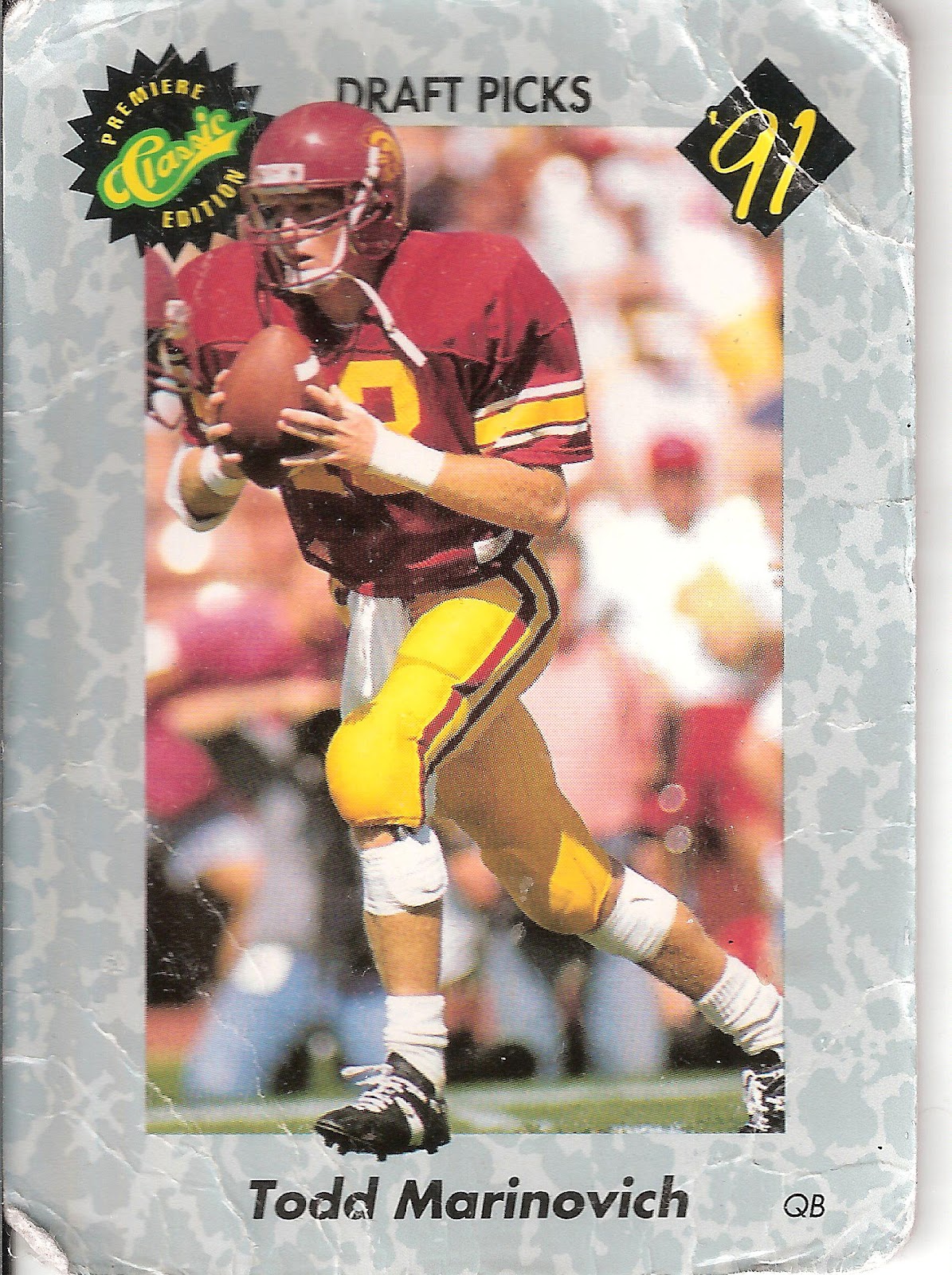
Speaking of pieces of detritus a society produces and no one wants to claim, Todd Marinovich. Once upon a time this card was valuable. Now it’s not. It’s better that it’s not, by a long shot.

I'm digging through pants pockets and dryer filters for more. I'll write when I find some.


[1] Which looked suspiciously like the faux batting helmets that used to house ice-cream sundaes.
[2] Though I wonder if Dr. Timothy Leary wasn't doing Topps' color-matching in the late '60s and early '70s. Some of those cards sport some suspiciously far-out, day-glo shades, like you'd expect to see from artists who would rather be painting Beatles guitars or marking buried power lines for backhoe operators.
[3] I drove a mid-1950s Nash for a New York Times story, and the experience was as revelatory as it was frightening. You had to plan to make a turn about 15 seconds before you actually made it. Braking took a weightlifter's touch, and the brakes grabbed about as firmly as Kevin Youkilis' top hand. The turning radius was larger than the parking lot at Sam's Club. On the other hand, you could fix anything on it with a flathead screwdriver and a roll of electrical tape.
[4] Or consider movies: The Artist is the cinematic Dodge Challenger. The greatest movie musical ever, Singin' In The Rain, recycled old Arthur Freed songs and put them in a comfortable setting of 30 years previous. It was more of a Mustang convertible.
[5] If it was Hoda Kotb head-butting Roger Ailes we might be on to something. Also, I am gobsmacked that this movie is being remade. Had they not seen this card?