Showing posts with label SkyBox. Show all posts

Wednesday, May 22, 2013

Have a Snot Sip, Rex Menu, Or Stoney's End

It was either write about these cards I found inside my desk or place my head on the aforementioned desk and nap.[1] You decide which was a better use of my time.


The technology is staggering (by 1990s trading-card standards) behind this SkyBox eX card, the more highly evolved version of the E-Motion card we pilloried months ago. The front is a mirror image of the back, yet nothing is reversed. Grant Hill’s jersey reads “PISTONS”  front and back, not “PISTONS” and “SNOTSIP.”[2] Even the writing on the basketball reads appropriately front and back. Near as I can figure, a graphic artist worked hours on each card un-backwardsing everything that went backwards when the image was flipped. It’s like building the Great Pyramid of Cheops with Macs.

It’s a gobsmacking little trick, but so what? Trading cards were the collectible equivalent of the Princess phone when this card came out, and this particular card wasn’t going to halt the slide to the abyss.

In that respect it’s a lot like a car ad. There’s a class of car ads that consists of footage of vehicles navigating ever more absurd settings – up the sides of walls, careening through pinball machines, whipping down the intestinal tract, dodging chunks of City Hall in post-apocalyptic Los Angeles, plowing merrily through in the bowels of hell, outacting Tom Cruise in Mission: Impossible movies, crossing the Atlantic, appearing suddenly in the middle of the battle of Yorktown – but in the end it’s just a car driving. You could have saved yourself $5 million, given the nice CGI man a day off, filmed a Chevy Malibu cruising down Grand Avenue, and sold just as many cars. Same here. You could have just put a nice Grant Hill picture on a nice piece of cardboard and sold as many Grant Hill cards as this double-positive piece of legerdemain.[3]


Note that I chose not to remove the protective film. That’s because I know what’s underneath.


One of my sons’ elementary-school classmates was named Jamyz, which always struck me as a particularly cruel hip-hop joke. For the record, I feel the same way about Mozaics.


The best way to describe Stoney Case is that he’s Tim Tebow without the athleticism, which begs the question: What was Signature Rookies trying to accomplish by making a trading card of him, paying money to have him sign it, and then attempting to market it as a collectible? There was no market for autographed Stoney Case cards, no pent-up demand for Stoney Case cards that built all through college and was only waiting for his matriculation(ish) from New Mexico to burst to the surface, and furthermore there was no path in professional ball that could have elevated him from emergency-starter status or make him anything other than the kind of quarterback that you tell, “Just hand off the damn ball."[4] The CFL didn’t want him, for Pete’s sake, and in the absence of the Lingerie Football League the only way things could play out was for Case to hold clipboards for four years, get thrown into the breach and found wanting (four TDs and 15 interceptions in 20 games, six starts), take a tour of several training camps and tryouts, and then pick up his career as a high-school football coach or insurance agent. He came and went, and like a Looney Tunes witch leaving bobby pins in her wake, he left behind this autographed card for us to remember him by.
I think I’m going to throw it away now.


Long before Jeremy Lin and Yao Ming there was the Upper Deck Chinese Basketball Alliance set. Call it prescience; I call it throwing crap on the wall to see what sticks.[5]

Unlike previous attempts to foist an outmoded technology on the lucrative Asian sports-collectibles market, the Upper Deck CBA set made no nods or winks to western markets. Well, other than the usual Upper Deck stuff, of course. In Taiwan, your chances of buying this set were slightly less than getting a good plate of pompano en papillote, while your chances of finding these cards at any church-basement show from Perth Amboy to Petaluma were greater than the odds of finding at least one attendee who thought “Old Spice” referred to nutmeg.

Given that, this set’s raison d’être grows fainter with each passing day. Because there is not a shred of English on these cards and no one in my pod reads Mandarin, I have no idea who these players are and what their relative goodness level is, other than to assume if the best you can do as a professional athlete is land on a team with the first name of “Luckipar,” you are probably not a professional athlete that needs to be immortalized on hundreds of thousands of cardboard rectangles. A simple line in a program will suffice, thank you.

That begs another question: Why is this person smiling? He is living in a foreign culture, eating dogs and eyeballs (and sometimes even dog’s eyeballs), he doesn’t understand the language – he can’t even tell you what it says on his shirt, for crying out loud – the beer tastes like soybeans, and he’s about 5,000 miles away from even the absolute worst franchise in the NBA, playing for a team so bad that not even Dexter Cambridge wants to play for them. I’ve got an idea: maybe it’s rictus. 


What’s better than a picture of a smiling basketball player in a jersey he can’t even read? A team-logo card of a team no one’s heard of, written in a language no one can speak, describing the glorious history of a franchise that can’t be very glorious, seeing as it only was in existence from 1993 to 2000, max.[6]
Turns out the team name was wrong on both counts. It wasn’t that lucky and it was way below par.


[1] An activity that requires a mouthguard, apparently. For those of you who don’t know, I work at a dental-insurance company, and because of my position I receive oral-health tips periodically. Today’s tip included a list of sports for which a mouthguard is suggested. The actual list included discus-throwing and skiing; the list we came up with added bocce, synchronized swimming, and falling asleep at your desk. So I should be wearing a mouthguard while typing this, just to be on the safe side.
[2] There’s a thought, huh, McLauchlin and Seals?
[3] Though speaking of post-apocalyptic stuff, isn’t it amazing that Grant Hill is still at it, creating separation from defenders and burying the fallaway 15-footer? He’s hit the same shot on Steph Curry and his dad. I swear, he’s the NBA’s very own post-atomic cockroach.
[4] So naturally he started games for Detroit and Arizona.
[5] Or, alternately, I call it someone at Upper Deck saying, “we should do a CBA set,” and forgetting that there was a Continental Basketball Association already alive and well (or at least, as alive and well as anything with Isaiah Thomas running it can be) in the United States.
[6] The league history (at http://www.taiwanhoops.com/2001/01/chinese-basketball-alliance-brief.html) is semi-fascinating, though. The first player to score a point in CBA history was named “Rex Menu,” which leads one to believe that Marvin Barnes chose his new alias at Denny’s.


Tuesday, September 18, 2012

Seashells and EMTs

I don’t know if you’ve noticed, but the road to seashells and balloons in the NFL does not involve being a defensive lineman and the No. 1 overall pick.

The first name that springs to mind faster than he ever sprang in real life is Walt Patulski. Walt Patulski; even the name evokes onion farming in the mud flats of central New Jersey. But what can you say? The guy was a Notre Damer, and Notre Dame defensive linemen are famous for translating their college gridiron exploits into professional success. Except for Mike McCoy. And Kevin Hardy. And Paul Grasmanis. And Steve Niehaus. And Jeff Alm and Mike Fanning and Mike Kadish and Chris Zorich. [1]

There were exceptions to the linemen-No.-1-overall thing, namely Lee Roy Selmon and Bruce Smith. And we won’t be too hard on Bubba Smith, who was headed to Canton until his knees got in the way, forcing a career shift that netted him a special sort of fame that can only come from playing a token large black cop in a series of dumb-and-dumber movies.

But for every Lee Roy Selmon there were two Russell Marylands, and for every Bruce Smith there was a Kenneth Sims or a Courtney Brown. And for every Mario Williams (who is not a sure-shot Cantonian by any means) there is a Steve Emtman.

Steve Emtman was neither the guy who composed the music for the Batman movies nor the guy who snatched the foul ball from Moises Alou at Wrigley Field. He was a very active if not Mt. Rainier-sized defensive end from Washington who was chosen No. 1 overall by the Colts in 1992, at the very height of the Handful O’Landfill era.

A big reason why for so many years the Colts were the Colllllllts, just two small vowels away from colitis, was because when the Cowboys had the overall No. 1 they chose Troy Aikman, and when the Colts had the overall No. 1, they chose Steve Emtman. [2]

You can’t fault the Colts for not knowing that Emtman was a ticking time bomb of bodily breakdowns that would blow nine games into his rookie season, when he tore everything tearable in his left knee. The next year he shredded the patellar tendon in his right knee. The year after that he blew out a disc in his neck in a collision with a teammate. [3]

This particular card was the promo card, the high supreme collectible, of Courtside’s 1992 Draft Pix set.

There are a number of incongruities to consider here. The first is that there would be a series of football-draft-pick cards called Courtside. It’s a little like oceanfront property in Nebraska. The other is that something could conceivably be accomplished by shortening “Picks” to “Pix.” How does that make these cards more fun, more youthful, more dynamic, more collectible, or anything other than more dysfunctional? In the end, they kinda deserved Steve Emtman, and he them.

The combination of No. 1 overall and Colts and defensive lineman – and Courtside endorser – was lethal. Steve Emtman should consider himself lucky he got out alive.

The one true golden non-sport franchise regardless of manufacturer, time, date, place, cost, quality of cards, or quantity of cards was Star Trek. This was because the absolute best audience for non-sport trading cards was Trekkies, seeing as they were spending every waking hour, all five-and-a-half of them, hanging out at their local card-cum-comics stores throughout the entire span of the Handful O’Landfill era, Sundays and holidays included, arguing over why there weren’t more Klingons in Star Trek: The Motion Picture and playing marathon sessions of RuneQuest because Dungeons & Dragons just wasn’t hardcore enough.

(Okay, I realize I’m painting with a broad brush here. Many Trekkies overcame their essential gravity and went on to have productive careers as video-store clerks, RPG programmers, and Medieval Languages majors.)

The Star Trek license made many stops along the way, including Topps, SkyBox, Decipher, and the Rittenhouse Archives. All of them made money for the licensee and the licensor. But despite the wealth of material – remembering that you could done screen captures of the original episodes at one-second intervals, so you could have made flip movies with a complete set, and they would have sold like William Shatner hairpieces – SkyBox in particular always gave the impression with its cards that it was scraping the bottom of an extremely large barrel.

Case in point: This card from the 1991 Star Trek set shows cover art from one of the few Star Trek art forms that didn’t crush it at the box office, the Star Trek Pocket Books. The artwork is black-velvet quality – maybe that’s why the Pocket Books didn’t sell, huh? – and couldn’t be any less evocative of Star Trek or unseen enemies if it had featured golfing dolphins. [4]

Because it was Star Trek, this card sold along with all the others. But not on its merits. Because unless you’re naming a star, you can’t sell something you don’t have.

[1] We’ll give you Alan Page, and call it a draw on Justin Tuck, Bryant Young and Renaldo Wynn.
[2] This was not an isolated instance. Two years earlier the Colts had the No. 1 overall and chose Jeff George, just to get the taste of Art Schlichter out of their mouths. And back in 1983 when the Colts had the overall No. 1 they chose John Elway, but were forced to ship him to Denver in a blackmail deal involving Mark Herrmann, Chris Hinton and a couple of mismatched socks. Some people say the Colts should get a get-out-of-jail-free card because Elway wanted to play on the West Coast. I say if the Colts had been something other than the Colllllts Elway would have been happy as a clam in Baltimapolis. Uneasy lies the crown on Andrew Luck’s head.
[3] Having a name that started with “EMT” might have been a giveaway.
[4] Reference: Sometime during the Handful O’Landfill era we received in our office a copy of a kids’ book titled Arnold Palmer and the Golfin’ Dolphin. It wasn’t explicitly stated in the book or the accompanying materials, but I got the very strong impression that a significant quantity of Arnold Palmer Hard Half and Half was involved in the creation of this book. In the end, it was just another high-concept media project that fell flat. Like Cop Rock.

Sunday, February 26, 2012

Golympicards!

Good intentions pave the road to hell -- and the road to the landfill.

Every trading-card set proposed to us by a stone-cold sober Sy Berger wannabe contained flashes of nobility. Even baseball cards in cans.

(Of course, no one ever came up to us and said, “We want to do a parody set called Pukey-Mon.” Because we would have rapped him in the beezer.)

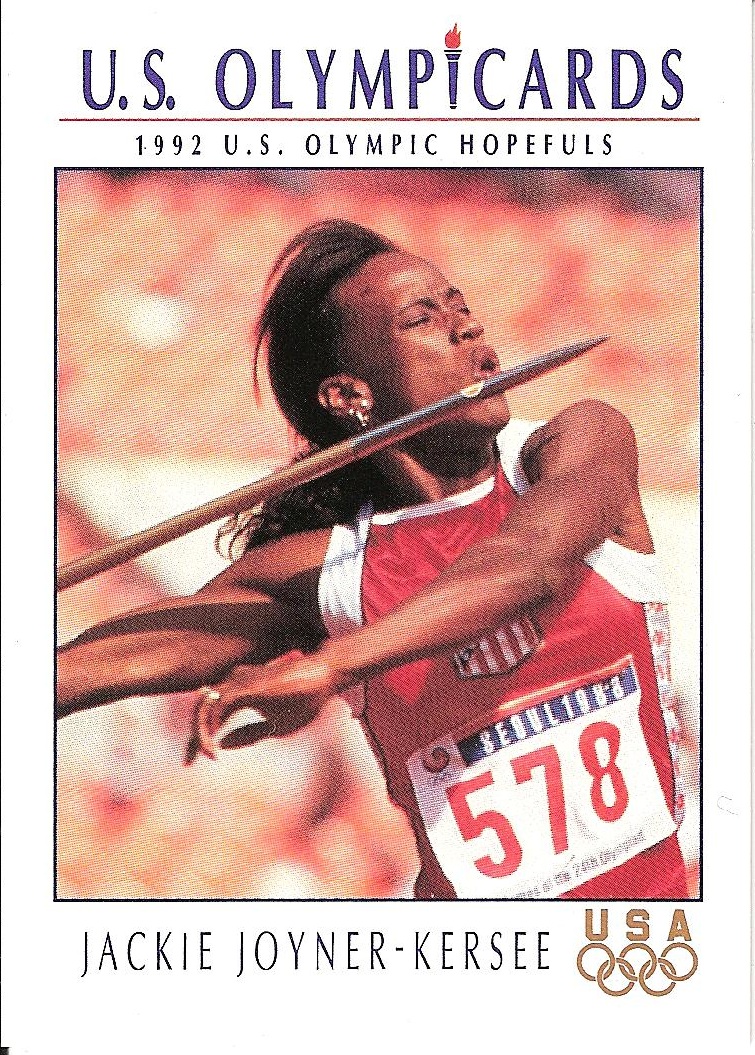
Take for example Skybox-neè-Impel U.S. Olympicards from 1992.

SkyBox: noble cardmaker. Well-intentioned company dripping with talent: Frank O’Connell, Bill Bordegon, Scott McCauley, Sherry Wallace, Allan Caplan, Keith Wood, Ken Baroff, Doug Drotman, George White, Martha Modlin, et many al. They made wonderful trading cards, and just because most of their cards currently lack monetary value does not diminish their accomplishments one whitlet.

The Olympics: noble sporting event ... blood doping, drug use, cheating, hermaphroditic polymorphism, racism, nationalistic jingoism, and terrorist acts notwithstanding. In the pantheon of sport, basically noble.

So, noble people from a noble company made a noble set for a noble sport. They negotiated countless individual deals with estates of athletes and licensing firms whose valuations of their clients’ worth ranged from mildly inflated to Hindenburgian. They set a not unsubstantial pile of cash in front of the U.S. Olympic Committee, whose altruistic taste for not unsubstantial piles of cash knows few bounds. If Caligula ever worked for a non-profit, it would have been the U.S. Olympic Committee.

And, of course, nobody bought the cards.

With the 2012 London Olympics fast approaching and a summer of drug use, cheating, hermaphroditic polymorphism, and Topps Olympic trading cards staring us in the face -- just your typical Lindsay Lohan summer -- I thought it might be useful to delve into the curriculum of the George Santayana School of Marketing and revisit a lesson from the past people (people who work for Topps, especially) have mindfully ignored.

If it ain’t one of the Big Four sports, and you’re not willing to make bupkis on the deal, don’t bother.

In retrospect, the 1992 U.S. Olympic set was about as good as non-Big-Four sports cards could get. The 90-card Hall of Fame set spotlighted über-worthy all-time greats like Jesse Owens and Wilma Rudolph, with room at the inn for Bruce Jenner Kardashian. The 110-card Hopefuls set included the one-and-only-original Dream Team as well as a young bike racer named Lance Armstrong. There was silver foil, and full-color backs, and some rudimentary chase – in short, everything it took to sell a trading-card set in 1992, except for: baseball, hockey, football, and basketball.

Okay, there was some basketball -- a one-in-10 chance of getting an accept-no-substitutes, one-and-only-original Dream Team card. (Four years later, SkyBox almost made back its USOC nut on Dream Team sets and subsets. Almost.) There were no baseball players in the SkyBox U.S. Olympics set. Topps had Team USA, Barry Larkin, Jim Abbott and the gang, an honor that cost the Sy Berger Bunch a different not-unsubstantial pile of cash set before the U.S. Baseball Congress or some other tangentially involved licensing body. There were no football players in the Olympics set (except for Jim Thorpe), for obvious reasons.

So no football, no baseball, no basketball, and no hockey; instead, swimming, gymnastics, and track and field, with epee and dressage and a whole bunch of past and future Wide World of Sports commentators thrown in gratis. Want to again express surprise that these cards didn’t sell?

Should they have sold? Sure. Was it unfair? Sorta kinda. It’s unfair to the extent that American Idol or America’s Got Talent is unfair. Was Clay Aiken really the most talented undiscovered singer in America the second season of American Idol? We would like to believe not with every atom in our protoplasm, but America put Clay Aiken over the top, and America is never wrong. Ask Rick Santorum.

In retrospect, Aiken’s win was the result of the segment of society that has turned the internet into a forest of LOLcats getting all gushy over someone who, let’s face it, is a LOLcat with opposable thumbs. But if we produced a Kelly Clarkson every year America would be awash in women bellowing in Camrys with Chris Berman and singing the national anthem in muumuus. And we couldn’t have that. God, no. Anything but that.

So things have not turned out all right for SkyBox U.S. Olympics cards. They’re largely forgotten and basically valueless outside of Armstrong and the Dream Team, though if you’re looking for a Mark Spitz rookie, here you go. It’s even hard to imagine a scenario where they might experience a renaissance. All the current athletes are no longer current (except for Armstrong, who is busily examining the Pete Rose career path). And the all-time greats? Jesse Owens is long gone; the fact that he stood up to Hitler is only going to get less important with time, and the fact that he spent many of his latter years racing thoroughbreds at county fairs, fascinating as that may be, is going to fade from the public consciousness (though it would make a hell of a trading card).

Figuring out what would sell in the trading-card biz was always a crapshoot. Fleer Flair had the low press run and the funky foil and the flip-top pack, but Topps Finest sold. Stadium Club had nothing but some perceived scarcity and Leaf had all the attributes (and the lower press run), but Leaf was sent home.

However, it was never a crapshoot figuring out what wouldn’t sell. Swimmers wouldn’t sell. People on horses wouldn’t sell. Pole-vaulters, high-jumpers and discus-throwers wouldn’t sell. Decathletes. Divers. Sprinters. Hurdlers. Yachtsmen. The Berenstain Bears. And they were all collected in the 1988 SkyBox U.S. Olympic set – all except the Berenstain Bears, who would have been in the set if the USOC had found a way to fit a couple of two-dimensional, manners-crazy grizzlies into double-breasted blazers and ice-cream pants.

I was reading the other day that Kodak pumped millions and millions into the U.S. Olympic Committee and in return got bankruptcy. And a handsome plaque. SkyBox didn’t pump in quite as much money and didn’t quite go bankrupt. Upper Deck was the next to fling the coin, and they didn't go bankrupt either, thanks to the marvels of movie-studio bookkeeping. And now it's Topps.

I know enough about fiscal policy during the Great Depression to see the echoes in contemporary "the way to make up for a lack of spending is to spend less" rhetoric. And I see a lot of SkyBox in what Topps is  trying to accomplish with Olympic cards.

In the end, it's amazing what a not-unsubstantial pile of cash can get you. All the javelin throwers you can eat. And a handsome plaque.