Tuesday, August 28, 2012

The Fast And The Spurious


From the Department of Amplifications, a correction.

When I was referring to a crew member pictured on a Traks racing card with the statement, “This is what hand-fishermen do on their off hours,” I was mistaken. The Clyde Booth card shows what feed-mill operators do on their off hours. The Greg Moore card shows what hand-fishermen do on their off hours.

The Times regrets the error, and so do I.


In a previous edition I mentioned how the 1992 Score Baseball All Star subset created a series of caricatures that “was less distorted, anthropomorphically, than Woody Allen.” Here is more proof. Ramon Martinez was roughly 90 percent head and 10 percent body, with the body stretched along a six-foot-four-inch frame. All the warnings plastered to buckets aimed at head-heavy two-year-olds applied equally to Ramon Martinez. Many’s the day when the aftereffects of Ramon bending over to tie his shoes was a call to the paramedics. Had R-Mart been able to use his head as a counterweight, as is suggested in his card, he might have been able to throw the ball 120 miles an hour without his shoulder disengaging from his body, the condition that ultimately killed his career.

Somewhere out there is a Score All Star where the huge head is bestowed on someone so entirely bottom-loaded, so Bozo-bop-bag-shaped that the caricature actually has some sock.[1] But I’m still looking.


I realize that those also serve who sit and wait, but by the same token, I always thought of trading cards as the one playing field where everyone plays at once. Happy Feller gets a card just the same way that Walter Payton gets a card. Even the special cards deign to include the proletariat. Ted Shows How features Ted Williams and Mike Epstein. There’s a Boyhood Photos of the Stars card of Wilbur Wood. The SkyBox Slammin’ Universe subset includes Tony Dumas. Like Sly Stone said, everybody is a star.

So is it right to single out Detlef Schrempf not as the top player, not as No. 2 or No. 3 or No. 4, but as the sixth man? I realize being the next guy in after the starters have played can be a special thing in basketball, but it’s really only a basketball thing. The twelfth man in football is only relevant in Canada and College Station. The 10th man in baseball is Casey Candaele. The seventh man in hockey gets you a two-minute penalty for delay of game. The fifth person on a relay team gets you disqualified.[2] And even in basketball the sixth man doesn’t always come into the game on a winged chariot of fire trailing clouds of rosin dust. (cf., the sixth man on the 1989-90 New Jersey Nets was Purvis Short.)

My other problem with this card is that I have a personal bias against haircuts whose sole reason for being is to simplify headstands.

Detlef Schrempf was a fine basketball player whether he started or came off the bench. Should we really draw lines on an endless green expanse?


In my rather lengthy treatise on umpire cards several months back I danced around the nasty truth of cards showing officials: Officials really don’t do much, even when they’re doing their job, and when they do something interesting you can’t show it. This goes for managers and coaches, too. I can think of only one exception: The 1972 Topps Billy Martin In Action card shows the volatile manager chewing out an umpire while pointing to a spot where someone was safe or out or went to their mouth or caught the ball or dropped the ball or missed a called strike or a foul tip or a balk or catcher’s interference. There are no cards of Jim Mora ripping off a headset, Buddy Ryan flying into apoplectic shock, Slick Leonard tossing a chair, Don Cherry getting unhinged, or Lou Piniella repositioning second base. Similarly, there are no umpire-and-official cards showing Dale Scott getting it on with Martin, Mendy Rudolph teeing up Bill Musselman, or Don Koharski going after Jim Schoenfeld.

Instead, we get this: Pat Dapuzzo bent over at the waist.

While I admire completeness (and do appreciate the fact that Pat is an avid weightlifter and karate enthusiast, like several million other individuals worldwide), the wages of completeness in Mr. Dapuzzo’s case are a lifetime of autographed-set completists chasing him through hotel lobbies and cornering him in restaurant restrooms.

Was it worth it? Pro Set is out of business and Pat Dapuzzo’s image is frozen in thousands of collectors’ minds as the guy who looks like he was just gut-punched by Superfly Jimmy Snooka. Upon further review … nah.


Talk about excitement. For several years before Fleer got a Major League Baseball license (and for several years after, actually) this was Fleer baseball: A team logo and clip art on the front on the front, and a baseball quiz on the back.[3] Fortunately Fleer picked a fairly animated piece of clip art to suggest action and canted the letters in “Baseball Quiz” at odd angles so we knew it was all in fun and didn’t misunderstand. Otherwise we might have thought that it was, you know, a colossal waste of cardboard.


I give up – which one is this?

If I'm Vin Diesel, I'm royally hacked off right now.


I understand the problems with checklist cards in the pre-computer era. You want to know all the cards in the set because you want them all, even the elusive Derek Livernois card. However, the card you want least is the card that shows you all the other cards you want, and that’s a conundrum.

Cardmakers have been wrestling with this forever. They’ve put facsimile autographs on checklist cards, team logos, head shots of stars, or photos of players milling around batting cages comparing runs in their doubleknits, all in hopes of sparing the cards from a painful death at the business end of a Daisy Red Ryder. However, most of the time they’ve cut their losses and put as many players as would fit onto cramped, ugly checklist cards. They were a cost of doing business.

Like everything else associated with trading cards during the Handful O’Landfill era, this cost of doing business went up, too. There may be more unattractive, inefficient checklist cards than the checklists from the 1990 Best minor-league set, but I haven’t seen them. It probably doesn’t help to note that there are six of these cards, each in a different color, and the job could have been accomplished with two.

Sometimes three of these cards would show up in a pack, filling the spaces between cards of Scott Plemmons, Sam Ferretti, and Jeff Mutis. They added negative value even under that scenario. And that truly is as low as you can go.


It’s fantasy-football-draft time again, and this card emerged from the floor to remind me of my best fantasy-draft experience ever.

It’s the afternoon of April 4, 1994 – Opening Day – and a fantasy-baseball draft is being held at The Lakeview, in Iola, Wis. The Cubs game is playing as the draft begins, and Cubs centerfielder and leadoff man Tuffy Rhodes is having the game of his life. Rhodes goes four-for-four with three home runs off of Dwight Gooden in a losing effort, but Rhodes’ effort is enough to get him drafted, and highly, by one of the fantasy managers, to a chorus of groans, shouts, flung french fries, and pelted pretzels from everyone in the room – even the Norwegian bachelor farmers at the end of the bar who hardly knew English, much less baseball, fantasy or otherwise.[4]

Two weeks later Rhodes was out of fantasy baseball, and he was out of the majors not too long after that, but he had accomplished his purpose: In one game, he had won a week for his owner.

Speaking of stupid things, printing a player’s name in six-point type and burying it inside a rainbow-colored bar has dubious merit from aesthetic and practical standpoints, so naturally Topps was all over it for its retro-styled Bowman set, which dearly wanted to appropriate the no-name-on-the-front aesthetics of the original Bowman set without actually going there.[5]

Rhodes was the fantasy-ball equivalent of the stretch-drive rent-a-player, a body employed to produce but designed to be cast aside as soon as conveniently possible. As long as everyone’s good with that we’ll move on.


The reality is that Brad Daugherty is seven feet tall and Larry Nance is 6-11. The impression is that Mark Price has the dimensions of Billy Barty and is holding Mr. Wiggins’ prize pumpkin.

Some cards do their subjects no favors. In the case of this card and Mark Price, it doesn’t even insult him well.

Good to be back. We’ll talk more soon.

[1] Current Brewers catcher Martin Maldonado comes to mind.
[2] Though the fifth Beatle, George Martin, was knighted.
[3] Sample question: “True or False? The Mets played their home games at Ebbets Field in 1962.” If I’m an eight-year-old kid, I’m saying, “I don’t give a crap.”
[4] He wasn't our most popular owner. I'll leave it at that.
[5] It helped that the original Bowman photographs were generally so stunning they needed no embellishment.

Friday, August 3, 2012

A Card Blog Only For Adults And Absolutely Nobody Else

Today only it's the Same-Sex-Kiss edition of "Handful O'Landfill"! Just keep it to yourselves, if you don't mind.


A while back I mentioned that creating a card set for girls and calling it “A Card Set For Girls” is the kiss of death. That also applies to card sets made just for kids. Donruss Triple Play was such a set. It was low-cost, low-quality, and bright and colorful and obvious as an episode of Sesame Street but less educational, unless your career goal is writing the straight dialogue for A.N.T. Farm. It ignores everything that consumer research has learned about kids over the years, which is if you want to make Metamucil For Kids call it Metamucil Only For Adults And Absolutely Nobody Else. The kids will get there.

The back of this card reads, “Baseball players like to have fun at the ballpark. This photo shows three New York Mets who think they are playing for the New York Giants. David Cone is trying to block Jeff Innis’ kick. John Franco is the holder. Even though work is serious, this shows you can have fun at your job.” Yes, and family is the most important thing, and even though you’re young you can make a difference ‘cause everyone is special, and being different is okay, and it’s what’s inside that counts, and when you send a kid off sniffling in the third reel he comes back to save the day in the fifth, with a proton-beam accelerator crafted out of popsicle sticks and Play-Doh.[1]

Life lessons are important, but they’re better taught by someone who’s lived a portion of a life, and not a sunburst-bordered baseball card showing a bunch of pitchers screwing off.


Just in case the Scott Chimparino promo card of a couple of weeks ago didn’t get your blood racing for 1990 Donruss Baseball, here’s a Kevin Morton promo. Restrain yourself.


One of the big areas of the Handful O’Landfill I really don’t have covered is fantasy art. There were dozens of fantasy-art sets released from about 1990-95, and some of them sold extremely well. Companies like Krome Productions and Comic Images made demi-scads of money on sets featuring characters like Lady Death and artists like Frank Frazetta, Boris, Roger Dean, and the Hildebrandts.

There were a lot of these sets. As former Cards Illustrated editor Don Butler put it, “Basically any artist who ever did a prog-rock album cover got a card set.”

I always found fantasy-art cards to be sort of limiting, but I realize now I had it totally upside down. If Comic Images ran out of pictures for its Ujena Swimwear set, it could call up Ujena and have him/her paint some more hydraulic babes in thongs. If Topps ran out of baseball players three-quarters of the way through Stadium Club 2 Baseball it couldn’t exactly call up the Oakland A’s and have them make more players [2].

That’s the long way around to this Brockum RockCard showing a Megadeth album cover, done up in a style that would loosely qualify as fantasy art. The back of this card is black. I like the back better.


Score had no way of knowing the future when it made this card, but in retrospect we say: Not the best choice, guys.


Just as a reminder that at or about the time of Bo Jackson there were three players excelling at major-league baseball and NFL football – Brian Jordan, Deion Sanders and Jackson.[3]

Maybe today’s pro athletes are bigger, faster, and stronger. But they ain't Bo.


Quick – guess the set!

That’s right – Young Indiana Jones Chronicles, from Pro Set.

This card has a place of honor right next to my Pagemaster promo cards.

I know you’re dying to know what’s on the back of this card, so here goes: “Indy is totally lost in the bush. A large Askari rescues him and takes him back to camp. Indy’s parents are very angry with him but are glad he is alive.”[4]

Alive until the Nielsen numbers come in, that is.


And here’s another card from the same set. No, Topps did not print this card. This was an (intentional) 3-D card, meant to be viewed with the glasses that came in every pack.

Okay, so viewed through the 3-D lens of history it was all a failure – the 3-D cards, the base cards, the glasses, the marketing, the TV show, the marketing of the TV show, the works – but there are other measures of failure besides sales. And by those measures Young Indiana Jones Chronicles trading cards were a hit. They looked good, read well enough for the audience, were colorful and interactive, encouraged play, and didn’t take themselves too seriously. In every way but one they were superior to similar TV-show sets of the ‘60s and beyond: Gomer Pyle USMC, Charlie’s Angels, Valley of the Giants, The Monkees, and so on. The difference was that people cared then – cared about the cards and the shows. There were only three-and-a-half networks, so the number of shows airing across the nation at any one time was maybe a dozen, with tens of millions of people watching the top three. There was no VCR, no DVR, no Hopper, no PS3, no Xbox Live, no Netflix, no Hulu, and no YouTube. It’s not hard to get wrapped up in Captain Parmenter when your other options are Gunsmoke, Adam-12, or doing the dishes. Similarly, the card-and-toy aisle wasn’t awash in Pokemon and Bakugan and Digimon and Gundam Wing and Pagemaster and Marvel vs. Wildstorm and Webkinz and Neopets and avatars of a thousand flavors. It had jacks and paddleballs and a couple of 100-piece puzzles, some cars, some Barbies, and lots of guns.

There was less of everything except guns, and because there was less of everything there was more time to pay attention to the things that were there [5]. It’s great to be able to choose; it’s better to revel in the choices you have.


I think I show so many Traks cards because I’m fascinated by the thought process that places such an emphasis on crew members and car haulers and all the assorted camp followers and monkey wrenches of auto racing. I understand the numbers perfectly. It’s hard to make a 250-card set for a sport where there are fewer than 40 cars, 40 drivers, 40 owners, and 20 racetracks. On the other hand, baseball-card sets at their most desperate (and disparate) did not show cards of trainers, clubhouse boys, tarpaulins, or chartered aircraft. Umpires, yes. Trophies, yes. Stadia, yes. But there the line is drawn, and stays drawn.

I also appreciate card backs that note as a career highlight, “Started 20 years with United Parcel Service, oversaw 10,000 vehicles as Northeast Region Automotive Manager.” It foreshadows PeopleCards, and I do love me some PeopleCards.

All was not equal in the Handfull O’Landfill world. Some cards existed merely to fill the spaces between cards of stars (or, in this case, cards of cars). But do you think any of that matters to Clyde Booth? I’m guessing not.

Anyway, if there’s a card that’s more evocative of the daredevil, thrill-a-minute world of big-time stock-car racing … it’s one of many. This tells me what hand-fishermen do on their off hours.


Remember: Every stupid fashion look throughout history was considered attractive and stylish at the time, and there may come a time in the not-too-distant future when you say, “Hey, a bumblebee-striped stovepipe baseball cap looks really cool when you pair it with a black doubleknit top.[6]”

I personally am hoping I am not alive at that time.


[1] This is one of the reasons I really appreciate Phineas and Ferb. At its best it takes a lot of the hoariest kid-programming clichés and turns them on their heads. In that regard, it’s reminiscent of – but more subversive than – the best episodes of Animaniacs. In the absence of anything as artistically satisfying as Looney Tunes, it’s the best kid-colored social satire we can get.
[2] Hey, but it could break out another Rob Mallicoat card!
[3] Drew Henson, Chad Hutchinson, Josh Booty, and D.J. Dozier were close on both counts – they were bad major-leaguers in both sports. Booty and Henson missed breaking balls and open receivers. Hutchinson couldn’t miss bats or opposing D-backs. Dozier was a so-so fielder who couldn’t hang onto the ball. And don’t get me started on Michael Jordan.
[4] As a disassociated statement, this is remarkable. As an allegory, it’s enlightening. “Indy” must refer to the Colts, and Andrew Luck specifically. I’m thinking the large Askari is either Askari Jones or a normal-sized example of a breed closely related to the Labradoodle. And Indy’s parents are Roger Goodell and Jim Irsay.
[5] I think about this in terms of music. If musical evolution had been pushed back 50 years, Mick Jagger would never have been able to spot Keith Richards with a copy of a Muddy Waters record under his arm because it wouldn’t have been Muddy Waters but one of several hundred Muddy-Waters-type artists (categorized even more diffusely as rural Delta blues artists with urban overtones), and they would both have been plugged into iPods and not making eye contact anyway.
[6] I wonder: At what point did single knitting not be good enough?

Friday, July 27, 2012

Stuck Inside Of Aikman With The Edgemar Blues Again

Have you ever wondered what it feels like to be stuck inside of Mobile with the Memphis blues again? I'm guessing it's like being a trading card and going through the washer and the dryer. Oh, well. I just made the surviving examples that much more valuable.


There was a time when traded cards made sense, when Topps was making a 900-card baseball set and issuing it in seven series and it had burned its Aurelio Monteagudo card in Series Two before he was dealt from the A's to the Tigers, and Topps really wanted to put another Aurelio Monteagudo card in their set. Under that set of conditions – space to fill, a trade after the editorial deadline, Aurelio Monteagudo – a traded card was Topps' only recourse. But over time the necessity for a traded card faded away. Trading-card manufacturers began making a new set basically every month, so if regular Topps didn't catch the trade Stadium Club would, and if Stadium Club didn't Finest would, and if Finest didn't Bowman would, and so on. Even under those circumstances manufacturers persisted in issuing traded sets, or rookie-and-traded sets, at the end of the baseball year as another means of wringing blood out of the collecting turnip.

Still, as photo-retouching techniques became more sophisticated the old ways of airbrushing a new cap[1]  over the prior one or resorting to the file photo showing a hatless Jack Baldschun became unnecessary, since even Photoshop 1.0 could do better in a couple of minutes what Topps artists could barely accomplish in a day.[2]

Finally, competitive pressure cut deadlines, so a set that used to go into production in December to be issued in March was being cranked out in late January. A lot of Casey Candaeles can trade addresses in that amount of time.

The upshot is that by the time this card of Olden Manynice was issued NBA Hoops had a half-dozen options at its disposal that would have been more appropriate than slapping a police-tape-ish "Traded To Detroit" along its bottom. Hoops could have cobbled together a Detroit jersey, or Photoshopped the picture or simply cropped it differently, or it could have flipped the generic back photo to the front. Instead, it went the lazy route and hoped that collectors would say, "Oooh, it's just like the old days," which they didn't, because basketball cards never did it that way and it was just Olden Manynice.

This card is like the remake of Footloose. There was no need to make it the way it was made because there were so many other better ways it could have been made. If it needed to be made at all.


I return to the Parkhurst Missing Link set because it's like the Dodge Challenger: It's an unapologetically retro muscle car only better because it has and antilock brakes and steel that won't crumble in your hands and seats that actually hold your butt in one place and a shift knob you can hang onto and steering that steers and a hole for my MP3 player and a zillion other creature comforts we've come to expect from motor vehicles.[3]

All things considered, neo-retro is probably the best of all worlds. Does it matter if it's derivative? Every piece of popular music made over the last 40 years is derivative of Jackie Brenston's "Rocket 88," the Beatles’ Revolver, the Ink Spots’ “My Prayer,” or James Brown's "Say It Loud – I'm Black and I'm Proud." Does it matter? Is "Good Vibrations" less of a song because Brian Wilson had just heard Sgt. Pepper's Lonely Hearts Club Band? Is Paul Simon's Graceland diminished as an accomplishment because Simon appropriated riffs from The Indestructible Beat of Soweto? Do we think less of Straight Outta Compton because it sampled Funkadelic's "You'll Like It Too"?[4]

Everything a society produces is somehow influenced by what went before. Some productions are simply more obvious than others. Drawing a line and calling certain things neo-retro while failing to acknowledge the deep debts to history owed by Facebook or an iPod is revisionist. And I hate revisionism.

With the Missing Link set, Pro Set constructed an intentionally deceitful world. It reincarnated a zombie Parkhurst and built a set Parkhurst never made, considering it simultaneously from the outside – acknowledging Parkhurst's historical reputation among collectors for look and feel and readability – and the inside – making a set that was consistent from the first card to the last. It had to be stupid and careless and intentional and shrewd all at once. And it had to find something interesting to say about Marcel Bonin.

At least the last part was easy. "No other NHL player can lay claim to have wrestled bears as a sideline nor that he eats glass but that is part of Bonin's unorthodox portfolio," his Parkhurst back reads. And, look – it's in French: " Aucun autre joueur de la LNH peut se targeur prétendent avoir lutté comme un à-côté, ni qu'il mange de verre, mais qui fait partie du portefeuille orthodoxe Bonin."

The front is bitchin', too.


You know, it's probably not a good idea to devote a card to Roger Ailes addressing the National Press Club after head-butting Hoda Kotb[5]. I'm not buying that "Dr. Edgemar" stuff for a second.


I talk a lot about draft-pick sets in these excursions and I’m not sure why, other than a whole bunch of draft-pick cards made it into the box of indescribable delights I handed down to my son as his legacy. No stock portfolio of blue chips like Enron and Bank of America; no sir. No stash of bonds, no real estate, no annuities, no cash equity something-or-others, no precious metals, no jewelry, no money-purchase pension plans – none of that stuff. You get draft-pick cards.

But, hey, wasn’t that the way it was supposed to work? Weren’t we all going to cash in our stashes of trading cards right around now, the pristine sealed boxes of ’88 Donruss and the ’87 Fleer tin sets, sell them to the next generation of collectors hungry for Johnny Ray rookie cards and then pass on those profits of patience to our children, who would stare at the check with and then look up at you with gleaming, grateful eyes and murmur, “TWELVE-FIFTY? You kept an entire wall of trading cards in our basement for 25 years and all you got out of it was a lousy twelve dollars and fifty cents? You could have bought cauliflower 25 years ago and sold it for more than $12.50! I hate you! I never want to see you again as long as I live!” And so on, in filial affection.

Looking at back at from this direction, from the other end of the telescope, the numbers seem all distorted. Of course there was going to be no demand for largely vast quantities of trading cards showing players of no interest to anyone currently looking to pay money for trading cards. Even the sure things, the lock Hall of Famers, guys like Ken Griffey Jr., or the recent Hall of Famers like Barry Larkin are of little interest to a collector. You want an ’88 Topps card of Barry Larkin? Maybe if someone gave it to you, but you wouldn’t buy it as an investment nor would you validate someone else’s investment projection by buying from them.

The thing everyone missed about the trading-card boom that precipitated the Handful O’Landfill era was that it was as long-term as Carly Rae Jepsen’s popularity. The gains were all transitory. The only smart folks were the ones who flipped a few cards and got out. All of which has very little to do with this Star Pics card of Troy Aikman. Star Pics, after a few times around making draft-pick cards for various sports and enjoying a tantalizingly small amount of early success, found itself surrounded by competitors in a business where the margins were thinner than Manute Bol’s ankles. Its path to differentiation was to sprinkle in amidst its draft-pick cards cards of players who were draft picks a decade ago. Amazing commonality, yes, and the player wasn’t too terrible – Troy Aikman, practicing for his Rent-A-Center gig. But the card itself was something Salvador Dali might have whipped up for Topps if he was in a variant of Chopped featuring great artists moonlighting as trading-card designers. Picasso did a blue-period Bombo Rivera, Da Vinci went all classic with Mickey Mantle, and Dali did this little piece of business.


And this was Andy Warhol’s contribution to the competition.

It’s hard to know what to make of these as trading cards. They’re phenomenally unattractive worthless cards of a couple of Hall of Famers and some miscellaneous players, and there was never a time they were anything else. They’re tangible examples of the previous step in the collectibility process, the one where someone thought something might be a pretty neat collectible without having any evidence to prove his belief. These are the ideas that sound like good ideas until you actually see them, at which point you go, “Oh, yeah …”

These cards are a couple of those pieces of detritus a society produces and no one wants to claim. And now I have them. And here you go.


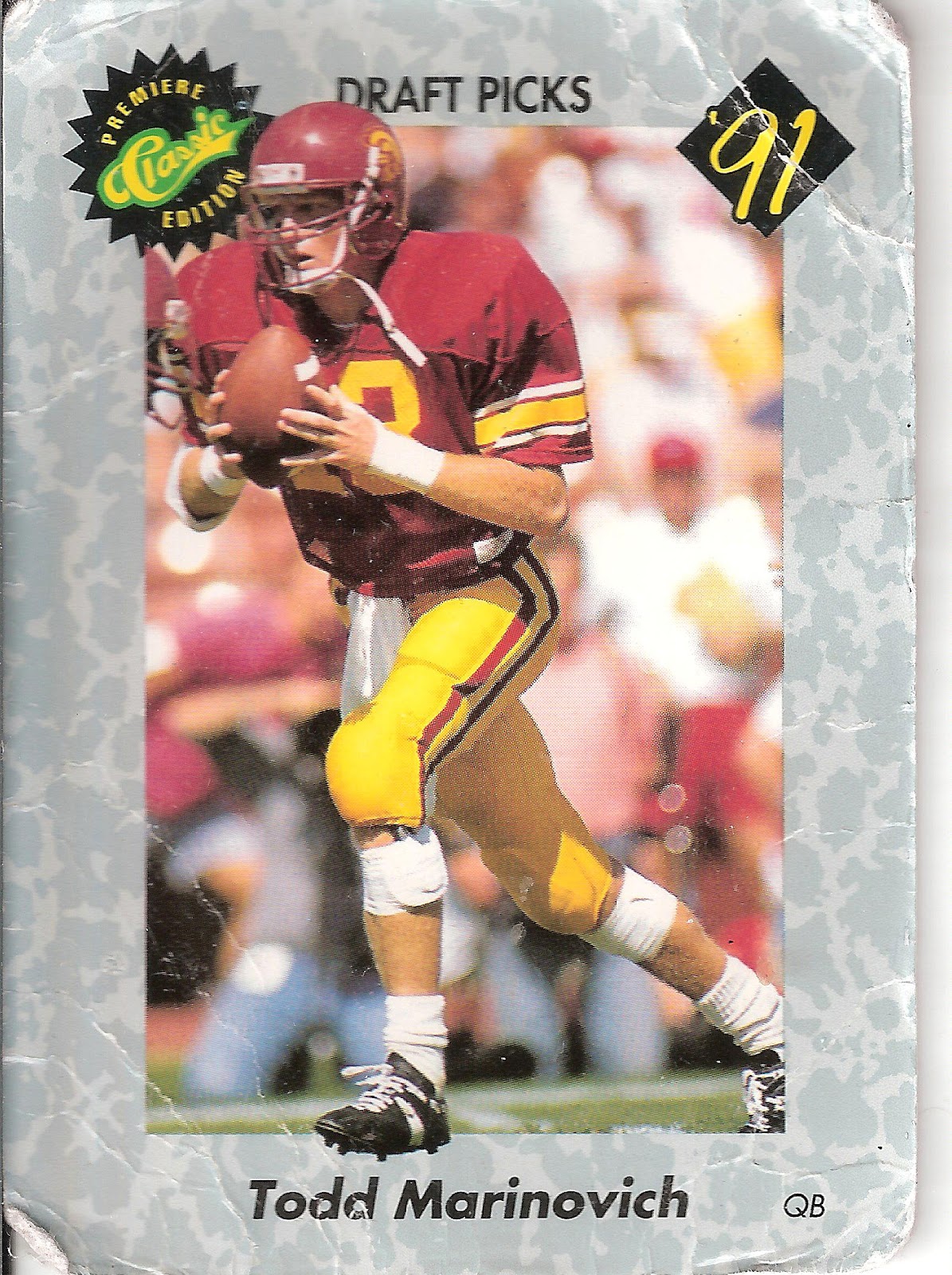
Speaking of pieces of detritus a society produces and no one wants to claim, Todd Marinovich. Once upon a time this card was valuable. Now it’s not. It’s better that it’s not, by a long shot.

I'm digging through pants pockets and dryer filters for more. I'll write when I find some.


[1] Which looked suspiciously like the faux batting helmets that used to house ice-cream sundaes.
[2] Though I wonder if Dr. Timothy Leary wasn't doing Topps' color-matching in the late '60s and early '70s. Some of those cards sport some suspiciously far-out, day-glo shades, like you'd expect to see from artists who would rather be painting Beatles guitars or marking buried power lines for backhoe operators.
[3] I drove a mid-1950s Nash for a New York Times story, and the experience was as revelatory as it was frightening. You had to plan to make a turn about 15 seconds before you actually made it. Braking took a weightlifter's touch, and the brakes grabbed about as firmly as Kevin Youkilis' top hand. The turning radius was larger than the parking lot at Sam's Club. On the other hand, you could fix anything on it with a flathead screwdriver and a roll of electrical tape.
[4] Or consider movies: The Artist is the cinematic Dodge Challenger. The greatest movie musical ever, Singin' In The Rain, recycled old Arthur Freed songs and put them in a comfortable setting of 30 years previous. It was more of a Mustang convertible.
[5] If it was Hoda Kotb head-butting Roger Ailes we might be on to something. Also, I am gobsmacked that this movie is being remade. Had they not seen this card?


Friday, June 29, 2012

Ansgar, Sydner, Brickowski, and Mokeski: The Four Dorksmen of the Apocalypse

Still going through that box of random cards and finding things to write about. If Tom Robbins can write Still Life With Woodpecker while staring at a pack of Camels, surely a box of cards has to be worth a couple thousand more words.


One of the best back-to-the-future developments of the handful o’landfill era was the re-addition of middle names to the backs of trading cards. It seems so old-hat now, so 20th century that you couldn’t have Thabo Sefolosha’s middle name[1] within a couple of clicks, but even with the lens of retrospection affixed firmly to our unibrow it’s hard to imagine the thrill of a ‘90s child to learn Christian Welp’s middle name, and upon learning, to reflect that it’s so much more powerful than the middle names of all the other clumsy white seven-foot centers. Paul Mokeski cowered before the awesome name of Ansgar. Somewhere Richard Wagner is nodding his blond-pigtailed head in approval.[2]


“University of Hawaii slotback Jeff Sydner offers all the versatility of Keith Byars in a smaller package,” the back of this 1990 Upper Deck football card reads. The problem with that is that no one wanted all the versatility of Keith Byars in a smaller package in 1990. They wanted all the versatility of Keith Byars in a Keith Byars-sized package, minimum. In fact, the main attraction of Keith Byars was the, ahem, size of the package.

The Upper Deck folks never took this statement to its logical conclusion[3]. Imagine if someone offered all the versatility of B.J. Raji in a smaller package. If B.J. Raji was 5-11 and 170, the fact that he had could play inside and outside on the defensive line would be far overshadowed by the fact that he was the size of Pinball Clemons yet slower than Ted Washington.

Now, if Jeff Sydner had been a car, things might have been different. He could have been the Mini Cooper to Byars’ Dodge Challenger. But there’s no upside in smaller football players being able to do things bigger football players can do. It eventually gets them crushed.


Horses for courses, they say, and it is absolutely true that the No. 1 thing collectors of bowling cards wanted on a bowling card was a picture of a bowler staring at an End of the Trail statue while standing next to his wife, who is holding his young child while looking remarkably like Tracy Austin, and waiting to be interviewed by Chris Schenkel. Considering the alternatives – armpit follow-through, pre-roll pondering, over-the-hand-dryer hovering – they’re probably right. The fact that this is the antithesis of what would make a great Topps WCW Nitro card[4] or a Yo! MTV Raps card is one of the things that makes this era of trading cards so reminiscent of a cluster migraine.


Darrell Sherman is so obviously hiding something under his hat … but what? My guess is Jose Altuve.


Every team has a player or player that so obviously embodies that team that it makes you wonder whether a negatively transmogrified version of the player somehow begat the team, and not the other way around.

You can prove this to yourself. Close your eyes. Imagine a team, and then picture an archetypal player in the uniform of that team.

The first team I think of is the Boston Celtics and the first player I think of is Kevin McHale. The absurd way he stuck out his chest says “Celtics” to me more than a million floppy Rajon Rondo drives or Bill Russell hook shots. Then it’s Red Sox: Ted Williams edges out Dustin Pedroia. Twins: Rod Carew over Kirby Puckett. 49ers: Joe Montana over Steve Young. Packers: Forrest Gregg, in the mud. Astros: Jeff Bagwell, wearing the terminal section of the Keystone XL pipeline on his elbow. Oilers: Tie between Warren Moon and Earl Campbell. I could do this all day.

The unfortunate thing for the Bucks is that when I work my way down to the Cream City I see the embodiment of Milwaukee basketball in Brad Lohaus, the whitest of all the pale pivots ever to wear the home green-and-various-unattractive-shades[5]. These large white shadows shared several essential qualities: They had a Big Ten (or at least a Midwestern) upbringing, their Nike Air Assaults had soles of lead, they were blond or buzz-cut, they had a European surname, and given the choice between hip-checking Moses Malone and jump-shooting, they planted themselves behind the arc every damn time.

The line started with Dick Cunningham and included Kent Benson, Randy Breuer, Jack Sikma, Paul Mokeski, Frank Brickowski, Joe Wolf, Joel Pryzbilla, Jamie Feick, Jon Leuer, Jared Reiner, and Lohaus[6]. But Lohaus was the most blond, corn-fed, and contact-shy of the bunch.[7]

Other teams have this problem. The archetypal Tampa Bay Buccaneer is Vinny Testaverde -- and not just Vinny Testaverde, but Vinny Testaverde trying to escape a collapsing pocket while wearing a uni the color of Sunny D. It's just that I have this feeling that Brad Lohaus is not only the Bucks' past but its future. Miles Plumlee and Tyler Zeller may not have been drafted by the green-and-various-unattractive-shades last night, but that doesn't mean they won't eventually be wearing Milwaukee colors.


Instead of blaming Bud Selig for his problems, Pete Rose needs to put the pile-driver on Swede Risberg. The Black Sox really scotched it for gambling in baseball.

I’m not saying that baseball players ought to gamble on games, nor am I saying it’s all right for Michael Jordan to run a sports book the size of Harrah’s Tahoe. The fact that more than any other game baseball is about individual performances aggregated into a team score means there are more ways for a player to influence a baseball game, especially if that player happens to be a pitcher. A starting pitcher looking to dump a game can be counted on for six runs minimum before the hook comes. A cleanup-hitting first baseman can let in a couple for the other team and strand a couple for his own team without breaking a sweat. A manager can pinch-hit the .180 hitter and leave the .280 guy on the bench. But I really don’t think that’s what motivates baseball’s raging anti-gambling attitude. I think it’s the fact that gambling queered a World Series at least once … and here is where I’m supposed to say, “and it took baseball years to recover fans’ trust,” only it didn’t happen that way, because Babe Ruth started hitting home runs and the fans were back, bringing friends, within three years.

It’s like John Edwards, who slept and swaggered his way through the New South and now feels he has to spend the rest of his life trying to convince people that he really is an uptight dude. Because gamblers got to some baseball players 100 years ago baseball is by-god determined it should never happen again, so it keeps moles on both sides of the dollar while putting its players through drug testing less rigorous than what they give the parcel-tossers at the South Philadelphia post office.

Baseball was burned on gambling so it’s draconian on gambling[8]. Football was never traumatized as a child, so it suspended Paul Hornung and Alex Karras for a year for doing essentially what Pete Rose did, then elected Hornung to the Hall of Fame right on time, though Karras was arguably the more qualified candidate.[9]

The unfortunate thing for Pete Rose is that the will-they-ever-let-a-gambler-in question has been supplanted by the will-they-ever-let-a-juicer-in question, though last I checked, Rose is still cranking out autographed baseballs for $75 a pop in Vegas.


All this time I thought Super Laguna was an obscure-yet-influential proto-ska-punk band. Shows you how wrong a guy can be.


[1] Patrick, silly.
[2] I also find it fascinating that Welp was traded for Uwe Blab. I had always wondered where the inspiration for the Nazr Mohammed-for-Primoz Brezsec trade came from.
[3] And why should they? It was just a Jeff Sydnar card.
[4] Of Lex Luger, preferably.
[5] Including red, which made Toby Kimball look like a Christmas tree topped with a cantaloupe, and purple, which made Larry Krystkowiak look like Sheena Easton, minus the leg-warmers.
[6] The 1988 Milwaukee Bucks roster included Breuer, Sikma, Mokeski, and Dave Hoppen, and finished 19th in the league in rebounding, though they were 11th in three-pointers made. Ah, but they remedied this situation in 1989: They got Fred Roberts.
[7] Near-qualifiers: Roberts, Keith Van Horn, David Meyers, Zaza Pachulia, Richard Washington, Swen Nater, Jake Voskuhl, and Dan Gadzuric. Curiously, four of the eight are from UCLA. If only Li Jianlian had gone to Northwestern!
[8] It kicked Willie Mays and Mickey Mantle out of baseball for a year – a punishment that’s always perplexed me, since they were retired Hall of Famers at the time – for being greeters at a casino, a job no less illegal – or degrading – than being a greeter at Walmart.
[9] If there was any fallout from the Karras-Hornung gambling scandal, it was the effective end of Karras as a Hall of Fame candidate. Karras was a four-time Pro Bowler and a three-time first-team All-Pro (and he went into the stands and talked to girls at the halftime of Canadian Football League games); Hornung was all-pro twice and a Pro Bowler twice. I’ve often wondered how Hornung could have been one of the least productive offensive Hall of Famers of the postwar era and be voted in on the first ballot. My guess is that he had something on Pete Rozelle.


Tuesday, June 19, 2012

Brien's Song


I was reading Chuck Klosterman writing on the essential weirdness of nostalgia, and what exactly we remember when we look at something from our past that we have no immediate personal connection to, like a song or a movie, and then I looked at this card of Brien Taylor and was struck with an overwhelming sense of nostalgia – not nostalgia precisely, but a memory of how people viewed baseball's No. 1 draft pick at the time that that was the only way people identified Brien Taylor. Thousands of collectors knew nothing about Brien Taylor other than he was baseball's No. 1 draft pick (by the Yankees): knew nothing about his high-school career or the speed of his fastball or even which hand he threw with. They knew he was baseball's No. 1 draft pick and if they were able to acquire something of him, most commonly a trading card – maybe this card -- Brien Taylor would return 200 percent minimum. He was more than an instant celebrity; he was an instant investment -- in Google stock, not Facebook.

I remember editing an interview with Ken Griffey Jr. where his greatest astonishment was saved for the notion that people were making hundreds or thousands off of his image without any involvement from him. Someone took his picture and made it available at random, and the people who found it sold it again for 50 times what they paid for it. And it was completely legal, and sanctioned by everyone involved. And just like M&M Enterprises in Joseph Heller’s Catch-22, everyone had a piece.

It didn't happen that way with Taylor – didn't really happen with any of the No. 1 picks beyond Griffey, just a little with Darryl Strawberry and Alex Rodriguez – but there was always the thought that it could happen with this one, even if this one was Matt Anderson or Phil Nevin.

The thought process reminds me of boy bands. There's a new one of those every year or so, and the thought is always that this one is so different. One Direction is different from Take That because Take That won the Eurovision contest as a group while One Direction was made up of individual singers who appeared on X Factor. Big Time Rush was different from Justin Bieber because their song "Boyfriend" was nothing like his song "Boyfriend."

This is totally untrue, of course, because everyone who's grown up in the rock-'n'-roll age has had a moment when a boy band makes all the sense in the world. The moment happens at a different time for everyone, so they think it's a different moment, but it's actually the same semi-sweet moment, on a tape loop.

So I took all the No. 1 draft picks from 1980 to 2000 – from Strawberry to Adrian Gonzalez, pre-Bryan Bullington and post-Al Chambers – and came up with an equivalent boy band. Here's how it looks:

I never realized the connection between Darryl Strawberry and the Jackson 5. One-fifth of the Jackson 5 – Michael – was transcendent. One of Strawberry's five tools – hitting for power, generated by that incredibly fast, whippy swing – was the Michael Jackson of hitting tools, simultaneously locked into a moment in time and transcendent, and utterly irreplaceable.

(One of the reasons I don't enjoy baseball as much as I used to is that everyone has been coached into near-sameness. The best swing in the game belongs to Josh Hamilton, and it's James Loney's swing, only the middle of the bat finds the middle of the ball more often. There's one knuckleball pitcher in the big leagues, and while every team seems to have a submariner, no one has a pitcher who slings it like Dennis Eckersley, no one whips the bat like Straw, and no one hits from the Walt Hriniak stance that allowed Cecil Cooper to post a .352-25-122 line with the '80 Brewers. Were Hriniak and Charley Lau wrong because no one employs their theories anymore, or were they right because many of the hitters who used their theories put up great numbers ... or were the hitters who followed Hriniak and Lau just great hitters who would have hit .300 standing on one toe? I have a hard time believing that Cecil Cooper would have been a better hitter if he swung like Josh Hamilton, but I also have a hard time believing Josh Hamilton would be a better hitter if he swung like Cecil Cooper. For all the attention giving to batting stances -- there's even a "Batting Stance Guy," who presumably makes a living imitating famous batting stances -- how you stand is just preparatory to setting the bat in motion. Better hitters move the bat faster to the ball, and strike the ball more squarely more often. Judging a hitter on his batting stance is like judging Stevie Ray Vaughn by the way he tuned up.)

I do know this: Ted Williams loved watching Strawberry hit, and it wasn't because Strawberry swung just like Williams. Williams loved the excitement in Strawberry's swing, and I get that. It's why I would still pay to watch Ichiro hit. It's something like nothing else. It's Graceland.

It’s easy to take this too far – was Strawberry’s speed Jermaine or Tito? – but when Michael Jackson released Bad Strawberry was in the midst of a .284-39-114 season. Their careers were frontloaded, and their career arcs were not without parallels.

Monday, June 11, 2012

The Other Other Hot Hot Cards

You'd think I'd be about done with handfuls from the landfill that is a box of '80s and '90s cards that spilled on the floor of my storage room. You would be wrong. We're just getting started.


The back of A.G. Dillard's Traks Racing card reads as follows:
183 A.G. Dillard
Owner
Gwaltney Big 8 Hot Dogs[1]
Dillard Motorsports Buick

1987 Began Busch Grand National, helped son-in-law Rick Mast win first two (Dover, Martinsville)

1988-89 4 more wins, 26 top-10s, 2 poles, $243,585; finished 8th, 7th in Busch Grand National points

1990 Mast to Winston Cup. Elton Sawyer driver. 31 races, 10 top-10. Sawyer married driver Patty Moise following season; will become the first couple to compete against each other in a major series in 1991.

Outside of the high-level items like the Winston Cup, Busch Grand National, Dover, Martinsville, and Buick, there is nothing on this car that I recall or even believe. Gwaltney Big 8 Hot Dogs? Dillard Motorsports? Married NASCAR drivers racing against each other? Patty Moise?

This card is the most tangible proof I've found of the existence of an alternate reality[2].


Barry Colla was a portrait photographer of baseball players who did some trading-card shooting, a little magazine work, and sold some 8x10s to be autographed, and as the Handful O'Landfill era progressed grew increasingly frustrated with the fact that most of the money that was flying around baseball in those days was not flying his way. Being an industrious self-starter, like a lot of the photographers I met in those days, he dropped the big change on an MLB license, which lifted him out of Broder territory and let him sell cards anywhere he wanted.

Actually, it was anywhere they wanted, and they turned out not to want. Colla had the license and the skills and a player (Ken Griffey Jr., who probably doubled his salary on individual trading-card deals), but didn't have design, motivation or distribution. Mostly distribution for a small single-player set.

The result was like running the Gwaltney Big 8 Hot Dogs Buick against the Millers and U.S. Armys of the sponsored-ride world. Colla turned some 8x10s of Ken Griffey Jr. into cards, and figured that would be enough. It wasn't. Not even close.


I'm going to try to describe the origin of chase sets, but it's probably not going to make much sense. It's like trying to explain how disco logically evolved from Creedence Clearwater Revival without getting into polyester, granny glasses, bowl haircuts, or the switchover from heroin to cocaine.

Postwar baseball cards were originally issued in series, which was an incredibly sensible way to market the product. Fresh product (including fresh-ish bubble gum) could be kept on shelves throughout the summer. Kids would buy early series until 80 percent of the packs contained 99 percent doubles and shove the extras in their bicycle spokes or flip them or just rubber-band them and toss them in the attic for their mother to throw out in another dozen years[3], and even though sales of subsequent series dwindled through the summer, that eventually drove collectiblity. I realize Topps probably lost its shirt on fifth-series 1952 Baseball, but the American collectibles economy is forever in its debt.[4]

The other thing Topps did in those days was print cards in different quantities. Cards were printed on sheets of 100; trading-card series weren’t always created in the same multiples. Sixty was a good number for a later series in an early Topps set, allowing for three and three-quarters cards per team – a utility infielder, a backup catcher, and a pitcher recently optioned to Keokuk of the Three-I League. That unbalanced dynamic resulted in 40 double-printed cards and 20 single-prints. Single-prints were twice as hard to get as double-prints, creating a series of scarce cards within series that were increasingly less desired as the summer wore on.

(This wasn’t new. A lot of prewar cardmakers promised kids a new baseball glove or a similar object of desire if they assembled a complete set and sent it to the manufacturer. To limit the damage, the cardmakers would drastically short-print one or two cards in the set, leaving thousands of gloveless American kids tantalizingly close to their dream, but destined never to get there. And then when World War II came, Goudey and U.S. Caramel blamed it on the Japs. No wonder American kids fought like devil dogs.)

As time went on, short-prints became less frequent and the allure of having Bird Belters available for a limited four-week engagement was not enough by itself to sell baseball cards. In response, Topps began including a bonus card in every pack – a scratch-off or a poster or a coin or a gold-foil card. These added indescribable luster to a series whose only other highlight was a Boyhood Photos of the Stars Wilbur Wood card.

Modern chase cards combined elements of the one-per-pack inserts with the scarcity factor of short-prints and began appearing in 1985 – in football cards first, strangely enough. However, in their first incarnation they were like The Operation from the old Monty Python sketch, where the notorious Piranha Brothers would select a victim and then threaten to beat him up if he paid the so-called protection money. In this case, Topps made the chase cards (named “The Star Set” without a smidgen of irony) easier to get than the set’s regular cards, effectively devaluing Ronnie Lott, Eric Dickerson et al. and making every pack less valuable than if it had just contained the usual assortment of Hoby Brenner and Uwe von Schamann cards.

In a couple of years, and with some help from Fleer Basketball, cardmakers progressed to the Other Other Operation and got the whole chase-cards thing straightened out – and by “straightened out,” I mean straightened out the way George W. Bush straightened out the tax code. They started making chase cards harder to get to drive sales, and then added a layer of chase above the chase cards that were harder to get to drive sales, and then another layer above that, and then another, until the base set was a conveyance valued less highly than a Geo Metro.

All of which is a long way around to the point that calling a chase set “Hot Cards” is a lot like naming your baby “Human” and then having it grow up to be a dog – or Christian Okoye, in this case.

I’m done now.


I’ve been scouring pro-football-reference.com trying to figure out what made Lorenzo White and Ken Tippins such bitter arch-rivals that they merited their own (poorly designed) card from the 1991 Upper Deck Football set. Were they a couple of brush-cut junkyard dogs, like Dick Butkus and Jim Taylor? Was there a debilitating injury, like Jack Tatum and Darryl Stingley? Were there bounties involved, like Jonathan Vilma and Brett Favre?

I dunno. I’m guessing the split occurred because White liked milk on his strawberry shortcake and Tippins preferred Cool Whip.

Tippins was a fulltime starter for one year in his seven-year career, White a fulltime starter a sconch more, meaning that Upper Deck expended a card on a couple of part-timers banging ineffectually at each other with less violence and rancor than is seen on a Catholic-high-school kickoff return.

It's possible I'm missing the point with this Arch Rivals card. Tippins might be representing corbel arches and White pointed arches, and this card might be a subtle treatise on the underlying tension between the gothic and Romanesque schools of architecture, especially during the expansive and emotionally charged architectural environment of post-Civil War America.

If that's the case, Upper Deck is more erudite than I'd imagined, and it's still a major waste of cardboard.


Okay, now that you won it, what are you going to do with it?


The futility of hockey draft-pick cards has been mentioned before, and somewhere I have the Ultimate hockey-players-in-tuxedos set that merits its own column, but suffice it to say the only thing that beats hockey draft-pick cards as a waste of cardboard are Roundy’s scratch-and-win game tickets.[5]

Being a No. 1 overall draft pick is usually a path to a modest level of stardom, unless you were chosen by Al Davis or are fond of recreational drugs of abuse. But too often hockey teams dip into the vast pool of international talent and select with the first pick in the NHL Draft … Alexandre Daigle. Bryan Berard. Rick DiPietro.

Part of the problem is hockey’s unique player-promotion system, relying as it does on multiple spins through myriad junior and minor leagues. So it should come as a shock to no one that Alex Stojanov’s NHL career is a big ol’ goose egg – especially when you read the back of his card and see that his heroes are Cam Neely and Bob Probert and his scouting report reads, “Not a naturally skilled offensive player” – not the best attribute for a winger.

I have a new favorite Mark Twain quote that goes, “The trouble ain't that there is too many fools, but that the lightning ain't distributed right.” I can think of a couple of places that could have stood a dose of lightning back in 1991.


I was going to give The Vette Set the title of "Card Set With The Smallest Potential Audience," but I look at Star Pics hockey draft picks and am tempted to reconsider. The Vette Set does slice the market thin enough to read a newspaper through. It’s not just a set of car cards, which have a limited track record of success (Odd Rods excepted), or a set devoted to a marque, which have no record of success, but a set devoted to a specific model of a car carrying a marque made by a manufacturer of many marques and cars.[6] It would be like devoting an entire set of cards to Sam Horn. Oh, wait …


[1] What people with their black belts in Lean Six Sigma are absolutely not allowed to eat.
[2] But not a bad alternate reality. It has hot dogs.
[3] So how come I never hear of the cleaning frenzies of the mid-‘60s -- and how come baseball cards are the only thing I ever hear of being thrown out? I haven't even heard of a Wagner card being accidentally decoupaged.
[4] If Topps had issued its 1950s cards in one series and Gibson made all its 1959 Les Pauls with plain tops, thousands more American dentists would be driving around in McLarens and Maseratis. The guitar dealer's windfall is the luxo-auto dealer's downfall.
[5] Where the odds of winning anything were like one-in-40, and the prize won by 95 percent of prize-winners was more game tickets.
[6] Though as such it has more curb appeal than The Plymouth Volarè Set.


Tuesday, May 29, 2012

Aw Pair

So here’s another handful o’landfill rescued from the storage-room floor.

If you remember the introduction to an earlier installment, I gave my son a box of hundreds of cards to teach him the value of a dollar and the valuelessness of trading cards. Looking at these cards has made me wonder, WHAT SORT OF FATHER AM I? WHAT DID THE BOY EVER DO TO DESERVE THIS?

While I figure out how I’m going to answer those questions before the grand jury, onward.


Making a card of a poster of a picture of a player reminds me of one of those parlor-trick pictures where Barack Obama is sitting in a rocking-chair by a fireplace reading a magazine with a cover showing Barack Obama sitting in a rocking-chair by a fireplace reading a magazine with a cover showing Barack Obama sitting in a rocking-chair by a fireplace reading a magazine with a cover showing Barack Obama sitting in a rocking-chair by a fireplace reading a magazine with a cover showing Barack Obama sitting in a rocking-chair by a fireplace reading a magazine with a cover showing … you get the idea. It’s a flavor of bottom-of-the-barrel-scraping, but I can’t tell whether it’s butterscotch or sarsaparilla.


The twilight of the draft-pick-card era actually produced some really nice cards. The problem was that the players on the cards continued to be steaming dung piles. Consider stonemason Tim Burroughs. According to his 1992 Star Pics card, Burroughs’ strengths were rebounding and scoring (not shooting) within 15 feet. According to his card, his weaknesses were shooting beyond 15 feet. According to pro-basketball-reference.com, Tim Burroughs had an NBA career of null, so maybe 15 feet was being optimistic, like when they say that the Decemberists create cerebral folk-rock when all they do is rewrite America songs with polysyllabic words. Discovering that Burroughs’ nickname was “T-Rock” was icing on the cake.


Designing trading cards has got to get old. I mean, you’ve got a box, and it’s small, and it’s got to hold a picture, a team name, a player name, a brand name, and a position. If it doesn’t contain all those elements in the right amounts suddenly you're the Ayn Rand of trading-card designers. And you need eight different designs for every set. I can totally understand why some of these frustrated artistes throw up their hands and say, “You want a name? Fine; there’s a name. Oh, you want a first name? Tough tinkles. You want a team logo? There. Nice big team logo for you, ya capitalist pig. A product logo? There’s your flippin’ product logo.” I absolutely get it. But you know, every card that uses a massive first name or a huge last name as a design element has looked stupid – even when it halfway makes sense, like it does with this Bruce Armstrong card from the 1992 SkyBox Impact football set. Check out the guns … Arm-strong … get it? Ha ha. I look at cards like this and whisper a prayer of thanks that they peaked too soon for LaRod Stephens-Howling.


Still, making a good-looking trading card is not hard. Even David Lipscomb College, the college with “tiny” permanently grafted in front of its name, could pull it off, for crissakes. The nicest thing about these cards is that they have the player's parents' names on the back, as in "Mr. and Mrs. Morey Joseph." All player cards should have this information. And how often they have meat loaf for supper.


I saw two-thirds of Ben Coleman’s games with the Bucks, and I can tell you for certain that the rock (as opposed to T-Rock) never, ever behaved like that when it was in his hands.


Repeat after me: Nothing good can come of a card showing a hockey player in a tuxedo holding a vase.


I’ve mentioned elsewhere that I really like the Canadian Football League. Actually, I just plain like Canada. It’s logical and doesn’t make me choose between a candidate named “Mitt” and a candidate named “Barack[1],” and it’s like that for everything except Canadian football, which plays like it sprung fully realized from the cleaved forehead of the Ways and Means Committee.

Canadian football is bizarre in ways that a sixer of Old Vienna can’t begin to explain. For instance, there’s a 50-yard line on either side of midfield. A 110-yard field? Why not make the Canadian yard 40 inches and put 50 of those yards on either side of the field? Also, the field is wider and the end zone is the size of a Walmart Supercenter. Maybe this has something to do with the fact that the end zones are open in most CFL stadia -- more opportunities to get the breezes -- but it also means the goalposts are on the goal line. That gives all the kickers Tom Dempsey range, and I suppose justifies the rule where a team gets one point if they miss a field goal, even though teams don’t want those points. They’d rather kick a ball out-of-bounds at the five than get a point for booting a ball out of the end zone.

Twelve men on a side makes sense; you can drink a beer per player with no leftovers. The everyone-in-motion thing also has more internal logic than the current American-football rules. Why not let two guys move at the same time? It’s not like the coaches and talent can’t adjust. And who wouldn’t love to see what Randy Moss could have done with a running start? Three downs instead of four means more kicking, and as you’ve already seen, the CFL loves kicking like Beyonce loves chain mail.

All this nonconformist stuff makes the CFL eminently entertaining but totally Canadian, so there’s no reason to export it to the United States. We’re not talking Crown Royal or the Barenaked Ladies here. However, because it is a sport that remotely resembles football, the CFL is the continual subject of one or another boneheaded export schemes.

There were the American cable-TV broadcasts in the 1970s, noteworthy for the halftime entertainment: Alex Karras roaming the stands talking to women. Then there was the American expansion of the 1990s. It made more sense than the Professional Spring Football League, but only in an abstract sense. The CFL plays better when you know that a williwaw is going to come screaming through the Canadian-Tire-parking-lot-sized end zone at 10:21 of the third quarter and decapitate Ken-Yon Rambo. There were also no toques in Shreveport in August.

The Handful O’Landfill era contained CFL-related boneheadedness, though let it be said that through most of those years a Canadian company called Jogo made CFL cards, and did fine. Nothing that grabbed you by the tonsils, but no football-card-and-candy-cane combos, either.

However, in 1991 L.A. Raiders draftee Raghib “Rocket” Ismail didn’t like the numbers the NFL was throwing his way and signed with the CFL’s Toronto (Countless Screaming) Argonauts[2]. This made sense for Ismail, since he was the least NFL-ready Heisman winner since Gerhard Schwedes. But Ismail was the Lower-48 hook marketers were looking for to open the floodgates and let the CFL crud come screaming down.

The lead screamer was AW (as in "All World") Sports. Hailing from the CFL hotbed of Brea, Calif., AW dropped $87.50 and a side of poutine[3] for a CFL license, quickly signed Ismail to an endorsement deal, and built a set around him.

When I say AW Sports built a set around him, that’s exactly what I mean. The 110-card set contained five cards of Ismail, plus a half-dozen cards of people peripherally associated with Ismail, like Toronto owner Bruce MacNeill and semi-recognizable name Pinball Clemons, in addition to a “Legends” subset that was strictly for south-of-the-border consumption, in that every player pictured (except for Toronto Argonaut and former Notre Damer Tom Clements) made his name with American fans in the National Football League. Otherwise the set was well-balanced if a botch aesthetically; if Amy Winehouse ever designed a CFL football set exclusively for Pamida, this is what they'd look like.

The AW set hit the U.S. market the way the Red River hits Grand Forks in April. Only the devastation was restricted to collectors.

After a Facebook-IPO-like flurry of interest the set plummeted like an Alouette.[4] The market reaffirmed the all-American virtue of projectile-vomiting anything threateningly foreign – like American-made cards of mostly American American-football players who play a few hundred miles north of here.

AW got a second year out of its Ismail deal before riding off into the sunset, too soon for the Las Vegas Outlaws and Shreveport Pirates. And Ismail eventually evolved into a decent if minute NFL wide receiver.

If timing is everything AW Sports had nothing. And if star power is everything, AW had Pete Giftopoulis. The times were brutal that way.


On the other hand, I feel eminently reassured and fortunate to be living in a world where someone named "Joey Knuckles" is spinning a wrench at the absolute highest levels of wrench-spinning.

Watch for another handful in a couple of weeks.


[1] It's not really a name thing. In Wisconsin we have a recall race between a candidate named “Scott Walker” and a candidate named “Tom Barrett,” and they’re a couple of dingleberries.
[2] Don’t you love teams with names derived from They Might Be Giants songs? When the NFL expands and creates the L.A. Blue Canaries in the Window By The Lightswitch, that’s the day I die with a smile on my face.

[3] I don’t understand why central Wisconsin isn’t all over poutine – brown gravy over French fries and cheese curds. The curds are 13 miles down the road, the potatoes five. The gravy we can figure out. I could see poutine crushing it at Riverfront Rendezvous. Especially when you chase it with a funnel cake.
[4] Per Red Smith’s obit of football coach Peahead Walker: “On his first evening in [Montreal] he dined with the football team’s owner and his wife. ‘By the way,’ he asked between the escargots and boeuf fondue bourguingnon, ‘what’s an alouette?’ “A bird, the owner’s wife told him. ‘The most ferocious of birds, king of the skies. It attacks and drives off hawks, shrikes, the eagle, anything that flies.’ It was two years, Peahead confessed later, before he learned the truth. When he did, he thought back to his dressing-room orations when he wanted to stir his warriors to a peak of savage ferocity. ‘Remember,’ he would cry, appealing to their pride, ‘remember – you’re alouettes!’”