Saturday, October 23, 2010

Gotta Trash 'Em All

I’m not quite sure where trading-card manufacturers got their sense of humor from. Kim Jong Il, maybe.

With the exception of Topps, which had pop-culture coolness hard-wired into its chicle-powered consciousness, card companies’ attempts at humor have gone over as well as Jackie Mason at the Umm Al-Quwain Dairy Bar.

I know why, and I’ve known ever since I first met the guys behind Fleer. In those days Fleer was run by a bunch of characters straight out of Dickens – I mean, straight out of Dickens, right down to the quill pens and knee breeches -- and they were trying to keep up with Wacky Packages. And with what? The hopelessly hopeless Baseball Weird-Ohs. CB Convoy Code. Jet Set Stickers.

Fleer showed same sort of creative comic thinking behind the German killer joke in the classic Monty Python sketch -- which is about what you’d expect from a bunch of Bartleby-the-scrivener types from the land of the scrapple and the cheesesteak.

If Fleer had done this in Veterans Stadium instead an nondescript industrial pile they would have been booed.

The problem with funny trading cards is the problem with Fleer trying to be Topps: ancient gummakers have no idea what’s funny to kids. It’s completely beyond them. It’s like handing an iPhone to Benjamin Franklin and telling him to call his girlfriend in Paris.

And this doesn’t simply apply to gummakers; makers of trading cards from the Handful O’Landfill Era were equally clueless.

Lime Rock’s Mad magazine set, for instance, took the most relentlessly hysterical magazine in history and reduced it to a hopeless mélange of cover art and teensy-weensy Spy Vs. Spy comics. It was like Reader’s Digest condensing The Great Gatsby by cutting three pages out of every four, and printing the remainder in single-spaced four-point type.

And then there was Pokémon. I have great admiration for the makers of Pokémon cards, because they’ve been able to convince kids to collect cards of half-baked pieces of neo-Shinto environmental bric-a-brac (a rock? A lily-of-the-valley? A sparrow?) with powers that rank just above exhaling on the Ability-O-Meter.

In any other milieu these characters would be as collectible as janitors – and yet Pokémon has kept it going for 15 years! Topps can’t get anyone to buy a LeBron James card more than once every couple of years, and Pokémon has kids lining up for yet another Shellder.

Naturally that sort of success raised the cackles (thanks, Duke) of the cardmakers who paid millions of dollars for the right to make Roland Melanson cards only to find that no one wants a Roland Melanson card, not even Rollie the Goalie.

Chief among the raised-cackle crowd was Pacific Trading Cards, whose president, Mike Cramer, by-God vowed to do something about it. And the name of this pre-emptive nuclear strike? Pukey-mon.

There may be a non-sport parody set more mean-spirited, more clumsily executed, more ugly on so many levels than Pukey-mon, but I haven’t seen it. If you took the most evil political attack ad imaginable – “Russ Feingold wants to send American jobs overseas so he can elect Iranian terrorists to the Supreme Court,” along those lines – and had its creators make a Pokémon parody set, it would still lack the putrid tang of Pukey-mon.

Consider this set’s construction: one-toilet, two-toilet, and three-toilet chase levels. Names like Blewchow, Yuhorrid, Upchuckmander, Starpee, Hitmongroin, Crampy, Gastricate, and of course, Yuk. The deathless slogan, “Time to flush ‘em all.” The value statement, "A new low in trading cards." The disclaimer, “These cards are a parody and are not authorized or licensed by the makers of Pokémon. In fact, Pokémon makes us puke.” And, finally, the irresistible sales pitch, “Pukey-mon cards have no purpose, value, or reason to exist; therefore, everyone will want to collect them.”

Talk about biting off the hand that feeds you. At the shoulder.

Regardless of your station or how much skin you have in its game, you have to give Pokémon props. When the rest of the collectible card world was falling apart like a ’99 Hyundai, Pokémon kept interest, kept collectability, and kept making money, and did so largely by selling pictures on cardboard to kids.

Pukey-mon is a cardboard hissy-fit thrown by a cardmaker spurned, seething with jealousy at the thought  of some stupid monster game stealing away his kids from his crown-shaped, die-cut Shyrone Stith pictures.

Eric Clapton got jealous of George Harrison and produced “Layla.” The Beach Boys got jealous of Sgt. Pepper and made Pet Sounds. Beyond that, there aren’t many instances of raging jealousy producing great art – especially when the jealousee is something of a hack to start with. You don’t have to look any further for proof than Pukey-mon.

I’ll be back next time with more examples of not-quite-comic cards extricated from the landfill. And in the meantime, here’s a memo to Mike Cramer: If you’re going to make stuff for kids that they really want, grow up a little yourownself.

Monday, October 4, 2010

Pros And Cons, But Mostly Cons

Of all the unfortunate souls who came into the trading-card market with a handful of cash and left with 100,000 cases of pictures on cardboard, the two most unfortunate categories are those who came with the wrong product and those who came into the market long after Fonzie leapt Shamu. Which would make the uppermost-unfortunatest those who came late and wrong.

I have many favorites in this category, many of whom we will meet over the next several weeks. But because I have them in the upper-left corner of my desk, close to my heart but even closer to my John Gordy-as-Potzie card, let’s start with America’s Most Wanted cards.

At first blush, America’s Most Wanted cards sound like a reasonable idea. Take cons from the popular syndie TV show and slap ‘em into packs. The cards spread the word, maybe bring a few perps to justice, and hey! There’s a gold-foil chase besides.

Even in that brief description the essential silliness of this product rears its head. While trading-card history has its share of criminals on cards, O.J. included, most of those cards were luridly colored comic-book panels. When you bought GUM Inc.’s G-Men and Heroes of the Law cards in 1936 you weren’t buying the J. Edgar Hoover rookie and a lenticular mug shot of John Dillinger where you tilt it this way and get a sneer and tilt it that way and get … well, less of a sneer. You were buying an off-register depiction of a running gun battle with blood spurting out to there and women screaming and Chevrolet sedans careening around corners tilted on two wheels – and what kid doesn’t want to open up a pack of trading cards and get one of those? Think what they could have done to Cinderella trading cards, and that’s just one example.

The truth is my limited vocabulary is tested and found wanting when compared to the breathless prose on my lone pack of America’s Most Wanted Trading Cards (Inc.). Leave us start at the top, where the pack reads, “The most wanted fugitive card in America.” The lack of hyphens is not a problem with your computer; rather, that was a play on words, you sillies. Wanted … cards … get it? Leave us not to wonder why the cards are fugitives. Get me a Woodchuck and let’s press on.

Below the large gold eagle and a script “Most” lifted off the back of a ’59 Caddy, there’s the word “Wanted” in all caps in a type face usually seen on packing crates – you know, the kind where they stow dead bodies. Then, at the very bottom of this Wuthering Heights of card packs, we get down to where the rubber meets the road: “1992 Premier Edition. 7 Randomly packaged Fugitive cards. Youth Awareness. Tribute or special cards. 1 Missing Child card. 1 Sweepstake card."

The bountiful feast is almost too much to consider without weeping. Seven random fugitives and a Missing Child? And aware youths? And a sweepstakes? Yes, Virginia, there is a Santa Claus, and he’s giving away $400,000 to some lucky convict-card collector. If that doesn’t truly make these America’s Most Wanted Cards, it’s only because Lime Rock is giving away Justin Bieber in every pack.

And consider this, friends and neighbors: All this richness is just on the outside of the pack. We haven’t even come to the cards themselves.

Here America’s Most Wanted Cards pulls out all the stops, and we mean full and complete stops, officer. These cons get the full Cal Ripken treatment: Full-color card fronts, particularly nicely done on the card of that ruthless desperado, author Michael Werner. (Remember, child: Writing books doesn’t pay. Really it doesn’t.) And for those challenging cases where all the cardmakers have to work with is a black-and-white mug shot, an elegant solution: The photo is lovingly placed atop an impressionistic background of grafittoed walls or Imperial Valley main drags, and encased in silver-ink borders thicker than Rod Blagojevich’s hair. There’s gold foil for the “Top 10 Most Wanted” chase. The Youth Awareness cards? Say no to drugs, sonny, and lay off the Lucky Strikes. And finally, the piece of resistance: facsimile autographs. If you want the John Hancock of America’s top young Assault With A Deadly Weapon-er, it’s waiting for you in your next pack of America’s Most Wanted cards – only knowing these guys, it’s probably forged.

The backs build on the good vibrations of the front. The stats include convictions, outstanding warrants, aliases, and tattoos, and tell the truth: You really wish Topps would borrow this approach for the Cincinnati Bengals team set, don’t you? And on the bottom of the card back, where a mere sports trading card might show what Sam Bowens did in the Three-I League in 1959, America’s Most Wanted cards show the phone numbers of the state police in various states across the country. Talk about a public service: Should you see Osama bin Laden at Sam’s Club in Texarkana, you can simply whip this card out of your pocket, dial the Arkansas State Patrol, and send ObL speeding to justice before you’re out of the bulk-pasta aisle.

Gosh, for all the whole-wheat goodness in this set, collectors ought to be paying America’s Most Wanted Cards Inc. $400,000 for providing such a valuable public service.

Speaking of public service, I can hear the cries of the righteous, begging me to spare America’s Most Wanted Cards because they performed a public service. That they show fugitives from justice and missing children, there’s no question. But they charged you for the right to look at pictures of fugitives from justice and missing children, an activity you could perform for free at your local post office, not to mention exposure to miscreant authors and PSAs on the dangers of drinking amaretto sours on an empty stomach. If public service was a for-profit undertaking I would expect to see Jack Link’s hop on the bandwagon, dump the sasquatch, and in as somber tones as a seller of desiccated beef can muster, advocate its Teriyaki Steak Bites as the only known cure for Jerkytonia. And mean it.

Funny thing, but for the last 18 years the makers of America’s Most Wanted Cards have been underground, incognito. So officer, would you be so kind as to hand me that megaphone? Thank you.

Is this on? There we go. America's Most Wanted Card makers, please turn yourself in. Come home. All is forgiven. The statute of limitations has run out. And besides, I think I have a winning game piece.

Friday, September 24, 2010

Do You Have Jim Abbott In The Can?

If Don McLean can pinpoint the Day the Music Died, I’m pretty sure I can pinpoint the Day the Baseball Cards Died.

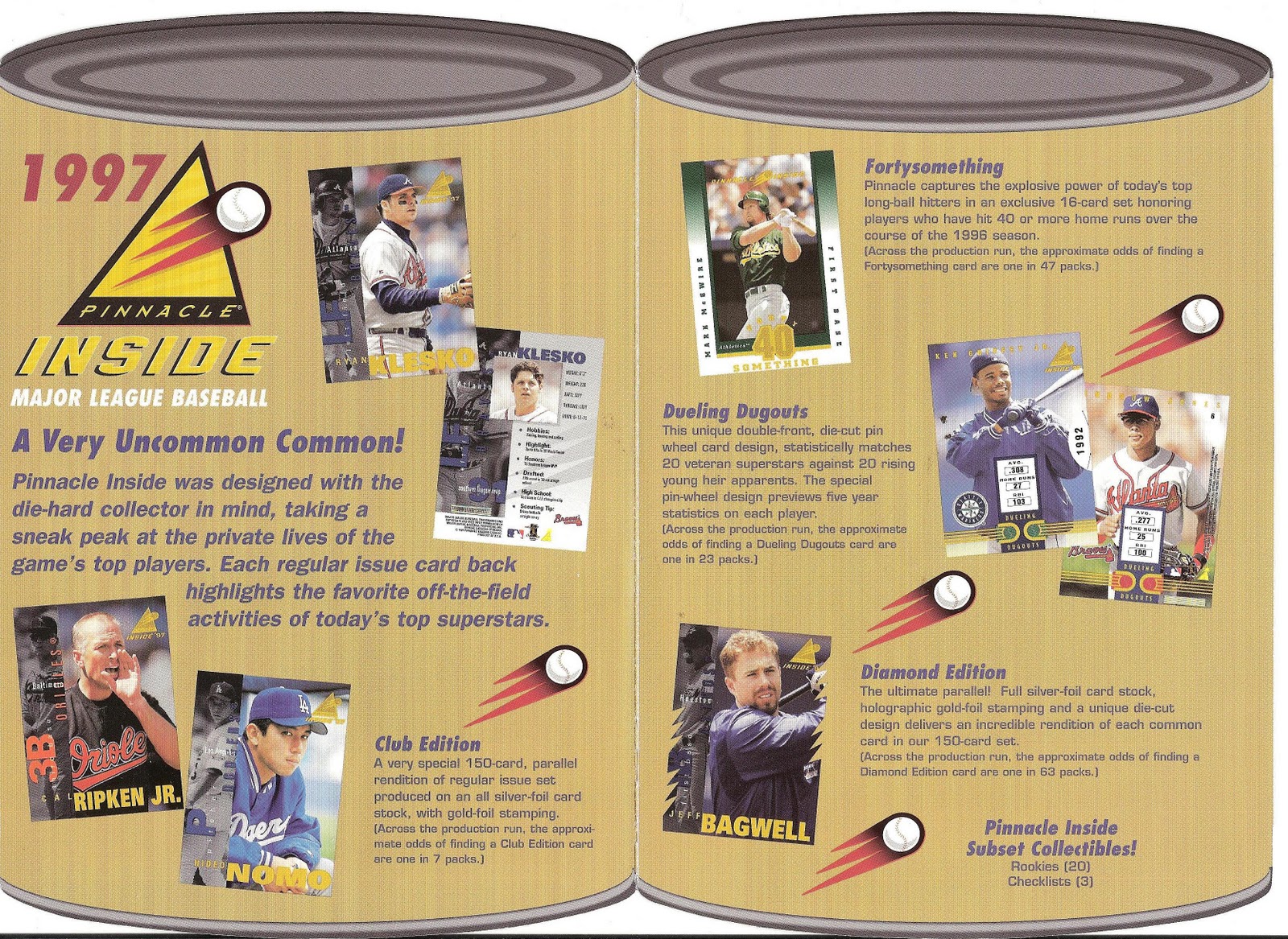
It was the day Pinnacle put cards in cans with Pinnacle Inside.

I know it may seem like untoward Pinnacle-bashing to subject a dead company to my rib-tickling scorn two weeks running, but you need to consider that 1) any company that puts baseball cards in cans has it coming and 2) I was part of the team that put the cards in cans to start with.

I can safely say from my padded cell inside my cozy little insurance company that I didn’t know what the hell I was doing. Neither, presumably, did any of the other members of the development team. In fact, I have no idea how cards in cans got past joke stage. I’m pretty sure no one on our team had the idea spring full-blown from their forehead, like Zeus birthing Athena. I don’t remember a product meeting where someone came out of the bathroom and said, “Hey, guys – let’s put cards in cans!” Meth on a stick I remember. But not cards in cans.

I’m guessing the way it happened is the way a lot of things happened in trading cards in those days. Once Upper Deck hit the scene, printers pretty much called the shots in the card business. If you were a printer and had a special technique for embedding diamond dust into football cards, Fleer was sure to be on line one and Pinnacle on line two. And Playoff was in the lobby, fishing around in its pockets for a dime.

Companies that owned their own printing plant had a leg up in this trading-card space race, unless they printed BP gushers of cards like Pro Set, or only printed in colors dogs could hear, like Upper Deck, or were so all-in on one funky technology that they couldn’t cope with anything else, like Action Packed and Sportflics.

I’ll bet my co-worker’s farm that the way cards in cans happened was that some printer simultaneously printing cans and cards messed up and accidentally put the cards in the cans.

It was one of those chocolate-and-peanut-butter moments where the guy with the cards and the guy with the can looked into each other’s eyes and said, “Let’s call Pinnacle!” And Pinnacle said to us, “Make it collectible, boys.”

Lord knows we tried. I mean, we had plenty to work with in an abstract sense, Gremlin-era butt-ugliness and Kim Jong Il autograph-model illogic notwithstanding. We had cans that could show the same image printed differently in varying levels of scarcity. We had a chase called "Duelling Dugouts," which I'm pretty sure I had nothing to do with. We had the most self-evident product name in trading-card history. And we had cards inside the cans that ranged from one-in-ones up to one-in-83s. The elements were easier to manipulate than a Republican Congress; as a collectiburger it had the Arch Deluxe beat eight ways to the golden M.

However, as noted card expert Junie B. Jones would say, yeah, but here’s the problem: It’s Dare to Tear all over again.

For the life of me, I don’t know how we could have let Pinnacle believe that destroying one collectible to save another was not the card-biz equivalent of invading Afghanistan with a dumptruck full of asphalt and a road roller.

Collectors have never, ever, ever seen the logic in destroying one thing to get at another. They don’t eat eggs for that very reason. They won’t even take a fingernail to their Kohl’s mailer to unleash their 15 percent discount. And I am dead-on certain that somewhere in this great Hole-Digging Mutant-Weasel State a collector is hoarding unused four-year-old lottery tickets because they might be valuable someday and, hey, the gold smears really make those cartoon billiard balls pop.

And furthermore, cans have never been a big part of the sports-collecting oeuvre. There are all kinds of soda cans from the ‘60s and ‘70s featuring athletes, and they’re about as collectible as a macramé kit. Why? They were never a part of anyone’s essential childhood memory package; they were just cans with guys’ pictures on them that were floating around for a little while. And I can tell you from personal experience that no one bought a can of Dr. Pepper because it had Carmen Fanzone’s picture on it.

So what you have with Pinnacle Inside really is an extremely tangible non-collectible with marginal collectibles sealed inside. And a company bankrolled by The Money Guys Who Brought You Enron not understanding why the heck these puppies aren’t flying off the shelves like brisket sammiches.

Oh, yeah, this too: We never gave people an easy way to get into the cans.

I can take my Olympia Beer “It’s the Water” can opener and punch a hole in the lid, but when I do baseball cards do not pour out. There is no opening tab, easy or otherwise, that grants you access to the golden succor waiting within. What I have to do to my can to get at the baseball cards inside my can is grind a clamp-and-twist can opener across the top, peel back the jagged metal, and resist the urge to scrape it across my wrist as I withdraw the cards.

Sure, I could cop out and use a Sawzall, but if you’re relentlessly old-school enough to collect baseball cards you’re not going to use an seven-horse power tool on the stinkin’ wrapper. You’re going to open it by hand, even if results in five stitches in your thumb.

(For the record, hand tools like crosscut saws, splitting mauls, or railroad spikes driven just below the lid with an eight-pound hammer also do the trick.)

Hard to believe, but I had forgotten about cards in cans until last week. Blocked it out of my memory entirely. But now that it’s back I am suddenly struck with a powerful urge to return to those halcyon days … of last week.

I know how to go make it happen, too. Just move the spike a little more to the left … a little more … just a touch … there. Now … SWING!

Ahhh. That's better.

Wednesday, September 15, 2010

Can't Bear To Tear

I was going to write about non-sports cards this week and for several weeks after, since non-sports cards are like uranium 235 for people who write about wretched trading cards. You just need a small amount and you can go on forever. And then you discover you can’t even bury the waste in a mile of concrete without defiling the territory in a hundred-mile radius.

However, this noon as I was buying a hockey puck for my son to autograph with a silver Sharpie I also had to purchase, I remembered a sports card set so surrealistically counterintuitive, so virulently anti-collectible, so Marilyn Mansonesque in its appearance and so much like a Jennifer Lopez movie reduced to trading cards that to not write about it would be like watching the Concorde take off and not saying, “Mommy, look at the big airplane.” Even if you were watching it take off with a group of 55-year-old men. During your job interview.

And the greatest surprise about this set is that it was not designed by Jeffrey Dahmer and the Unabomber during Choice Time but by a group of reasonably sane and mature individuals that included … well, me.

This set is, of course, Pinnacle Zenith.

I have to specify which Pinnacle Zenith I’m talking about, since Pinnacle Zenith, like every good and true trading-card brand created during the Great Proliferation, was worked over more times than Yosemite Sam on a pirate ship.

Pinnacle initially created brands to a certain logic. Score was at the bottom, the card set for the masses. It might be worthless, but it was quality worthless, with chase and color and readable backs. Score was the card set you’d find at the checkout at the Gas ‘n’ Gulp if you were only going to be finding one.

Score Select was a smaller set, more restricted clientele, but still Score -- like a McDonald’s that took reservations. I once told Pinnacle’s vice president that Score Select was like mid-grade gas, and who buys mid-grade gas? He was a packaged-products guy; he got it, and even repeated my line for the higher-ups. But Pinnacle kept making Score Select anyway.

Pinnacle was upscale but not up-upscale – Cape Carp instead of Cape Cod. You can spend $7 for an ice-cream cone there but you won’t see any Kennedys.

(True story: When Pinnacle was bought out by the Bass Brothers and moved to Dallas, the name changed from Major League Marketing to Pinnacle Brands because Jerry Meyer, Pinnacle’s president, said, “I always wanted to run a company called Pinnacle.” I wonder what would have happened if he had wanted to run a company called Zenon Andrusyshyn.)

Pinnacle Zenith was theoretically at the top of the Pinnacle ziggurat. Now, don’t ask me how you can fit a zenith on top of a pinnacle, and make room for Score Summit besides. I’m lucky if I can keep a pop can upright on a table until it’s empty. Zenith took its cues from Fleer Flair and Stadium Club, so it was about a dozen cards to the hundredweight, and more encrusted with gold than the lead table at the Boca Raton Bridge Club.

So far so good. Score-Select-Pinnacle-Zenith: Nice progression. Would have made the boys from GM proud. But then a green little greed reared its head, and while it looked exactly like Larry King, spray-on hair and everything, it was actually an IPO. Pinnacle wanted to fatten its bottom line and then go public, so the Bass Brothers and their brohams could cash in their massive payday and pay Ross Perot his latest installment of shut-up money.

The way Pinnacle chose to get to the payday was to open the cardboard floodgates. More products at each level, and more of each. If Select did 20,000 cases before, the new print run was 40,000 cases, and find a way to sell them in so they still look collectible. Oh, and you have to buy 20 cases of cards in cans (if you don’t remember, don’t ask) for every case of Zenith.

Maybe the trolls who hid art treasures from the Nazis in a salt mine could have buried those 20,000 cases of Select, but neither Pinnacle’s sales force nor its customers could. Pinnacle’s fortunes turned like T.O. on Donovan McNabb. Within 18 months the company was on its last legs, holed up in the bunker, and reaching for cyanide capsules designed as last straws. The straw it chose for Pinnacle Zenith was dubbed Dare to Tear.

The concept behind Dare to Tear is fiendishly simple: Seal a collectible card inside a super-high-quality envelope tarted up as a trading card. Have levels of collectibility for the envelope-card and the cards inside the envelope-card. Present collectors with a conundrum: Do I destroy the envelope-card to get at the card inside, or keep the envelope-card intact and never know what riches may lay beyond?

Wow. Randomly sticking five cards and a slab of gum inside a piece of wax paper looks pretty chintzy compared to that. Except for one thing: Collectors don’t like being put in a situation where they have to pay four bucks so they can destroy one card to get at another card. It’s like someone trapping your mother and your wife in a burning house, and telling you you can only save one. And charging you $25,000 at the door.

Collectors were barely over their moms tossing their ’52 Mantles, and now Pinnacle was taunting them with a super-sized nightmare card you have to rip in half to find … what? Junior Felix dolled up like Joan Rivers? A Jeff Blauser holofoil? It was too much for their fragile constitutions to handle.

Of course Dare to Tear was a debacle. It was Pinnacle’s Little Big Horn. After Zenith the only person left at Pinnacle was Jeff Morris, who wandered from office to office turning on and off lights to make it look like there was business afoot. But here’s the funny thing: What made these cards so unpopular also made them collectible. Are there still extremely valuable (by the compromised standards of ‘90s trading cards) cards sitting inside jumbotronned Charlie Hayes and Chuckie Carrs? Unquestionably. And did people destroy reasonably valuable, and huge, Biggios and Pizzas so they could baste in the glory that is a base-level Jeff Fassero? But of course. The relentless logic behind Dare to Tear ensures collectibility for both levels, and the fact that two-thirds of the press run went to exacerbate global warming is frosting on the beater. Its only drawback – and it’s huge – is that Dare to Tear takes the premises of collectibility to their most uncomfortable extremes. Zenith laid bare for collectors the basic forces behind scarcity and value, and they couldn’t decide any longer to ignore the man behind the curtain. It may have been the most cynical product in the long cynical tail-off of the trading-card industry into its current doddering insignificance, but Pinnacle Zenith was also the most honest.

And I think I said the same thing, minus the doddering part, back when the product was being kicked around the table by bright folks like Morris, Chris Dahl, and Dean Listle. And I think they agreed with me. But you can’t lay down in front of a steamroller, you can’t stop time, you can’t pull the mask off the ol’ Lone Ranger, and you can’t argue with Texans with a bankroll. Dare to Tear became flesh – well, cardboard. And here we are.

All the way around, the world’s a better place because Dare to Tear didn’t take off. It wouldn’t have taken trading cards in a good direction.

Hey, reach over and hand me that Honus Wagner card, willya? I’m thinking there’s a Peek-A-Boo Veach inside.

Wednesday, September 8, 2010

Becooz. Just Becooz.

There is a trading-card equivalent to practically everything, including trading cards. The trading-card equivalent of trading cards is trading cards, and the trading-card equivalent of trading cards that are the trading-cards equivalent of trading cards is trading cards, and the trading-card equivalent of that is Sean Hannity beating on your skull with a hammer.

Yes, Virginia, there is even a trading-card equivalent to the age-old question, "How long after a breakup is the right time to start seeing someone else?" The correct answer to that question is 10-15 minutes, which is not the same as the answer to the trading-card equivalent of that question, which is, "How long after someone is retired or dead or good as dead (i.e., hitting below .270) is the right time to issue a set of cards showing no one else but them?

Just as there is an infinite range of answers to the first question, provided you have an atomic stopwatch, there is an infinite range of answers to the second question.

When the subject of the set is Sam Horn, the correct answer is there is no correct answer. Never is the right time for a Sam Horn set. For Star Company, the Sam Horn set was a spurned suitor who chooses a life of celibacy over more heartbreak, which brings to mind a fantasy-baseball story.

Scheduling issues had made it so the Krause Publications fantasy-baseball draft was to be held on opening day. Though this was in Iola and long before the ascension of the sports bar, there was a TV set above the bar at the Lakeview, and the drafters were paying attention to the game, the Red Sox and the Orioles, between picks.

This game just so happened to be the solitary game when Sam Horn transmogrified into Babe Ruth. He cranked three homers that day, prompting one of the Krauseites to jump on Horn in about the third round.

Naturally, that was it for Sam Horn for the year, but the picker remained defiant. He had gotten enough home runs out of Sam Horn to win his matchup for the week. He was happy and secure in the knowledge that everyone hated him anyway, even without dragging Sam Horn into it.

When the same thing happened even more inexplicably with Tuffy Rhodes, a Krauseite picker was all over him, too. But that person eventually regretted his choice. Besides, no one hated him.

Focus, Kit, focus. The reason this question is asked is not Sam Horn but someone who was as far removed from Sam Horn as you can get without leaving town. This player was epochally great, a winner, bald, and old. We are of course referring to Bob Cousy.

In Boston the right time to issue a Bob Cousy set is ... what time is it now? Bob Cousy and Bobby Orr are all the Beantowners need for life besides beans. And for Fenway Park to remain the charmingly anachronistic dump it is now, with bathrooms that make Adrian Beltre yearn for the slums of San Pedro de Macoris. And another world championship for the Celtics over the Lakers right now. Wait for basketball season, my eye. Oh, and something involving a Kennedy, any Kennedy, even Ian.

Sorry; back to Cousy. Bob Cousy has never been shy to admit that Bob Cousy was the greatest thing to happen to basketball since they booted the women in bloomers off the court. In this regard he is the basketball equivalent of Bob Feller, who we wish a speedy recovery while also noting that he never met a baseball that he didn't think could be improved by the addition of his signature. And that'll be 55 bucks, sonny.

Therefore, a Bob Cousy commemorative set – commemorating what? Oh, any old thing – is in Cousy's mind a capital idea.

In all fairness the set was not positioned as a commemorative set but as the "Bob Cousy Card Collection," which implies that it contains as many cards as my collection, which is somewhere in the millions, even if you leave out the Star Sam Horn set, which suffered fatal injuries by throwing itself in front of a rogue shredder, sacrificing its life to save the lives of its fellow (and much more valuable) cards, including its special friend, the Aurelio Monteagudo Traded card.

And seriously, the fact that this set is devoted to Bob Cousy means there are highlights aplenty, as opposed to the Sam Horn set, which by card three is delving into Horn's exploits with sunflower seeds in Pawtucket.

The Cousy cards are not unattractive, if you like rummage-sale signs. The fact that this card is a numbered specimen from the "Preview Edition" means its value has appreciated from nil to twice nil.

Listen: Cousy was a great basketball player – one of my favorites, truth be told. There would have been a Pete Maravich had there not been a Bob Cousy, but we would have deprived the ill-informed of the opportunity to say otherwise. But the question resonates like the bells in the Old North Church: Why Cousy? Why not Mantle or Mays or Orr or Russell or Williams (who, in all fairness, had his own card company) or Schmidt or Killebrew or Aaron or anyone but Cousy?

Simple: 'Cause someone with a little bit of money convinced Cousy it'd be a good idea. That's how it usually works, and that's how it worked here. That's how it worked for Sam Horn, too. And that's where the similarity ends – even in Boston.

Wednesday, August 25, 2010

Mush, So To Speak

Sometimes the problem with cards is not want-to but how-to.

Now Comic Ball -- that was a want-to thing. Comic Ball had more creative talents behind it than a Beyonce album. It assembled the maker of the world’s most collectible trading cards, the world’s largest media conglomerate and the best animator in cartoon history, fed them carloads of cash, and in return got Ishtar. Or for those of you needing a more recent frame of reference, The Last Airbender, Jonah Hex, and The Losers, remade as musical comedy.

It wasn’t that Upper Deck didn’t know how to make good, honest collectible cards. Whoops -- scratch that. It wasn’t that Upper Deck didn’t know how to make collectible cards. It was all about making collectible cards. And color correction. And slipping cases off the loading dock to certain very special dealers.

It was just that for whatever reason -- creative meddling by Warner Brothers, shuffling the project to the new kid, the person at Upper Deck in charge of collectibility being out that day -- Comic Ball was three years in the wilderness with Bill O’Reilly and Glenn Beck, and nothing to eat but haggis.

Harness Heroes, on the other hand, was 180 degrees removed from Comic Ball. Harness Heroes was created by a printer and someone who knew something about horses, possibly one in the same but most likely not. You can tell that a printer had a hand in it because when you look at the quality of the paper and the printing embellishments it screams “sample book!” Speaking as someone who has spent the last three years trying to convince local printers that trading cards need to be printed on paper at least thick enough to not fit between your front teeth unless you are Lauren Hutton, with Harness Heroes the printer was driving the bus. Or the starting gate, in this case.

And that brings things around to the Iditarod set.

Most of you have likely never heard of an Iditarod set, but take it from me, they’re all over Nome.

The set shows the sled-dog racers who compete in North America’s most grueling sled-dog race, and relax fans of large soulful eyes, each a different color: It shows sled dogs too.

The set is an extremely curious mix of Big League Cards and cards inspired by Big League Cards, which is like being inspired by a ABBA karaoke record, but that criticism aside, the non-Big League Cards parts of the Iditarod set were screwed together admirably. The fronts are on the front and the backs are on the back.

The makers even took a huge step toward ensuring collectibility by having the people pictured on the cards autograph their cards.

Only half of them signed their cards on the back.

I’m sorry, but this is like putting the senator from Louisiana in charge of raking tarballs out of the Gulf, minus the entertainment value inherent in his explanation of how building a four-lane highway from Lafayette to Shreveport helps the oyster beds.

Did the Yankees’ clubhouse boy sign “Best Wishes, Babe Ruth” on the backs of the 8x10 glossies? When you walk into a really old Holiday Inn, the kind with a lounge, and look at the autographed pictures of the Captain and Tennille impersonators on the walls, are they autographed on the back? A pleasant thought for certain, but in general not bloody likely.

I really do like my pictures of Libby Riddles and Joe Redington Sr., the “Father of the Iditarod,” a title which leaves him only 49.85 states behind George Washington. I really like the fact that they’re autographed. But I really would love them if they were autographed on the front.

But I know I’ll be swimming with the oysters before that happens.

Friday, August 13, 2010

Ringworms

Does any guilty pleasure make us guiltier than watching two people smack the nasal discharge out of each other?

That must be the case, because over the last 60 years we’ve come up with allowable ways to indulge our habit while simultaneously painting boxing, the most natural and dramatic form of this pleasure, as brutal and inhumane. First it was pro wrestling, Gorgeous George Edition, and we convinced ourselves this was okay because it was only acting, and besides, Gorgeous George had his own perfume. How serious could that be? You put the sleeper hold on a guy who has his own perfume, it’s because he had it coming.

Then it was cartoons, and we convinced ourselves that was okay because cartoons were ostensibly for kids – but if they were ostensibly for kids, how come Tex Avery’s women all looked like they stepped off of the nose of a B-25?

Then it was football, with Hardy Brown and the snot-knocker and Night Train Lane with the clothesline, and we convinced ourselves that was okay because they were wearing protective gear, and besides, it was a game, like foursquare or tetherball.

Then it was wrestling again, Da Crusher Edition, and you couldn’t convince anyone that Baron von Raschke’s Claw could hurt a chipping sparrow, much less the ever-capable Kenny Jay.

Then it was cartoons again, then hockey, then wrestling again, the Ric Flair Edition this time, and then football again, and now it’s ultimate fighting, which has to be okay because one of its stars is named “Kimbo,” and there’s never been a violent anything where one of the major stars is named Kimbo. No matter that Kimbo will be walking around with a cranium full of guava jelly by age 40, if he’s not drooling his way around town in a power chair; boxing is worse.

More people profess a liking for Ron Santo as a broadcaster than like boxing. If boxing had a Facebook page it would be more friendless than the guy who was just pulled over for marinating a live cat in his trunk.

Furthermore, boxing titles are now like newspaper awards: If you place a sufficient amount of money in this box you can have one. And it isn’t even necessary to spell all the words right.

Boxing has certainly hit itself with a right cross. Gone are the days of the Sweet Science, when Red Smith and Bill Heinz fell over themselves in composing panegyrics to the likes of Beau Jack and Sugar Ray and Jersey Joe. Maybe the sportswriters went overboard in their praise, but just as you can close your eyes and imagine the spectacle they described, Firpo falling through the ropes and Max Baer, his big right hand numbed to the elbow, fighting for his own survival against Joe Louis, you can fast-forward your thoughts and imagine the extent to which television diminished it. It took the smoke, the sweat, the smell, and the spotlights and reduced it to two small, flat images beating on each other in a square. It sold beer and razor blades, but at a huge price.

Well, at least boxing cards had nothing to do with the sport’s downfall. Boxing cards peaked at the turn of the 19th century and have been declining ever since.

Blame it on the audience. Boxers sold the product when the product was tobacco. Chewing gum? Not so much. The kids who had money to spend on a card-gum combo didn’t go to sleep with visions of knocking out Jack Dempsey dancing in their heads. Those were the dreams of the desperate, the street kids, the potato diggers, the kids with cardboard in their soles and chips on their skinny shoulders.

But for the last 130 years seemingly everyone has taken their poke at boxing cards.

Topps has taken several swipes, in the ‘50s and now. Goudey threw a few boxers into its Sport Kings set, and Leaf did boxers in 1948, so the field has not gone unplowed. And naturally, the heady atmosphere of the Handful o’ Landfill days convinced plenty of fledgling cardmakers that a pot of gold rested at the end of a rainbow-colored squared circle.

Never mind that the '90s were to boxing what Kansas in the '30s was to sustainable agriculture. Let’s start with Brown’s Boxing Cards because they sound so … well, friendly. Sort of like Grandma’s Boxing Cards.

Unless the product being sold is pickled, or meant to be enjoyed while listening to sitar music, calling something “so-and-so’s this or that” is not a good indication that this is a ready-for-prime-time player. The only exception to this is Madison’s Lively Stones, which is a gospel band comprised entirely of trombones. I’m not sure what to do with Madison’s Lively Stones.

Or Brown’s Boxing Cards, for that matter. In the great folk-art panorama of boxing issues domestic and imported Brown’s Boxing Cards were the painted plywood cutout of the bending-over grandma, bloomers and all. They were grade-Y cards of grade-Z fighters – what Joe Louis used to call “The Bum-of-the-Month Tour” – so they were better than you had a right to expect, but ultimately not very good at all.

After Brown’s came AW, which invested the money it didn’t spend on Rocket Ismail and the Canadian Football League on boxing cards. All told, AW Boxing was as fine a set as one could make for $14.25 Canadian.

Next up, Kayo. Kayo will be given its full measure later, when we tell the heart-stopping story of the Spring Professional Football League press release, but suffice it to say that Kayo did for boxing cards what Little Sun did for sportswriters: treated them extremely well to no effect. Kayo was the set that took in the mysterious lodger believing him to be the king in mufti, fed him the fatted calf, plied him with the old claret, and put him up in the feather bed, only to find in the morning that he was just a petticoat salesman from Dorset. Kayo cards looked nice, showed a reasonable assortment of fighters, included some Leroy Nieman art cards, sported a clean-but-unspectacular design, and had attractive, fact-filled backs, but had nothing after that first punch. Kayo couldn't answer the question I still can't answer: What’s the proper follow-up to a set full of big-name fighters – another set full of big-name fighters? How many Buster Douglas cards does a body need? For Kayo, the answer was a resounding, "One, I guess” – and then it was off to make skateboard cards. Love the kangaroo, hate the business plan.

Finally there were Ringlords. Ringlords had all the production values and all the big names, and a license from the quasi-official World Boxing Association besides, which even back then was worth more than a Ph. D. from the University Of The Spare Room Above The Drugstore. Even now the names in Ringlords resonate, in part because some of them are still fighting: Evander Holyfield, Julio Cesar Chavez, Hector Camacho, Pernell Whitaker, and the big daddy of them all, Muhammad Ali.

Ringlords threw a ton of money at boxing cards with the restrained logic of a Liberian presidential election. It sold its product as a complete set only – a recipe for disaster even back then – pegged the price at Fleer Flair levels, put an image of what appears to be a sleeping weimeraner on the box cover, and had no idea of what to do for an encore. Rarely was such a high-end set so justified in failing so abjectly.

I have nothing against boxing or boxing cards. I believe that submitting yourself to a left hook in return for the right to deliver an uppercut to the jaw is a valid career move. The boxing cards that came out of the Handful O’ Landfill days are certainly better and more justified than the Harness Heroes set. But the companies that made them didn't appear to be thinking clearly.
 
Maybe it was the last shot to the guzzle that did it.