Tuesday, May 29, 2012

Aw Pair

So here’s another handful o’landfill rescued from the storage-room floor.

If you remember the introduction to an earlier installment, I gave my son a box of hundreds of cards to teach him the value of a dollar and the valuelessness of trading cards. Looking at these cards has made me wonder, WHAT SORT OF FATHER AM I? WHAT DID THE BOY EVER DO TO DESERVE THIS?

While I figure out how I’m going to answer those questions before the grand jury, onward.


Making a card of a poster of a picture of a player reminds me of one of those parlor-trick pictures where Barack Obama is sitting in a rocking-chair by a fireplace reading a magazine with a cover showing Barack Obama sitting in a rocking-chair by a fireplace reading a magazine with a cover showing Barack Obama sitting in a rocking-chair by a fireplace reading a magazine with a cover showing Barack Obama sitting in a rocking-chair by a fireplace reading a magazine with a cover showing Barack Obama sitting in a rocking-chair by a fireplace reading a magazine with a cover showing … you get the idea. It’s a flavor of bottom-of-the-barrel-scraping, but I can’t tell whether it’s butterscotch or sarsaparilla.


The twilight of the draft-pick-card era actually produced some really nice cards. The problem was that the players on the cards continued to be steaming dung piles. Consider stonemason Tim Burroughs. According to his 1992 Star Pics card, Burroughs’ strengths were rebounding and scoring (not shooting) within 15 feet. According to his card, his weaknesses were shooting beyond 15 feet. According to pro-basketball-reference.com, Tim Burroughs had an NBA career of null, so maybe 15 feet was being optimistic, like when they say that the Decemberists create cerebral folk-rock when all they do is rewrite America songs with polysyllabic words. Discovering that Burroughs’ nickname was “T-Rock” was icing on the cake.


Designing trading cards has got to get old. I mean, you’ve got a box, and it’s small, and it’s got to hold a picture, a team name, a player name, a brand name, and a position. If it doesn’t contain all those elements in the right amounts suddenly you're the Ayn Rand of trading-card designers. And you need eight different designs for every set. I can totally understand why some of these frustrated artistes throw up their hands and say, “You want a name? Fine; there’s a name. Oh, you want a first name? Tough tinkles. You want a team logo? There. Nice big team logo for you, ya capitalist pig. A product logo? There’s your flippin’ product logo.” I absolutely get it. But you know, every card that uses a massive first name or a huge last name as a design element has looked stupid – even when it halfway makes sense, like it does with this Bruce Armstrong card from the 1992 SkyBox Impact football set. Check out the guns … Arm-strong … get it? Ha ha. I look at cards like this and whisper a prayer of thanks that they peaked too soon for LaRod Stephens-Howling.


Still, making a good-looking trading card is not hard. Even David Lipscomb College, the college with “tiny” permanently grafted in front of its name, could pull it off, for crissakes. The nicest thing about these cards is that they have the player's parents' names on the back, as in "Mr. and Mrs. Morey Joseph." All player cards should have this information. And how often they have meat loaf for supper.


I saw two-thirds of Ben Coleman’s games with the Bucks, and I can tell you for certain that the rock (as opposed to T-Rock) never, ever behaved like that when it was in his hands.


Repeat after me: Nothing good can come of a card showing a hockey player in a tuxedo holding a vase.


I’ve mentioned elsewhere that I really like the Canadian Football League. Actually, I just plain like Canada. It’s logical and doesn’t make me choose between a candidate named “Mitt” and a candidate named “Barack[1],” and it’s like that for everything except Canadian football, which plays like it sprung fully realized from the cleaved forehead of the Ways and Means Committee.

Canadian football is bizarre in ways that a sixer of Old Vienna can’t begin to explain. For instance, there’s a 50-yard line on either side of midfield. A 110-yard field? Why not make the Canadian yard 40 inches and put 50 of those yards on either side of the field? Also, the field is wider and the end zone is the size of a Walmart Supercenter. Maybe this has something to do with the fact that the end zones are open in most CFL stadia -- more opportunities to get the breezes -- but it also means the goalposts are on the goal line. That gives all the kickers Tom Dempsey range, and I suppose justifies the rule where a team gets one point if they miss a field goal, even though teams don’t want those points. They’d rather kick a ball out-of-bounds at the five than get a point for booting a ball out of the end zone.

Twelve men on a side makes sense; you can drink a beer per player with no leftovers. The everyone-in-motion thing also has more internal logic than the current American-football rules. Why not let two guys move at the same time? It’s not like the coaches and talent can’t adjust. And who wouldn’t love to see what Randy Moss could have done with a running start? Three downs instead of four means more kicking, and as you’ve already seen, the CFL loves kicking like Beyonce loves chain mail.

All this nonconformist stuff makes the CFL eminently entertaining but totally Canadian, so there’s no reason to export it to the United States. We’re not talking Crown Royal or the Barenaked Ladies here. However, because it is a sport that remotely resembles football, the CFL is the continual subject of one or another boneheaded export schemes.

There were the American cable-TV broadcasts in the 1970s, noteworthy for the halftime entertainment: Alex Karras roaming the stands talking to women. Then there was the American expansion of the 1990s. It made more sense than the Professional Spring Football League, but only in an abstract sense. The CFL plays better when you know that a williwaw is going to come screaming through the Canadian-Tire-parking-lot-sized end zone at 10:21 of the third quarter and decapitate Ken-Yon Rambo. There were also no toques in Shreveport in August.

The Handful O’Landfill era contained CFL-related boneheadedness, though let it be said that through most of those years a Canadian company called Jogo made CFL cards, and did fine. Nothing that grabbed you by the tonsils, but no football-card-and-candy-cane combos, either.

However, in 1991 L.A. Raiders draftee Raghib “Rocket” Ismail didn’t like the numbers the NFL was throwing his way and signed with the CFL’s Toronto (Countless Screaming) Argonauts[2]. This made sense for Ismail, since he was the least NFL-ready Heisman winner since Gerhard Schwedes. But Ismail was the Lower-48 hook marketers were looking for to open the floodgates and let the CFL crud come screaming down.

The lead screamer was AW (as in "All World") Sports. Hailing from the CFL hotbed of Brea, Calif., AW dropped $87.50 and a side of poutine[3] for a CFL license, quickly signed Ismail to an endorsement deal, and built a set around him.

When I say AW Sports built a set around him, that’s exactly what I mean. The 110-card set contained five cards of Ismail, plus a half-dozen cards of people peripherally associated with Ismail, like Toronto owner Bruce MacNeill and semi-recognizable name Pinball Clemons, in addition to a “Legends” subset that was strictly for south-of-the-border consumption, in that every player pictured (except for Toronto Argonaut and former Notre Damer Tom Clements) made his name with American fans in the National Football League. Otherwise the set was well-balanced if a botch aesthetically; if Amy Winehouse ever designed a CFL football set exclusively for Pamida, this is what they'd look like.

The AW set hit the U.S. market the way the Red River hits Grand Forks in April. Only the devastation was restricted to collectors.

After a Facebook-IPO-like flurry of interest the set plummeted like an Alouette.[4] The market reaffirmed the all-American virtue of projectile-vomiting anything threateningly foreign – like American-made cards of mostly American American-football players who play a few hundred miles north of here.

AW got a second year out of its Ismail deal before riding off into the sunset, too soon for the Las Vegas Outlaws and Shreveport Pirates. And Ismail eventually evolved into a decent if minute NFL wide receiver.

If timing is everything AW Sports had nothing. And if star power is everything, AW had Pete Giftopoulis. The times were brutal that way.


On the other hand, I feel eminently reassured and fortunate to be living in a world where someone named "Joey Knuckles" is spinning a wrench at the absolute highest levels of wrench-spinning.

Watch for another handful in a couple of weeks.


[1] It's not really a name thing. In Wisconsin we have a recall race between a candidate named “Scott Walker” and a candidate named “Tom Barrett,” and they’re a couple of dingleberries.
[2] Don’t you love teams with names derived from They Might Be Giants songs? When the NFL expands and creates the L.A. Blue Canaries in the Window By The Lightswitch, that’s the day I die with a smile on my face.

[3] I don’t understand why central Wisconsin isn’t all over poutine – brown gravy over French fries and cheese curds. The curds are 13 miles down the road, the potatoes five. The gravy we can figure out. I could see poutine crushing it at Riverfront Rendezvous. Especially when you chase it with a funnel cake.
[4] Per Red Smith’s obit of football coach Peahead Walker: “On his first evening in [Montreal] he dined with the football team’s owner and his wife. ‘By the way,’ he asked between the escargots and boeuf fondue bourguingnon, ‘what’s an alouette?’ “A bird, the owner’s wife told him. ‘The most ferocious of birds, king of the skies. It attacks and drives off hawks, shrikes, the eagle, anything that flies.’ It was two years, Peahead confessed later, before he learned the truth. When he did, he thought back to his dressing-room orations when he wanted to stir his warriors to a peak of savage ferocity. ‘Remember,’ he would cry, appealing to their pride, ‘remember – you’re alouettes!’”

Sunday, May 13, 2012

Houses of the HOLy

I grabbed another handful of cards that spilled out of a shoebox as I was reaching for a different box. Here are some of the wonders I uncovered.


I am 178 percent for historical accuracy. If a card company chooses to take up a fallen flag and make a retro set, and especially if it’s trying to flat-out copy an old set, it’s taken a blood oath to create not a Dart but a Challenger, an Historic Series Les Paul, a 50th-anniversary KitchenAid, a screw-for-screw duplication of the original. I want to open that case or sink into that upholstery and smell 1958, taste 1967, rub 1964 between my fingers.

Thankfully, the 1954-styled Topps Vintage cards take me there – and in the process they create the most worthless Joe Mauer card ever.

That’s not a bad thing. Oh no no no no.

The card, a takeoff on the so-bad-it’s-good Johnny and Jimmy O’Brien card from the original ’54 set, pairs Joe with his nominally baseball-playing brother Jake, who checks in below Henry Mathewson and Tommie Aaron on the Rotten Baseball Brother scale.[1]

The front’s not exactly the way they did it back in the day, but how many pictures of Jake Mauer in a Twins uniform – heck, any baseball uniform – kneeling side-by-each with his brother could there be?[2]

For forsaking collectiblity in favor of historical accuracy, Topps gets a big ol’ attaboy. And this card gets chucked – fondly – back into the commons bin.


One of this blog’s most popular entries, “Truly Comic,” starts with me asking, “Which property was more screwed up (and over) by trading cards: Disney or Looney Tunes?”

It’s clear from the evidence that of the Big Three properties done dirty by the trading-card biz – Looney Tunes, Disney, and Peanuts – Looney Tunes, via Upper Deck, got the short, filthy end of the stick. All the stars aligned and produced the trading-card version of John Carter[3].

Peanuts suffered from alienation of affection, and having its signature set made by a company called Tuff Stuff Productions. Disney wasn’t abandoned or mismanaged as much as niche-marketed to death.

You know how Disney operates: No matter how old you are, no matter where you live, no matter your socio-economic status or species or party affiliation or feelings about cilantro, Disney has a property for you. In a cup[4].

Little girls get Disney Princesses. Big boys get ESPN. Medium-size boys[5] get The Avengers. Native Americans get Pocahontas and Brother Bear. People of one color get The Princess and the Frog. People of a different color get Mulan. People of a still different color get Aladdin, with a tan Tom Cruise and Robin Williams sputtering gibberish, for the looneys. Navel-gazers get Dancing With The Stars. It’s still unclear to me who gets GCB – people who wished for Hee Haw with cheerleaders, I guess.

Disney (and its cardmaking partner, Impel) took that approach with its trading cards and finally ran afoul of the immutable rules of marketing. Its first set was fine – a general-interest Disney set, Middle America in Mylar, with a few character cards, some activity cards, some screen grabs from really old cartoons, and lots of that mysterious cultural icon, Mickey Mouse. Disney easily had enough material in the can for 20 years of such sets. But it quickly abandoned that approach in favor of a bigger target and the potential for much more money.

Impel followed Disney Collector Cards with a set called Minnie ‘N’ Me. Its purpose and positioning was clear: It was a trading-card set for girls – young girls.

I don’t know if you know this, but girls of any age do not make up a sizable percentage of the card-collecting population, here or abroad, ever. Girls and women have never shown an affinity for trading cards[6].

There are many theories as to why, but it’s simple to me. It usually only takes one 10-minute spin around the floor at any card show for a woman to be disabused of the trading-card habit for life.

Disney and Impel thought they had the power and the property to reverse this behavior. However, they were going up against the immutable power of fat, stinky guys in Keith Hernandez doubleknits scarfing longjohns with sprinkles.

So instead of doubling the size of the potential market for trading cards, with Minnie ‘N’ Me Impel and Disney actually cut the market for their product by somewhere north of 90 percent. And even the Mighty Disney couldn’t bust that dam. Not with Minnie ‘N’ Me.

Minnie ‘N’ Me’s failure takes me down another road. I can think of about a jillion for-girls products, and they almost all tanked – “tanking” meaning not doing nearly as well as a comparable “boy” product. Josie and the Pussycats: animated spies for girls. The Runaways: punk rock for girls. The Bangles: pop-rock for girls. Virginia Slims: Cigarettes for girls. Marvel’s Girl Comics: ‘nuff said. Tomboy Tools: Power tools for girls. Pink LEGOs. Romeo y Julieta cigars. The Pontiac Sunfire. Professional women’s softball. Professional women’s boxing. Professional women’s soccer. The WNBA.

Now think about “women’s” or “girls’” products made for men. I can think of two: GI Joe (in his original incarnation) and Just For Men. They’re fewer in number, but they have staying power. You might not take the Touch of Gray concession over the L’Oreal franchise, but GI Joe spawned action figures, and all the action figures in the world versus Barbie is a fair fight[7].

The fact that marketers (mostly men) keep feeling compelled to make “female” versions of “their” products to appeal to women says something rotten and sexist and unfair about our society. And I feel a little twinge of satisfaction each time one of those products bites the large Bratwurst of Death.


One of my favorite lines is that I was a very successful sports marketer even though all my clients went bankrupt. It’s not my fault, I claim. I never told them putting cards in cans was okay.

In the interest of full disclosure, you should know I was wrong occasionally. Especially when it came to stickers.

I was absolutely, dead-solid convinced that over time stickers would supplant trading cards as a hot, valuable collectible. My logic was okay: Older trading cards derived much of their value from the fact that they were designed not as a collectible but as a commodity, to be used up and disposed of. Stickers are designed to be stuck on something. Once stuck, they lose their value as collectibles. They have the permanence of magnesium exposed to air. They drip production-for-use.

I envisioned a world where sports stickers were stuck on everything from Louis XIV highboys to “Expos Fan Parking Only” signs to Mayim Bialik. What I wasn’t counting on was collectors giving stickers the same open-armed welcome Axl Rose extended to the other members of Guns ‘n’ Roses, and sticker companies like Panini responding by printing 12.69 billion of each sticker.

There’s hope for stickers, but only if the government gets involved and encourages sticker-based vandalism – but positive sticker-based vandalism, with stickers being applied to unobtrusive places, like inside the lids of dumpsters.

I see a spate of public-service announcements with a tagline guaranteed to hang on people’s lips for eons: “Stick it where the sun don’t shine.”

Don’t tell me you didn’t see that coming.


The best that can be said about the Star Company Gregg Jefferies set was that it’s better than the Star Company Sam Horn set. The Horn set represents the nadir of A) relatively good-looking cards of B) a major-league baseball player because it took 13 cards to say what Topps could have said in one, with space left over to show a cartoon fish with a bat in his fins trying to hit a curveball. And because it’s Sam Horn.


You know how far society has come? When basketball cards really took off and the NBA got into the act personally with NBA Hoops, the league issued an edict to cardmakers: If a player has a tattoo you can’t show it. Get rid of it. Airbrush it.

This was not a big deal to Upper Deck, the company that considered card photos merely a muted suggestion of what might be. But in the case of Dennis Rodman, the result was semi-otherworldly. On TV he looked like an escapee from a Tad Browning movie; on cards he looked as clean as a No. 2 pencil in a singlet.

The disparity did not go unnoticed, but the NBA managed to plead ignorance (“It’s just the flash they use – yeah, that’s it”) for several years until the number of NBA limbs bearing Bible verses, gang symbols and ex-wives’ names reached critical mass. And Shaq put the Superman logo on his bicep.

These days, when players have entire encyclopedias inked on their person[8], by the time all the tats were airbrushed from all the photos in all the sets LeBron James would be 58, and looking like Redd Foxx with a wingspan.

The NBA admitting that it has a body-art issue is progress of a sort. I’m just not sure what sort.


I’m still wrestling with the notion that a picture of a truck that hauls a car that is driven by a driver in one direction around a track can be collectible, but a sticker of an actual player actually playing an actual sport can’t. Maybe I’ll figure out why by next time. But don’t bet on it.


[1]Though it does score the Twins 25 points in the Take Care of the Homeboy No. 1 Draft Pick Sweepstakes, placing them 1,893 points ahead of the San Diego Padres. Also, no matter how bad Jake Mauer is, he’s gotta be better than Ozzie Canseco, Pete Rose Jr., and John Henry Williams. Combined. 
[2]Further information on the Mauers was supplied by erstwhile Twin Citian John B. Seals, who points out that “Joe's brother Billy now sells Chevrolets.” To which I reply, “Well, of course he does.”
[3]Or more to the point, Looney Tunes: Back In Action.
[4]Thank you, Wall-E.
[5]Talkin’ mental age here.
[6]And yet they call them the weaker sex.
[7] Until they come out with MMA Barbie.
[8] You want to know the real reason Encyclopedia Brittanica quit printing? It wasn’t because the Internet wrecked their business. It’s because you could read it all on Marquis Daniels.


Saturday, April 28, 2012

The Faces on the Storage-Room Floor

I spilled a shoebox of cards while I was taking a shipping box out of our storage room. The shoebox contained thousands of mixed cards I had given my son in an effort to teach him the value of a dollar and the valuelessness of trading cards. As I was picking up the cards it struck me that many of them epitomized what Handful O'Landfill is all about. Let's have a look.


Card companies viewed promo cards the way the Nixon Administration viewed marijuana: As a stepping-stone to harder drugs. The conceit went that you took eight big stars and hot rookies, made cards of them in your upcoming design, stamped “promo” on them, and sent them to a strictly limited list consisting of the hobby press and key distributors … and card-store owners … and the players … and the league … and the teams … and people who attended major shows … and veterans … and people who opened the packages of floppy disks good for 30 free hours of America Online … and buyers of SmurfBerry Crunch cereal … and death-row inmates. And then those people would peddle their promo cards to other card-store owners or distributors or show-goers or America Online users or cereal eaters or death-row inmates, with ever-decreasing success.

Most promo cards found their equilibrium of worthlessness only after the set they were created to promote had long ago sold through. They were cardboard mayflies, giving up everything to perpetuate their species.1

None of which explains this 1991 Donruss promo card of Scott Chiamparino. I cannot recall a time when Scott Chiamparino was considered either a hot rookie or a big star. My contemporary impression of Scott Chiamparino was the same as my current impression of Scott Chiamparino: He was Andy Replogle without the ‘fro, or a really tall Brittany spaniel with a cutter. His most significant carrier accomplishment was being traded (with Joe Bitker, who also could have been Scott Chiamparino, if he’d only had the breaks) for Harold “Cooperstown” Baines, then in the Moses-in-the-wilderness phase of his career prior to heading back to the promised land of U.S. Cellular Field for the second of three stints filled with opposite-field doubles looped over Carney Lansford’s head and innumerable ground balls to first base.

Chiamparino’s ability to build demand for Donruss trading cards was like Ryan Braun’s ability to play third base: Just because you put him out there doesn’t mean he’s any good at it.


I work out in the mornings, starting around 4:30. Since I may be doing the official book on the SAW movies 2 and have seen none of the movies, I use this time to watch the movies. I don’t savor these movies in quite the same fashion as their fans 3. I run the movies at 8x so I can say I’ve actually seen all seven before I start writing the book.

A bonus of running the movies at 8x is that the dialogue doesn’t get any less unintelligible at that speed, so I just turn off the sound and substitute music instead. Right now I’m listening to a lot of African music, particularly the Indestructible Beat of Soweto series. And because the SAW movies can be hard on the eyes, I read. The current book on the stand is Roy Blount’s About Three Bricks Shy of a Load.

So when I say that riding a stationary bike and simultaneously doing weight work while reading about the 1973 Pittsburgh Steelers, watching new-age garrotings and listening to Ladysmith Black Mambazo is nowhere near as bizarre as the idea of former U kicker Carlos Huerta as an Upper Deck Star Rookie, I’m speaking from experience.


There are two object lessons here.

The first is that not everything in the Handful O’Landfill era sucked. For all the trading-card equivalents of Stars On 45 medleys there were equivalents of “Dim All The Lights,” and that was reason enough for card companies to green-light projects that today would be called boutique or artisan or bespoke or some other word applied to mass-produced stuff to make you think hands touched it in a meaningful way.

Pro Set was the Papa Doc Duvalier of trading-card manufacturers, but it was capable of quasi-bespoke stuff. The Parkhurst “Missing Link” set, for instance.

When Pro Set bought the Parkhurst name, it first made a hockey set that paralleled what Donruss was doing with Leaf: Nice quality, foil, slick thick paper, but no whiff of the attributes that made Parkhurst Parkhurst. It was like Hyundai buying the Packard name and slapping it on a Sonata.

It’s impossible to see what hockey collectors love about classic Parkhurst cards unless you’re a hockey-card collector, and then it’s so blindingly obvious that you can’t explain it to anyone who can’t see it.

Classic Parkhurst cards look like they were made with Photoshop for Daguerreotypes. Players are silhouetted on plain backgrounds, or backgrounds with Canadian or American flags depending on the location of the team 4, or backgrounds with fake crowds. The earliest Parkhursts disavow art entirely. They’re trading cards at their most primal, a picture glued to a slab of cardboard. That endears Parkhursts to hockey-card collectors the same way that Charley Patton excites fans of rural blues and hollers. It’s populist culture as opposed to pop culture, and the irony is that most people don’t like it.

Missing Link cards (the name refers to the fact that in 1956-57 Parkhurst, for no particular reason, decided to not make hockey cards) get the details right. The typography is just crude enough. The photos are just grainy enough. The cardboard is raw enough. The backs are bilingual. The wrappers feel like wax paper. If Missing Link cards were a guitar, they’d be a Gibson Les Paul Standard reissue. And they’d cost $5,000.

These things work together to make the Milt Schmidt Missing Link card the best card of a hockey coach since the 1964 Topps Casey Stengel card, and that’s the second object lesson.

Not all manager cards sucked. When we were kids collecting baseball cards, we absolutely could not figure out manager cards, especially Walter Alston cards. He looked like Walter Brennan’s idiot cousin. Luman Harris looked like Phil Harris, rum nose and everything. Herman Franks was fat. Don Heffner was ancient. Harry Walker pointed at nothing in particular. Even the green-stamp-sized B&W photo of Joe Kuharich on Philly Football play-of-the-year cards was overkill.

We never came up with a satisfactory justification for manager cards until we subsequently got our hands on a ’64 Topps Stengel, and much later pulled a Milt Schmidt out of a perfectly reliced Parkhurst pack. Manager cards could be cool, but it took a run-of-the-mill card out of a fringe product from the junk-card era to prove it.


On the other hand, nothing has ever come along to convince me that NASCAR cards of crew members are a good idea.


What I love about real minor-league cards – the sets you buy at the concession stands in Ogden or High Desert or the Quad Cities – is that they don't pretend to be anything other than what they are. They're cards of a team of slightly-better-than-college players that are together for a year and then are scattered, up, down or sideways. You can't break the set and buy the card of the first-rounder; it's the whole set or nothing.

Cards like these make me think of the semi-supergroup Little Village. No one really wanted Jim Keltner, John Hiatt, Nick Lowe, and Ry Cooder to form a band. They wanted the individual musicians to play on each other's solo albums, but they formed a band instead. That was Disappointment No. 1. Disappointment No. 2 was that once they got together they didn't stay together. They made their music, toured a little, and broke up. And their album wound up in the cutout bin.


Every pop-culture bucket goes through at least one retro phase sometime. Bruno Mars at the Grammys. Dave Grohl at the Grammys. Hell, everything at the Grammys 5. Pac-Man for the iPhone. Newsweek’s Mad Men issue. The Fiat 500. Anything on Broadway that makes money. Mitt Romney.

Sometimes retro is apropos of nothing: Miami Heat throwback nights. And occasionally the retro phases overlap each other until your head throbs with the cognitive dissonance: The Artist overlaid with My Date With Marilyn overlaid with The Three Stooges overlaid with the Dark Shadows remake 6 overlaid with the Battleship make overlaid with the continued existence of Scarlett Johannson despite any evidence of, you know, movies.

Trading cards had their retro moment in the middle of the Handful O’Landfill era, where cardmakers desperate for line extensions realized there were unclaimed old marques that held real heft with collectors.

At that point the race was on. Topps dusted off Bowman, which it had deep-sixed for 35 years. Leaf reclaimed Leaf. Fleer snatched Goudey. Pacific grabbed Philly Gum. Pro Set took Parkhurst and Pinnacle nabbed Bee Hive. No one took U.S. Caramel or Middy Bread, but Topps took the more generic T206 and created the first trading-card set whose namesake was a catalog designation used to index tobacco cards.

Most of these sets were pretty good. They varied in slavishness from Dodge Challenger to Chevy Camaro, but for the most part they got what collectors were looking for from these cards.

For the most part. Score Heads-Ups were an exception.

Heads-Ups were inspired by the Goudey Heads-Ups of 1938 that in turn were inspired by the Player’s Cigarettes cricket cards of the late ‘20s and early ‘30s. Those cards had a rickety, loopy charm that was the result of someone sitting down at a drafting table and drawing them, exaggerating noses, lengthening teeth and stretching out chins to get the point across 7. By contrast, the artist of the Score Heads-Ups appeared to be Commodore 64. They were caricatures without irony or exaggeration, just a slightly larger (but appropriately proportioned) head placed on top of a slightly smaller (but appropriately proportioned) body. Score had the chance to really hit baseball's top players with a double short of reverse andro; instead, they wasted scads of time and money on a subset of caricatures that were less distorted, anthropomorphically, than Woody Allen.


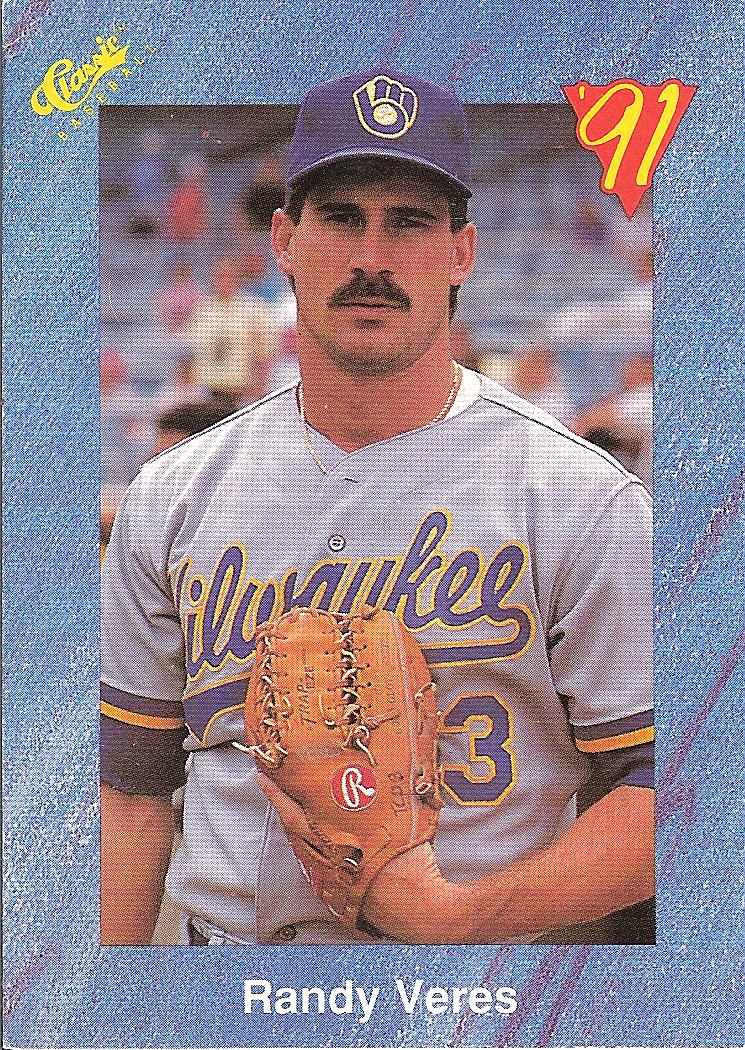
I don’t think anything captures the through-the-looking-glass oeuvre of the Handful O’Landfill era better than this: Classic made a crapload of money selling cards of players like Randy Veres. Even Instagram can’t top that.

Bye. I'll see you when I spill another box of cards.


1 Which really sucks in the case of a set like Donruss Top of the Order.
2 Don’t laugh. There’s money involved.
3 I know SAW fans exist because there will soon be a second SAW movie cruise. The cruise lets fans interact with a half-dozen SAW stars and starlets, and have their picture taken with the puppet from the movies. The guest list also includes the star of the Texas Chainsaw Massacre remake, but I don’t like that idea. I’m afraid he’s going to go over like Mel Gibson at a Frankie Goes to Hollywood concert.
4 And not the nationality of the player. In the NHL of the ‘50s, everyone came from Canada.
5 Except for Nikki Minaj, who is a more frightening animated character than any of the Tom Hankses in The Polar Express.

6 That may or may not have contributed to the death of Jonathan Frid.
7 In the case of the cricket cards, the caricature artist "RIP."

Tuesday, April 17, 2012

May B-Force The With You. Or Something Like That.

I know. I promised. I was done, I said. Done, do you hear? No more Handful O’Landfill. Ever. Again.

But this stuff, it’s the pretzel M&Ms of the collectible world. It’s candy-covered cocaine, deep-fried in methamphetamine. With Katy Perry playing in the background.

It doesn’t matter that the number of people who publicly or privately bemoaned the disappearance of “Handful O’Landfill” was none, as in zero. That would presume I write this stuff for an audience, to which I say “Ha!” and “Double ha!!” I could bloody care less if the only creatures consuming my work are cicadas.

So I was cleaning up my office-slash-guitar-repository when I stumbled upon the “Miscellaneous Non-Card Baseball” file immortalized in “Happy Baseball Freaking Birthday,” one of my favoritest columns ever, and peeking out of the top was a Nolan Ryan Baseball Superstars comic book. It started me thinking, to the tune of, “Well, it’s not a card so I could write about it because I said I wasn’t going to write about cards anymore,” and the next thing I knew I was in a strange pharmacy with Ryan Leaf, trying not to confuse the Ex-Lax and the oxycodone.

I stumbled to work in an attempt to get straight, but right behind the folder marked “PPO Dentists” was a B-Force comic book featuring non-combatants from the 2003 Milwaukee Brewers fighting spit tobacco, and darned if I wasn’t discovered an hour later in a diabetic coma, surrounded by mounds of Reese’s Peanut Butter Egg wrappers.

Sorry. I’m the Steve Howe of non-bloggers. When you set a B-Force comic in front of me I’m going to do a triple solchow off the calliope in my haste to say something snarky about it. I’m weak that way.

We’ll get to the snark momentarily, but first a little trading-card PBS-ness. Send me money or I’ll rerun Celtic Explosion! Featuring Bobby Vinton specials until your hair turns gray and you start talking like Garrison Keillor.

Sorry. I meant to indulge in the other form of PBS-ness. Let’s look at the history of comic books as sports collectibles, a history that in baseball-career terms is Jose Offerman. It sure sounds good until you see it in action. Then you find yourself yearning for Franklin Stubbs.

We can quickly dispense with the good sports-collectible comic books. The Topps comic books of the late‘60s and early ‘70s are good because they’re eight-page, three-and-a-half-inch-tall throw-ins. It’s hard to screw up a career retrospective of Gordie Howe that’s basically a long-form Bazooka Joe comic.

Everything else on the card side of the card-comic continuum is compost-bin fodder, including the aforementioned Baseball Superstars Ryan comic.

For the umpteen-millionth time, sports figures are not comic-book characters. Even sports figures that do their best to look and act like comic-book characters are not comic-book characters. Yes, we’re talking to you, Dwight Howard. Being tall and musclebound and able to hit your head on the backboard does not make you Superman, and not objecting to being called Superman only makes you pathetic.

Equating Dwight Howard to a superhero is like calling Tim Tebow a passer. He is, but only if your standard of comparison is Chester Marcol.

The unlikes between sports figures and superheroes are legion, but let’s start here: Sports figures rarely have a backstory. Comic-book characters are all about the backstory.

Think about Spider-Man: orphaned, raised by aunt and uncle, hazed by classmates, bitten by a radioactive spider, given the powers of super-agility and heightened awareness of surroundings, invented a viscous web fluid that enables him to swing like Tarzan down the canyons of New York, hot girlfriend, arch-enemy. That’s a backstory. To paraphrase the great line from the criminally underrated movie Easy Living, what other backstory goes so far back?

You can make a comic book out of that. Nolan Ryan throwing rocks at trees in Refugio, Texas? Not so much.

It’s also hard to make an effective comic book of a sports star when the writer uses a Fleer Baseball’s Best card for source material and the artist failed the “Draw Winky” test in the back of his Street & Smith’s.

To get down to the nuts of the Baseball Superstars comic book, you have someone who can’t draw and someone who can’t write collaborating to tell the story of someone who isn’t that interesting. And yet wonder was expressed when it didn’t sell. Hmmmm.

Even so, I would rather live out my days curled up with a copy of Baseball Legends and a steaming cup of hemlock than even peer at the credits page for Dark Horse’s B-Force.

We just got done hammering home the point that a sports figure taken straight is not a superhero. So Dark Horse, taking us at our word, gave a couple of sports figures the full body kit and the Jim Lee cheekbones, making sport superheroes where none existed.

But in the words of my favorite made-up media critic, Junie B. Jones, yeah, but here’s the problem: The sports figures are Glendon Rusch and Jeffrey Hammonds.

You heard correctly: Glendon “Career 67-99 Win-Loss Record And 5.04 ERA” Rusch and Jeffrey “$300,000 Per Home Run” Hammonds.


The Daily Double: Glendon Rusch's fastest
pitch of 2003, and Jeffrey Hammond's
hardest hit. Boo-yah!
 Have you been smacked amidships with the irony yet? Glendon Rusch and Jeffrey Hammonds as comic-book superheroes. That’s like making Oprah and Roseanne SI swimsuit models. It moves way beyond yeah-you-could-do-this-but-why-ness into a send-for-my-straitjacket-Jeeves-I’m-going-out-tonight excursion into wackyland.

And it doesn’t get better when I tell you that the comic includes the cartoon model of semi-good former Brewer Larry Hisle, who did not get the full body kit but instead looks like Cedric the Entertainer channeling Romeo Crennel. Hisle makes occasional appearances to spout press-release boilerplate like, “Wisconsin is America’s number one papermaking state. Each year foresters grow and plant new trees. The timber from these trees help to produce the raw materials for all sorts of paper and consumer products!”

Yeah. An exclamation point. That’s what that sentence needed. And a bullet between the eyes.

With such material who needs a plot already? But trust the Dark Horses to give us one anyway, because they’re all about value.

You ready? Here it is: Special anti-tobacco agents Rusch (1-12 in 2003, BTW) and Hammonds (of the .158/1/3 line), fresh out of contract money, off the DL and reduced to wearing their Brewer uniforms, their last set of unsoiled clothes on earth, are hot on the trail of Grossmouth, a crazed convenience-store employee who dresses like Dracula, looks like Bill Belichick, and rides on the back of a rolling Superfund cleanup site. And his trusty dog-like-thing drives the truck.

You can pretty much tell where this is going. You’re not even surprised when Larry Hisle, filling in for Marshall Edwards, starts waxing poetic about the white-tailed deer on page 5.

Oh, and Grossmouth gets away. So next year he can torment Junior Spivey and Matt Kinney.

Now tell me, all you kiddies who may be staying up past your bedtime reading this: Are you going to stop dipping because long-retired mediocre demi-millionaires Glendon Rusch and Jeffrey Hammonds asked you to?

What’s that you say? You’re switching to snus? Fair enough.

And do Larry Hisle’s polemics on the beauty of Wisconsin bring a tear to your eye, or is it just the menthol? Thought so.

There are more clichéd, more hackneyed, more misguided, more entirely inane comic books than B-Force, but they exist only on the sketch pads of third-graders emerging from a Power Rangers marathon.

And with that, I’m back. Don’t know for how long, or when the next one’s coming, but sometime. Whenever I track down that B-Force sequel.

Sunday, February 26, 2012

Golympicards!

Good intentions pave the road to hell -- and the road to the landfill.

Every trading-card set proposed to us by a stone-cold sober Sy Berger wannabe contained flashes of nobility. Even baseball cards in cans.

(Of course, no one ever came up to us and said, “We want to do a parody set called Pukey-Mon.” Because we would have rapped him in the beezer.)

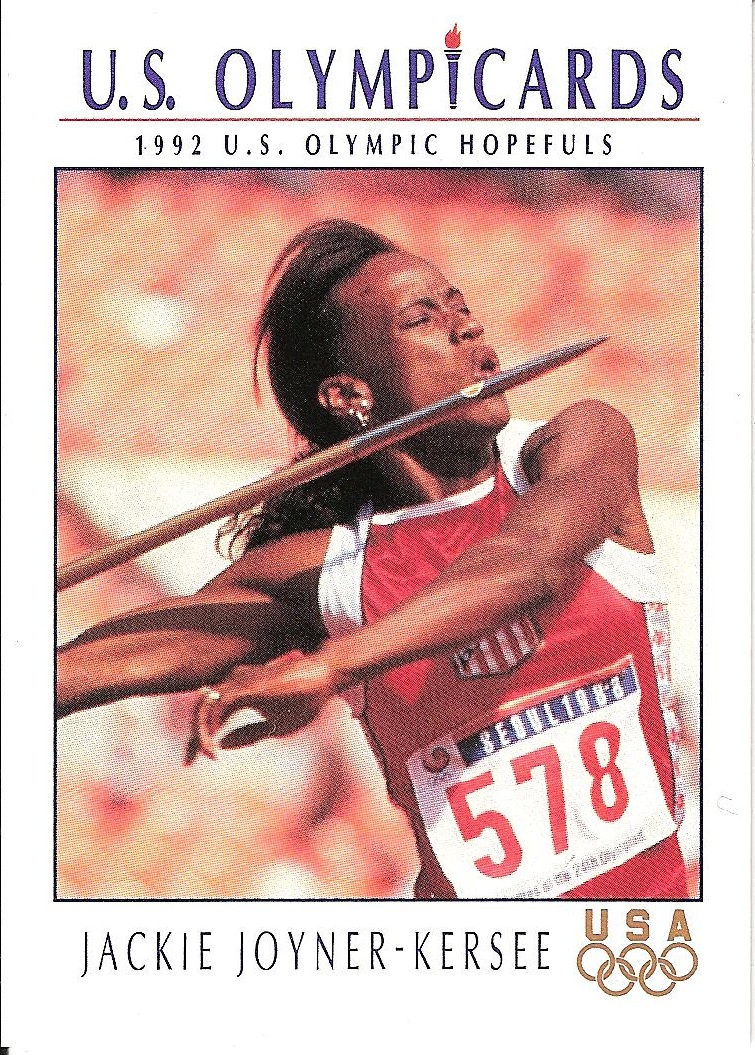
Take for example Skybox-neè-Impel U.S. Olympicards from 1992.

SkyBox: noble cardmaker. Well-intentioned company dripping with talent: Frank O’Connell, Bill Bordegon, Scott McCauley, Sherry Wallace, Allan Caplan, Keith Wood, Ken Baroff, Doug Drotman, George White, Martha Modlin, et many al. They made wonderful trading cards, and just because most of their cards currently lack monetary value does not diminish their accomplishments one whitlet.

The Olympics: noble sporting event ... blood doping, drug use, cheating, hermaphroditic polymorphism, racism, nationalistic jingoism, and terrorist acts notwithstanding. In the pantheon of sport, basically noble.

So, noble people from a noble company made a noble set for a noble sport. They negotiated countless individual deals with estates of athletes and licensing firms whose valuations of their clients’ worth ranged from mildly inflated to Hindenburgian. They set a not unsubstantial pile of cash in front of the U.S. Olympic Committee, whose altruistic taste for not unsubstantial piles of cash knows few bounds. If Caligula ever worked for a non-profit, it would have been the U.S. Olympic Committee.

And, of course, nobody bought the cards.

With the 2012 London Olympics fast approaching and a summer of drug use, cheating, hermaphroditic polymorphism, and Topps Olympic trading cards staring us in the face -- just your typical Lindsay Lohan summer -- I thought it might be useful to delve into the curriculum of the George Santayana School of Marketing and revisit a lesson from the past people (people who work for Topps, especially) have mindfully ignored.

If it ain’t one of the Big Four sports, and you’re not willing to make bupkis on the deal, don’t bother.

In retrospect, the 1992 U.S. Olympic set was about as good as non-Big-Four sports cards could get. The 90-card Hall of Fame set spotlighted über-worthy all-time greats like Jesse Owens and Wilma Rudolph, with room at the inn for Bruce Jenner Kardashian. The 110-card Hopefuls set included the one-and-only-original Dream Team as well as a young bike racer named Lance Armstrong. There was silver foil, and full-color backs, and some rudimentary chase – in short, everything it took to sell a trading-card set in 1992, except for: baseball, hockey, football, and basketball.

Okay, there was some basketball -- a one-in-10 chance of getting an accept-no-substitutes, one-and-only-original Dream Team card. (Four years later, SkyBox almost made back its USOC nut on Dream Team sets and subsets. Almost.) There were no baseball players in the SkyBox U.S. Olympics set. Topps had Team USA, Barry Larkin, Jim Abbott and the gang, an honor that cost the Sy Berger Bunch a different not-unsubstantial pile of cash set before the U.S. Baseball Congress or some other tangentially involved licensing body. There were no football players in the Olympics set (except for Jim Thorpe), for obvious reasons.

So no football, no baseball, no basketball, and no hockey; instead, swimming, gymnastics, and track and field, with epee and dressage and a whole bunch of past and future Wide World of Sports commentators thrown in gratis. Want to again express surprise that these cards didn’t sell?

Should they have sold? Sure. Was it unfair? Sorta kinda. It’s unfair to the extent that American Idol or America’s Got Talent is unfair. Was Clay Aiken really the most talented undiscovered singer in America the second season of American Idol? We would like to believe not with every atom in our protoplasm, but America put Clay Aiken over the top, and America is never wrong. Ask Rick Santorum.

In retrospect, Aiken’s win was the result of the segment of society that has turned the internet into a forest of LOLcats getting all gushy over someone who, let’s face it, is a LOLcat with opposable thumbs. But if we produced a Kelly Clarkson every year America would be awash in women bellowing in Camrys with Chris Berman and singing the national anthem in muumuus. And we couldn’t have that. God, no. Anything but that.

So things have not turned out all right for SkyBox U.S. Olympics cards. They’re largely forgotten and basically valueless outside of Armstrong and the Dream Team, though if you’re looking for a Mark Spitz rookie, here you go. It’s even hard to imagine a scenario where they might experience a renaissance. All the current athletes are no longer current (except for Armstrong, who is busily examining the Pete Rose career path). And the all-time greats? Jesse Owens is long gone; the fact that he stood up to Hitler is only going to get less important with time, and the fact that he spent many of his latter years racing thoroughbreds at county fairs, fascinating as that may be, is going to fade from the public consciousness (though it would make a hell of a trading card).

Figuring out what would sell in the trading-card biz was always a crapshoot. Fleer Flair had the low press run and the funky foil and the flip-top pack, but Topps Finest sold. Stadium Club had nothing but some perceived scarcity and Leaf had all the attributes (and the lower press run), but Leaf was sent home.

However, it was never a crapshoot figuring out what wouldn’t sell. Swimmers wouldn’t sell. People on horses wouldn’t sell. Pole-vaulters, high-jumpers and discus-throwers wouldn’t sell. Decathletes. Divers. Sprinters. Hurdlers. Yachtsmen. The Berenstain Bears. And they were all collected in the 1988 SkyBox U.S. Olympic set – all except the Berenstain Bears, who would have been in the set if the USOC had found a way to fit a couple of two-dimensional, manners-crazy grizzlies into double-breasted blazers and ice-cream pants.

I was reading the other day that Kodak pumped millions and millions into the U.S. Olympic Committee and in return got bankruptcy. And a handsome plaque. SkyBox didn’t pump in quite as much money and didn’t quite go bankrupt. Upper Deck was the next to fling the coin, and they didn't go bankrupt either, thanks to the marvels of movie-studio bookkeeping. And now it's Topps.

I know enough about fiscal policy during the Great Depression to see the echoes in contemporary "the way to make up for a lack of spending is to spend less" rhetoric. And I see a lot of SkyBox in what Topps is  trying to accomplish with Olympic cards.

In the end, it's amazing what a not-unsubstantial pile of cash can get you. All the javelin throwers you can eat. And a handsome plaque.

Tuesday, February 7, 2012

Draft, As In Daft

Quick – how many football-draft-pick card sets can you name? Offhand, I remember these quasi-companies that either drank the hemlock or thought hard about it: Star Pics, run by Bob Rylko out of the Detroit area; Ultimate, out of Las Vegas; Maxx (or was it Traks?), the good ol’ NASCAR-card boys out of Mooresville, N.C. (or was it Mocksville?); Classic of course, out of a shopping channel near you; Signature Rookies, out of nowhere; SAGE Rookies, who came late to the party and did all right for a few minutes; Press Pass, who resorted to draft-pick sets in a moment of weakness; Courtside, who Tom Mortenson had to remember for me; Broders and all the other unlicensed sets, though “unlicensed” in this context means zip; Star Company, meant to be confused with Star Pics; and many others, I’m sure.

If you’re thinking, “Man; that’s a whole lot of cards of people who have a one-in-five chance of actually sticking on a roster,” you’re catching on. With the Super Bowl in the rear-view mirror and the NFL sitting back regally picking its teeth like Thomas Nast’s rendition of Boss Tweed, I thought it’d be fun to look back on one of the more ludicrous lines of reasoning that came out of the high HOL-y days.

The reasoning (God, I hate calling it that) went like this: If we make a draft-pick set the leagues will see how great our cards are, and they’ll have to give us a license! They’ll have no choice! They’ll be drowned in the groundswell! People will make 34-story-tall human pyramids and bang on the boardroom windows until they give in!

True, this reasoning is too simplistic for Phineas & Ferb; it’s borderline for Big Time Rush (though it’s just right for Two Kings). Yet I know this is what many of these boyos were thinking, because I heard it come out of their mouths more than once.

I won’t even say these were logical people caught in a moment of weakness because I have no evidence of that, though I do have a picture of Classic’s Ken Goldin being held horizontally, Madonna-style, by Eric Lindros, Russell Maryland, Brien Taylor, and Larry Johnson – the No. 1 overall draft picks in their respective sports in 1991. The only reasonable conclusion is that many of these so-called brains behind these sets were genuinely wacked, like LMFAO without the conceit.

The number of big-league trading-card licensees that got their start making draft-pick cards is zero. Not give-or-take zero, not rounded-down zero, but just plain zero. It never happened. Ever. The closest anyone ever got was Pacific, who went from minor-league baseball to NFL football at a time when the NFL was giving out card licenses to itinerant window-washers and filing cabinets. But that never stopped the Bob Rylkos of the world from believing their ball-bordered, fuzzy-photoed cards would be the ones to prove the skeptics dead wrong and reach licensed-collectible Valhalla.

For that to happen, it would have been like the bicycle-powered 12-winged airplane being the one that flew, making chumps out of all those hoity-toity inventors with their motors and propellers and – don’t make me laugh – ailerons.

Let’s be nice for a second. Not all these sets were blatant attempts to milk collectors and bamboozle licensors. Some were 12-winged airplanes that their inventors were honest-to-gosh convinced would fly. And they had autographs.

Autographs were the wind beneath the wings of draft-pick cards. The right autograph could bump the needle on a set from 50 cases sold to 5,000, so the more well-heeled of the draft-pick gang dropped benjamins like they were POGs to lock down the exclusive autograph rights of the top draft picks. Of course Lindros, Maryland, Taylor, and Johnson were ready to peel Ken Goldin a grape. For the amount of ching they were getting for signing their names they were more than willing to throw in a couple of skinless concords.

(You could argue that the cardmakers’ penchant for stuffing their sets full of autographed cards can be traced back to draft-pick sets proving that autographs can sell cards. You’re probably right. But draft-pick sets made you shovel a whole bunch of manure before you got to the pony.)

Autographs almost made up for the near-universal mediocrity of these sets. Granted, they were behind the eight-ball from the starting line because their subjects were restricted by definition to anyone reasonably considered draftable. You wouldn’t think this would be a big deal in football-draft-pick sets, what with 30 teams and seven rounds and all, but these sets welcomed offensive linemen and D-backs into their ranks as eagerly as Brett Favre embraced Aaron Rodgers. Given a choice, Signature Rookies would have taken the 27-card Browning Nagle career-highlights set a thousand times over a single card of Ted Washington.

Then they were restricted by exclusive arrangements – and there were many. Then there was photo availability, which ranged from reasonable for the fifth-year seniors from major programs to impossible for juco transfers and Division III superstars. Then people had to think of something hopeful to say about Mark Dingle and Bobby Olive.

The heyday for draft-pick sets paralleled the peak of the Handful O’Landfill madness – 1989-95, roughly. As the ‘90s hit their midway point, the legitimate licensors came to a startling realization: Draft-pick sets thrive in a very narrow window between the draft and training camp. Take away the window and you take away the sets – and all the money that went there now goes here.

The result was the Rookie Photo Shoot in football, and similar events in basketball. Bowman Baseball shifted its release date to better cover draft picks, and hockey … well, no one cared what happened to hockey draft picks, not even the teams that drafted them.

(With that said, one is reminded of the furor that resulted when Upper Deck released a card of Eric Lindros that showed him in action in a Philadelphia Flyers uniform, even though there had never been a game or practice or scrimmage when he had worn said uniform. Upon further questioning Upper Deck disclosed that yes, it digitally inserted Lindros’ head on someone else’s body. For most of us, it was the first time we heard the word “Photoshop.”)

It’s fun to look back at draft-pick sets and think – wait; scratch that. It’s no fun to look back at draft-pick sets. They’re the Tucker Torpedos of the trading-card business, the place where better ideas went to die. Only there were no better ideas, just a bunch of bicycle-powered, 12-winged flying machines. With autographs.

Monday, January 30, 2012

A Little Sun In A Little Sky

In case you hadn’t guessed, I’m Pro-Life; I love the cereal and the board game. But I’m a purist; I have no truck with Maple Life or Cinnamon Life or the multiple bloated spinoffs of The Game of Life, with their flashing lights and electronic spinners and debit cards and snowboarders (really, snowboarders? In The Game of Life? Is nothing sacred?). Give me the white-box Life that Mikey likes and the original version of The Game of Life, the Wonder Bread of board games, with its hand-powered carousel spinner in the middle and its soft plastic convertibles filled with soft-plastic-pushpin families.

There were two basic tracks you could take in The Game of Life. The short route took you straight from high school to a tricked-out plastic convertible. It was the Milton Bradley* approximation of drug dealing, with as many pitfalls along the way. The long route required more spins of the wheel to get you to the American Dream – a frothy concoction of spouse, children, college, home in the suburbs, career, and all the play money you can stuff in a suitcase – but it was worth it, because hard work, grinding your way down the Road of Life without ever dreaming of skipping ahead three spaces, is the way to get what you want in America. And not drug dealing. And certainly not spending your rainy Saturday afternoons playing a silly board game when you could be inventing The Twitter or something.

I bring this up in the context of trading cards because just like in The Game Of Life, in the Life of Game are two tracks pro athletes can take to get to the soft plastic convertible of their dreams. The fast track is the football-basketball track, where players spend several months between high school and the pros in a licensed-apparel-merchandising operation called “college.” The roundabout path is the hockey-baseball track, where smooth-faced boys are sent on a hobbit-like quest that routes them through Visalia and Wilkes-Barre and spits them out at the other end pot-bellied and scarred and looking like a degenerate Bob Probert (who you probably always thought of as the degenerate model).

Because of that maybe we owe Little Sun a debt of gratitude for its two years of high-school baseball prospects sets. Without them, how would we know that major-league malcontent Tyler Houston, instead of sporting a Pal Smurch autograph-model sneer, once sported … well, a high-school-level sneer? Or that the most famous denizen of the Little Sun high-school-prospects sets, Manny Ramirez, once wore clothes that fit and did not have hair that could double as an abacus?

Ramirez is the biggest name in these sets, but there are others. Ryan Klesko was a free-swinging free spirit who got old overnight and wound down his career in San Diego, in a park worse than Yosemite for his left-handed power stroke. Cliff Floyd had a long, decent career and a well-earned rep as a nice guy, but injuries turned him into John Mayberry Lite instead of Manny minus his 150-car freight train of baggage. Mike Sweeney hit almost .300 over a 15-year career as a DH and pinch-hitter, but had the misfortune to spend most of that career with teams worse than a Mitt Romney attack ad. Benji Gil took the good-field/no-hit shortstop paradigm in a whole ‘nother direction with a swing borrowed from Billy Ashley. Jimmy Haynes and Shawn Estes sported great arms and less feel for pitching than Newt Gingrich has for nuance. Andy Fox hung around the majors for 15 years, and I have no idea why. Maybe it’s because his name was so short that GMs glanced right over it on cutdown day, never realizing until June that their 25-man roster actually contained 26 players. Not that it mattered.

Otherwise, the best these sets have to offer is one semi-cup-of-coffee guy (Mike Busby), a mess of busts like Al Shirley, Earl Cunningham, Greg Blosser, and Tyrone Hill who had success written all over them until they were discovered by the curveball or the rotator cuff, and then an ever larger mess of never-weres. And given that there are 55 player cards spread over two years, and we’ve only named 14 names, there’s lots of never-weres in these sets.

That’s the point – actually, two points. The points are that in the overheated atmosphere of the trading-card universe circa 1989 people went gaga over the first Bo Dodson card, and that learned baseball people didn’t immediately peg Bo Dodson as just another slow-swinging, heavy-legged first baseman who actually played Bat, and played it no better than scores of others who could play other positions besides.

In Little Sun’s defense, 1989 was a crapshoot year for major-league talent. Tyler Houston went second overall in ’89, right after Ben McDonald; Frank Thomas went seventh. Mo Vaughn went 23rd, in between Tom Goodwin and Alan Zinter. The first round was conspicuously short on all-around players; it favored the freaks, the guys with one preternaturally immense foot of a skill, whether it was throwing a fastball (Jeff Juden, Kiki Jones), hitting with power (Cunningham, Thomas and Vaughn), running the bases (Goodwin), or catching the ball (Charles Johnson, Brent Mayne). It was a decent year for setup guys and backup catchers. By contrast, the 1990 draft was about the all-arounders, led by Chipper Jones. These things go in cycles, but the 1989-90 cycles were more violent than Tie Domi on Five-Hour Energy. With both legs covered in poison ivy.

Players aside, there’s not much to say about these cards. They were sold only as complete sets, so you’re either in on the concept or not. Save for a psychotropic cover card, designs are Walmart assemble-your-own minimalist as opposed to Scandinavian design, contact paper instead of woodgrain. Backs are blah-on-blah, even by the forgiving standards of late-‘80s sub-major-league sets – but, hey, design is overhead. At least the snap-latch plastic case, sealed with the classic Little Sun “LS,” is nice.

People who bought the Little Sun high-school-prospects sets were the ultimate betters-on-the-come of their day. They were laying a smallish sum of money on the possibility that one player out of 25 or so would hit the big time, and create a collectible worth far more than the price of entry.

They almost got it right. One of the players in one of the two sets posted Hall of Fame-worthy numbers, pharmaceuticals notwithstanding. At last glance, the Little Sun Ramirez was going for around $10, and the rest of the set was fetching a couple of bucks. The combined value of all the cards about equals the set’s issue price, meaning that 20 years of investing and hoarding and waiting and hoping and leafing through college brochures has generated a net return of nil.

That’s not bad for the card business, but remember: Your results may vary. That’s life. And life is not a game. Or a breakfast cereal.


*Milton Bradley the game manufacturer, not Milton Bradley the malcontent. They’re easy to tell apart: One is all about games, and the other wants nothing to do with games. Neither has had anything to do with drug dealing, as far as we can tell. And we’ll leave it at that.